
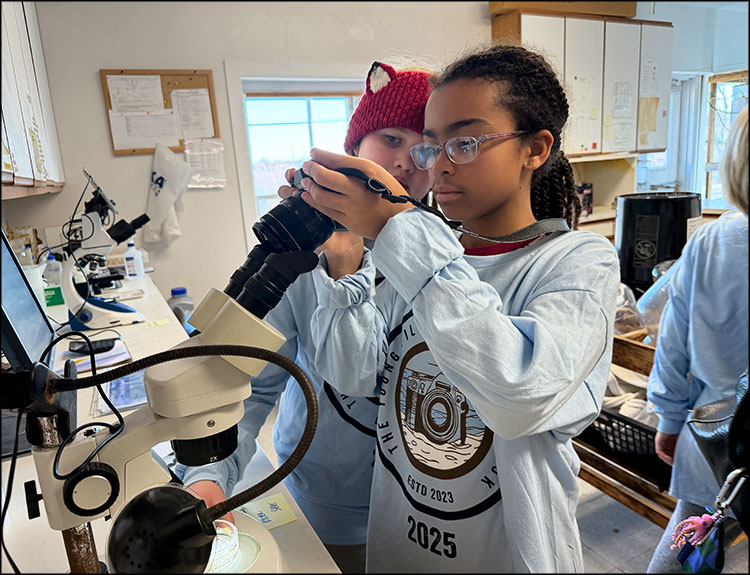
The Young Filmmakers of Montauk are on a roll. Two years after issuing a documentary about the Fire Island to Montauk Point Reformulation Project, and one year after they made “Water Is Life,” a short film about the importance of clean water to every living organism, they recently completed a film about oysters and their role in keeping waterways clean and healthy.
Founded in 2023 through a partnership between the Montauk School and Concerned Citizens of Montauk, the Young Filmmakers represent a STEAM (science, technology, engineering, arts, and math) program that explains, to tomorrow’s leaders, the different types of environmental projects that C.C.O.M. takes on. Each year, students delve into a critical local environmental issue, doing research, interviewing experts, and spending time in the field while learning the craft of documentary filmmaking, which is how they convey their findings to the community and the wider world.
The young scholars have learned that oysters are filter-feeding bivalves that consume algae and other particles, and that an adult oyster can filter an estimated 25 to 50 gallons of water per day, depending on environmental conditions.
On a Monday afternoon last month, the Young Filmmakers told a visitor about their latest project as they prepared to record the script and assemble the final product, which also incorporates voice-overs, video clips, and background music and graphics.
“We worked with the East Hampton Shellfish Hatchery,” said Coen. (Children’s surnames were not provided.) There, the students said, they met with John (Barley) Dunne, the hatchery’s director. “He showed us how oysters and shellfish are born and hatch,” Coen said, explaining the methods by which the hatchery staff grow millions of shellfish, which are seeded in town waterways. “We saw them as little eggs and cells under a microscope,” he said. “It was very cool. There was a whole bunch of different species of algae, for meeting different needs of the oysters and shellfish.”
The Young Filmmakers were also visited by Bob Tymann of South Fork Sea Farmers along with two interns from East Hampton High School. South Fork Sea Farmers has overseen construction, by high school students, of oyster reefs in several East Hampton Town waterways. From the group they learned that oyster shells used to create reefs are collected from local restaurants and the Citarella market in East Hampton.
They also met with Alex Kravitz, who with his brother founded the Relic apparel company, which has helped in the growing and seeding of more than two million oysters into Moriches Bay. The Young Filmmakers are now buying their T-shirts from Relic.
“Why is it important for us to learn about this?” Jenna Lipman, a teacher and staff adviser, asked the Young Filmmakers. “We could have had you learn about trees. Why did we choose oysters?”
“Because they filter water,” one student replied. “They get rid of bad bacteria in the water,” another said.
“Why did we teach you all about oyster farming?” Ms. Lipman asked.
“Because we live near the water,” said Maren.
“From the perspective of working with kids all day, it’s really interesting to watch them learn about a real-life issue that’s facing their community,” Ms. Lipman told the visitor, “and not just learning about the issue, but learning about how local people have worked to solve those issues. I’m excited for them to get to see how they can use film as a tool to bring attention and awareness to issues that are facing their community.”
C.C.O.M., said Camille Newman, the group’s environmental project coordinator, “is thinking about working with Barley in the future to put an oyster reef in Montauk,” possibly in 2027. “They’re all over Long Island, but we don’t have one here,” she said.
Jody Kennedy, a retired digital media arts teacher who co-founded the Young Filmmakers with Kay Tyler, C.C.O.M.’s executive director, told the students that the medium is “such a powerful tool, more than you guys probably even realize. It’s not that often where we can say, ‘Look at this video that these kids from Montauk School made about oyster farming. If you watch this, in four minutes’ time you’ll learn so much about oyster farming and who all the local people are that are doing all these really important things.’ So it’s a great tool in terms of spreading the word about it.”
Against a green screen, Navy and Charlie read the script in the opening segment of the Young Filmmakers’ new film. “Did you know that oysters and clams are basically ‘nature’s purifiers?’ ” Navy asks. “As they grow, they pull excess nitrogen out of the water and lock it away in their shells.”
“Exactly!” says Charlie. “They filter out pollutants by eating them or turning them into small, harmless packets that sink to the sea floor.”
“Get this: A single oyster can filter up to 50 gallons of water a day,” says Navy. “Plus, oyster reefs act like a natural shield, preventing erosion along Montauk’s coast.”
“It’s also great for the economy,” Charlie adds. “Aquaculture replenishes shellfish that our local restaurants depend on. It’s a win-win!”
A viewing party took place on March 30. “All of the kids, parents, students, and staff enjoyed watching it together,” Ms. Kennedy said. A critique session followed, with students discussing final edits and improvements before the public launch. “Young Filmmakers 2026 Montauk Oyster Farming” is now on YouTube.
The New York State Department of Environmental Conservation, Ms. Kennedy said, worked with the Young Filmmakers on their 2024 film about FIMP and beach erosion. Upon completion of their newest project, the filmmakers received a message from Ryan Porciello, a D.E.C. environmental program specialist. “Wow!” he wrote. “Another amazing video! I am continually impressed with the quality, content, and enthusiasm from all of the filmmakers.” Mr. Tymann, Mr. Dunne, and Mr. Kravitz also complimented the students and their production.
“I, personally, learned so much about this topic,” Ms. Kennedy said. “I always love learning with my kids and sharing it with the school and community.”