
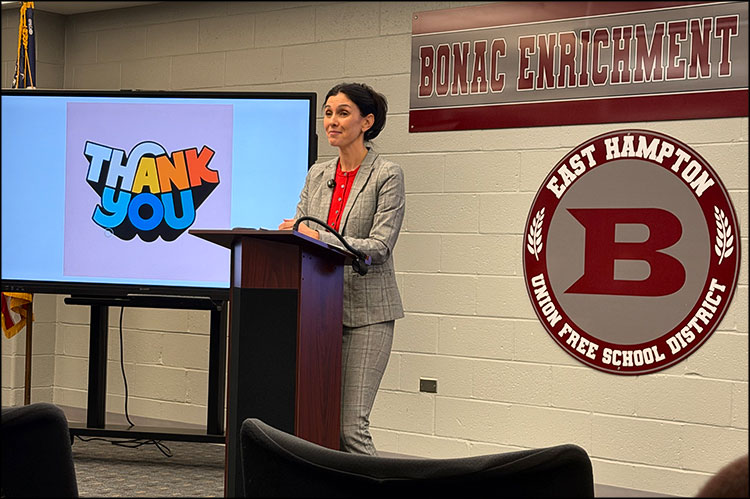
Using consequences instead of punishments, encouraging creativity, and supporting friendships were just a few of the practical tools Dr. Katherine Legare offered parents at a community forum on youth mental health at East Hampton High School this week.
Dr. Legare — an assistant professor in Stony Brook University’s department of psychiatry and behavioral health and a child psychiatrist with the CARE (Child and Adolescent Resource for Emotional Health) Initiative — has coached the high school’s mental health team on when to refer students for professional help. Sara Smith, the high school’s principal, invited her to speak to parents and community members about navigating the teenage years.
“We met Dr. Legare and she talked about such reasonable, sensible things that I just felt would be helpful for all parents,” Ms. Smith said. “There are things that all of our parents are going through, all of our teenagers are going through — and what part of that is normal and where are some of the red flags that we should be concerned?”
Dr. Legare said there are four pillars of optimum mental health: physical health, mental health, relationship health, and spiritual health. She advised parents to look at their own pillars and behaviors first.
“The skills that we had that may have served us in the early childhood years are not going to serve you anymore with a teen. When you notice the change, it’s an opportunity for you to adapt and modify the way that you parent,” she said, “approaching things in a different way than you might have in the past. Things like discipline might look different. Things like communicating or asking for insight into their day might look different when you have a teenager.”
One communication change that Dr. Legare recommended is to put the accent on curiosity rather than questioning. This approach is more likely to encourage a teen to open up. Instead of grilling a child about their math grade or their school day, express interest in an activity they care about to foster connection.
“If you want to connect and after school, at home isn’t working, maybe change up the scene a little bit. Can I invite you out? Oh, you like to go fishing? Can we go to the bait shop together? Can we go pick out new tackle together? Will you teach me? I don’t know anything about a spinner. You can be humble. Let them be the expert on something and lead you on an experience that you wouldn’t necessarily have had otherwise. The curiosity can open up all other kinds of conversations that may not be about their math grade.”
Active listening is another component of effective communication with teenagers. Dr. Legare said: “Active listening just means rather than commenting, you’re repeating back what someone said, making sure you understood it correctly. Stick to the facts and then help them figure out what are the emotions they might be feeling behind it and help them connect the two together. ‘Sophia did this thing. It made you feel this way. Oh, could you be feeling this? Could that be it?’ Then you’re asking questions, you’re testing hypotheses. It shows them that you’re paying attention to them, you’re listening, but you’re not trying to solve the problem for them. At the end, you could say, ‘Oh, that’s such a difficult situation. What are you going to do? How are you going to handle it?’ “
She also encouraged parents to use consequences rather than punishments. They may sound similar, but there are significant differences.
“Punishment we think of as something emotional, reactive, a decision made in the heat of the moment. It may or may not be relevant or connected in any way to the activity that led to you giving them a punishment. Whereas a consequence is something that’s logical. It’s a limit. It’s something that makes sense connected to the thing itself,” she explained. “If you forget your homework, mom’s not going to turn around, go home, pick it up for you, and bring it to school. You’ll just have to deal with the consequence of a late grade or a zero or negotiating some alternative with the teacher yourself. That’s part of the adolescent’s journey to endure some discomfort for the greater good of developing some autonomy and the ability to deal with difficult situations without being rescued or nagged or reminded.”
Parents in the crowd — which included East Hampton Town Supervisor Kathee Burke-Gonzalez, Town Councilman Tom Flight, and Sarah Minardi, a vice president of the school board — came armed with thoughtful questions and concerns. Managing cellphone use was one of the hottest topics.
“You need to walk alongside them. They may not be ready for social media at the same time as their peers. They may need limits set on social media use,” Dr. Legare said. “If you notice it becoming a problem like any other tool we have, you’ll have to restrict their use. And that’s a tough conversation, but it’s worthwhile so they can learn self-modulation of this tool just like a car or vehicle.”
Dr. Legare also reminded parents of some of the key components of adolescent health and wellness. Teens need eight to 10 hours of sleep each night. They should turn off screens an hour before bedtime, avoid caffeine after noon, and try to get daily exposure to natural sunlight.
Increasing access to healthy foods and water, encouraging daily exercise and exposure to nature, and supporting participation in creative activities and healthy friendships all contribute to positive mental health, she said.
If a teen expresses violent thoughts, behaves violently, abuses substances, or exhibits odd or paranoid beliefs or behaviors, it is time to seek help.
If a parent has concerns about their child’s physical health or if they feel stuck, it is also important to ask for assistance.
When one mother worried that she was failing her son because he shuts down at home but is thriving at school and among friends, Ms. Burke-Gonzalez, the mother of older children, encouraged her and other parents to remember that the teenage years don’t last forever.
“They come back around,” she said. “There is light at the end of the tunnel!”
Ms. Smith said parents should feel comfortable reaching out to her or the school’s assistant principals directly, or to any member of the staff with whom they are comfortable, should they have concerns or need help.
“That’s totally normal and parents do that all the time,” she said. “Our guidance counselors are well-trained in responding, and so many of those conversations come up during stressful times — college applications or dealing with the finances of college. Our counselors are trained to navigate those. “Our mental health team — our two school psychologists, Natasha Tumbarello and Aimee Neuman — are incredible resources people can reach out directly to. And our social workers Aimee Geehreng, Aubrey Peterson, and Carolina Fermin — two of whom are bilingual — are always there for anybody who needs them. Also, so many of our teachers are trusted adults. If you have someone in the building you trust who is not part of the mental health team, they can get you to the right place.”
LTV recorded Tuesday night’s forum, which included Spanish translation. Ms. Smith will distribute the recording link to all parents. The forum will also re-air on LTV.