
Sunday, 4/3 St. Martin
N 19.56, W 061.24
2,509 miles to go.
20 to 24 knot winds, 6 – 10 foot seas.
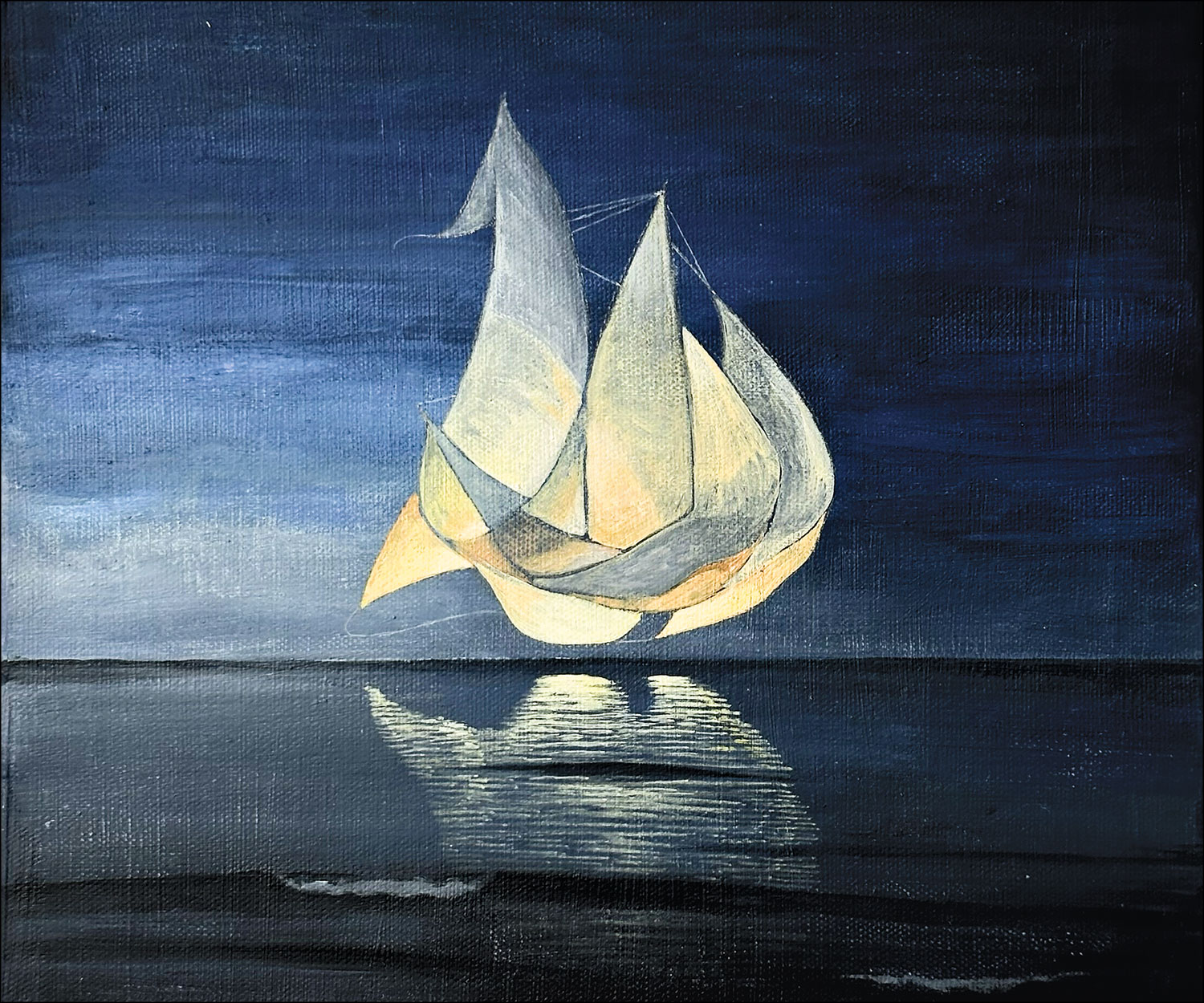
First day at sea. Clear skies. Incredible sunset. Going to sea is a kind of obsession, an addiction, which has its own rites of admission, its own repulsive tests before the salty, dreamlike elixir is given entry to your bloodstream.
I remember that first evening on Orion, adjusting my sitting position in the cockpit to avoid the dense, meaty odor of the boiling canned tortellini that wafted up from the galley below, where Dimitri, our captain, was preparing our first dinner at sea.
It was not yet dark. The winds had lessened to a docile, warm blow. Our first sunset out of sight of land had come and gone — all but a skinny belt of disco light that gleamed beneath the clouds on the horizon. But it was hard to enjoy the scene, and I didn’t want to eat. I grimaced as Dimitri doled out the pork tortellini floating in broth to the brim of my bowl. I ate slowly, cautiously, and as soon as cleanup began, I tossed my sticky pasta shells into the sea. My friend Yves and our crewmate, Nikos, had seconds. Yves said he felt great.
“I loved the tortellini!” he told the captain, and bounded down the companionway to help him clean up.
At the angle we were sailing, washing, drying, and putting away the dishes and pots was a lengthy, awkward process. Meanwhile, since Yves and I were to share part of the first watch from 9:30 to 12:30 that night, I stayed on deck and took the helm. The breeze had picked up, and though I was tired of muscling through the peaks and troughs of the waves, I was glad to have something to do.
A while later, Yves came up on deck, pale and uneasy.
“Are you okay?” I asked.
“I think I stayed below too long,” he responded. He looked like he might puke, so I reluctantly offered him the helm.
“Thank you, brother.”
Staying on deck and steering a boat works better than Dramamine to steady a queasy stomach. Nikos, too, stayed with us, sitting quietly in a corner of the cockpit, his hands crossed over his abdomen. The captain came up on deck for a quick look around.
“Stay between 35 and 40 degrees northeast,” he said. “Everybody okay?”
We murmured a subdued assent, and the captain grinned. He was not seasick, but he was tired. He had spent days preparing and provisioning the boat. He charted the course and prepared most of our meals, too. Finally he was going to his cabin to rest.
“Kalinychta,” Nikos said, wishing the captain a good night.
He was about to swing down the companionway, but I called him back and pointed at the tall, cumulus clouds scattered here and there on the horizon.
“There are squalls at night,” he said, giving me an annoyed shrug. “Let me know if the wind gets over 20 knots.” Then he went below.
Our shift began as a pleasant, warm evening with stars overhead. Yves, at helm, was feeling better and chattering. He had become a talker late in life, always ready with a story or a burst of song.
I wanted to engage, to help keep up the banter, but I was still nauseous, and I felt uneasy being so far out at sea; it left me dizzy and disoriented. I was seeing things, too. When I looked at the thunderclouds in the distance, they shifted subtly into threatening shapes and monstrous figures. If I looked up at the stars, I saw a spreading red nebula forming around them, like the colorful clouds of gas in photographs taken by the Hubble Space Telescope. Having never hallucinated before, I dismissed what I was experiencing. I thought it might be an atmospheric phenomenon caused by being so near the equator. Or had I just cut off the flow of blood to my brain by craning my neck so much to look at the stars?
I didn’t mention the visual aberrations to Yves or Nikos. There is an unwritten rule among sailors not to voice your fears at sea. Also, I was intent on following a set of dark towering clouds with telltale sheets of rain beneath them. I pointed them out as they merged and loomed ahead of us.
“Looks like a squall,” I said.
When the wind started to gust, I suggested we wake up the captain.
“I think it’s okay,” Yves said. “No reason for alarm.”
“We wait and see,” Nikos agreed.
I’d sailed through Caribbean squalls before. I knew how quickly they could ambush and envelop a boat. I’d once been hurled to the deck in a squall and seen other sailors on board badly injured and a nearby catamaran dismasted. After waiting a few more minutes, with the gusts touching 25 knots, I couldn’t help myself. I called down below for the captain to come up and have a look. I had to repeat his name several times to wake him. He came to the companionway bleary eyed, took one quick look at the clouds, said it was okay, and went back down below.
There was a silence on deck after the captain left. Yves and Nikos were annoyed and embarrassed that I had bothered the captain for nothing. Still, I thought I was right. If anything, I should’ve been more adamant and insisted he come all the way out on deck to see a second, more threatening front of clouds trailing slightly to the east.
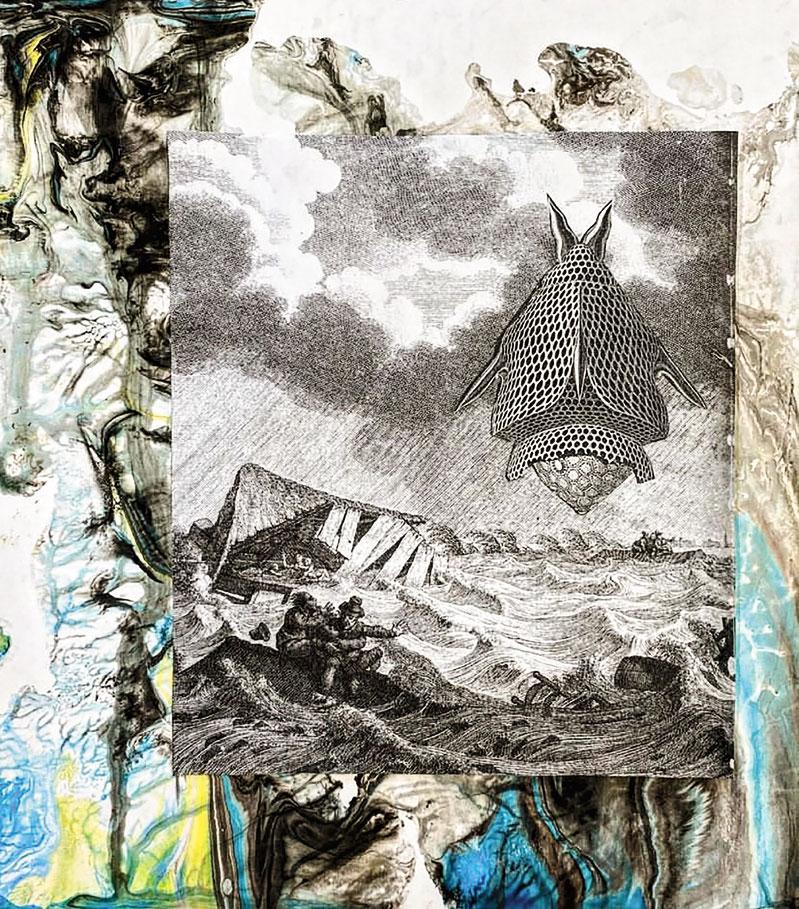
A few minutes later, the first thunderheads passed harmlessly, scattering heavy drops of rain on the deck. A second wall of black clouds, though, swiftly followed. As the front passed above us, a cold, violent gust of wind tipped the boat at a steep angle. The sea rose into a froth. Before we knew it, a deluge of rain, thick as a waterfall, pounded down on us. We were enveloped in a raging whiteout with buffeting 30-knot gusts when Nikos finally dashed below to rouse the captain. Dimitri erupted from his cabin, furious and naked except for his underwear. He barked out instructions in Greek and English to Nikos and me — though he kept calling me Yves, who was still at the helm. I was not wearing storm gear or a headlamp.Being new to the boat, in the dark, in the middle of a squall, I had a hard time identifying the lines we were supposed to pull or release. The boat was stalling and tipping this way and that. The captain became incensed.
“Yves!” he called out to me. “Release the outhaul!”
I hesitated, not sure he was talking to me and unable to find the correct line. So he shoved me aside and did it himself. At the same time, straddling the cockpit like an action-film hero, he grabbed the tail of the mainsail furling sheet on the port side where Nikos was at the winch.
“Bring the shit in!” He yelled at Nikos, pronouncing “sheet” as “shit.” “Bring it in!”
Once the mainsail was reefed, the captain commandeered the helm from Yves and told him to release the jib sheet on the starboard side while ordering Nikos to take in the furling line on the port winch. I was left standing helplessly, not knowing what to do. I began to straighten and coil the many lines that were tangled like a nest of snakes in the cockpit. The captain told me I was standing in the way; he could not see the heading instrument. I sat down quickly, automatically, like a berated dog, and continued to coil the ropes, my hands going numb from the wet lines.
Soon the squall passed. The stars reappeared. The sea calmed. Dimitri, his voice more level and paternal, gave us a short lecture. We had to memorize all the lines, we had to wear our headlamps at night, we had to let him know before a squall broke. He returned the helm to Yves and he went below to make coffee. Nikos followed him to try to rest before his shift. Yves and I were left alone on deck.
“What a shit show!’ I whispered to Yves. “Our first night at sea!”
“It’s normal,” he said. “We have to learn more about the boat.”
“I warned him about the squall! Reef before you have to.”
It’s a cardinal rule of ocean sailing. You always reduce the amount of sail before you think you might encounter high winds or a storm. This is especially true before it gets dark with an inexperienced crew on deck. I was seething. I went on about the condition of the boat, the lack of crew, the captain’s abrupt outburst. Yves refused to say another word.
As far as he was concerned, there was one captain and you didn’t question his authority. Yves’s watch was almost over anyway. He handed the helm over to me, coldly, as the captain came up on deck with his coffee.
“Glyn, go below and get some rest,” Dimitri said to Yves.
We looked at each other confused.
“I’m Yves,” Yves said to him with a friendly laugh, tapping him on the elbow as if to say, “Hey, what’s in a name? We all make mistakes.” They guffawed like old pals and Yves went below. They were already forming a bond.
As if to confirm my fears, the captain sat down on the port side, away from me, leaning against the cockpit and drinking his coffee. I could just make out the blue glint of his eyes in the darkness. Braced against the wheel, I looked up at the top of the mast, slipping and sliding between two stars.
“Are you alright?” the captain asked.
“I’m fine.”
For the rest of my watch we stayed in uneasy silence. I was sure he had written me off, that he thought I was incompetent. I wanted to tell him I was good at two things: reading the weather and navigating at the helm; that I had, in fact, tried to warn him and the others about the squall. But the episode had unnerved me. After witnessing his fit of rage, I was wary of crossing him. I was hallucinating again, too. It was getting more intense. Everywhere I looked in the sky was a red lava-like glow. At one point I saw a lit navigation buoy, eight feet tall, glide by the boat and disappear just as it passed.
Luckily the wind was steady and the clouds were scattered enough for me to steer by the stars. Being at the helm helped with the nausea. I managed to keep us on course and the sails full until it was the end of my watch. Right on time, at 12:30, Nikos came up on deck to relieve me, and the captain took the helm.
I needed to sleep to be ready for my next shift at 3:30 a.m., but I was restless and painfully alert. I went back and forth between my tilted, hot, airless cabin, to the slippery couch in the saloon, to curling up outside in the cockpit — the only place I didn’t feel sick. Dimitri and Nikos, conversing in Greek, went silent when I appeared on deck. Then they would speak intermittently in a whisper, as if I were not there. It felt ominous — the shadowy outlines of their bodies, their muttered conversation in a foreign language, with the boat now more than a hundred miles from shore, the water sliding by a few feet away.
I didn’t know anything about Nikos. He had been there when we arrived, and he clearly had a different relationship with the captain than Yves and I did. Dimitri ordered Nikos around like he was a hired hand or an old acquaintance he didn’t particularly respect. Nikos told us he was just another paying crewmember on the boat. He was from the same part of Greece as the captain, but he had never met him before. The story didn’t seem plausible.
As it was, I was sun- and wind-beaten, dehydrated, seasick, and had been awake for almost 24 hours. I kept wondering why the other two crewmembers had dropped out at the last minute. Did Nikos know anything about it? If he did, he didn’t say anything. Reticent and watchful, Nikos was difficult to read. As for Dimitri, I thought he was capable of anything. I kept going over a story he told us in St. Martin about being boarded at sea that winter by the armed crew of a Coast Guard cutter, his boat searched with dogs for drugs. I wondered if Dimitri and Nikos were drug runners. There were many of them in the Caribbean, off of Africa, in the China Sea — modern-day pirates of the high seas. Late into the night, I listened to their unintelligible conversation. I tried to interpret the tones of their hoarse voices. I imagined being thrown overboard. I pictured fending off Nikos, stabbing the captain in the chest with my two-inch sail knife (which I had left in my bag in the cabin below). I hoped Yves would wake up in time to help me when I was attacked.
I was being irrational, but we were isolated at sea at night. The thought of the unfathomable depth of water beneath the hull and the great distance to travel before seeing land and people again was unnerving. My sense of reality was unmoored. I thought about the tales of captains losing their minds at sea; of mutiny, delusion, and suicide — Odysseus, Moby-Dick, Mutiny on the Bounty!
It wasn’t all fiction. Christopher Columbus’s hypomanic, grandiose behavior was well documented. I had just read about the unraveling and suicide of Donald Crowhurst, one of the eight casualties of the Golden Globe race of 1968. Peter Nichols, in his book about the race, A Voyage for Madmen, gamely points out that “normal people aren’t driven to try to sail alone around the world without stopping.” Among the Golden Globe contestants, two hardy types had previously rowed a dory together across the Atlantic. A few months into the race, they both dropped out, one of them breaking down in tears on a daily basis. Nichols writes that among the other solo captains, almost all had “a dark streak of introspection.”
More than 50 years later, even the ever perky, optimistic Cole Brauer, with her online navigation teams and legions of internet fans, broke down mid-Atlantic, just a week or so from the finish line of the 2024 Global Solo Challenge race, crying and thinking she was not going to be able to make it.
On land, preparing for their voyages, these men and women, like other serious ocean sailors, are capable, careful engineers, taking every precaution to ensure their survival. But once underway, a transformation sometimes takes place. Nichols writes, “Sailors . . . when they head out upon the deep, the constructs of society soon drop astern and they are surrounded by shooting stars overhead, phosphorescence in their wake, and heaving shapes all around them in the sea and sky. It is easy, then, sensible even, to become afraid.” And irrational.
There were documented reports in the 19th century about ship crews suffering from calenture (heat delirium) or scurvy, who, in an overheated fit of thirst and tropical torpor, flung themselves overboard and drowned. In those days, the sea was a mysterious place inhabited by magical creatures and capricious gods who cursed sailors who displeased them. But today it’s still common for ocean sailors to have imaginary visions; to hear things and lose their mental bearings (all symptoms, also, of dehydration). There are studies exploring why sailors, both in the navy and on commercial ships, suffer from far greater rates of depression and suicide than the general population.
That first night aboard Orion, as I tried desperately to sleep, I visualized the inky, dark seabed below littered with shipwrecks and skeletons. How many sailors became so disoriented they no longer knew where they were sailing to? Was it the ocean void that brought on their derangement, or were these men driven to sea by their obsessions in the first place?
At the moment, it didn’t matter. What was apparent was that I had quickly become a casualty at sea. My first night on board, I was paranoid (I had to admit, in all probability, Dimitri and Nikos were not homicidal drug runners) and hallucinating. It was me who was not okay. It was my thinking that was becoming unhinged.
If this was day one, how would I survive until we reached the Azores?
Lying in the dark, I thought of Robert FitzRoy, the admiral and brilliant meteorologist (the first to publish regular “weather forecasts”) handicapped by his illustrious family’s history of depression and mental illness. His uncle committed suicide by slitting his throat. FitzRoy’s violent temper and depressions wore him down on his yearslong voyages with Darwin. Decades later, he resigned from the admiralty, and he slit his own throat when he was 59.
My thoughts turned to my father’s family’s murky history. There were rumors about my great-grandfather, a Syrian orphan who went to sea at an early age. I had read his ten-page letter handed down from generation to generation. He was not mad or (as his mother-in-law claimed) a murderer, it seemed, but an emotional cripple and an obsessive. His brittle, spiteful behavior alienated his son, my grandfather Arnold Vincent, a war hero whose personality issues led to criminal grandiosity and abuse. My father, too, despite his better intentions, followed a similar path. Many of my generation of the family have struggled with addiction and depression.
On my father’s side, nearly all of the men have badly stumbled, limped along, if not entirely failed in their idiosyncratic careers. One cousin, a psychic and healer, accused his mother, one of my father’s sisters, of “satanic,” abusive behavior. My other aunt was sweet and generous but a pathological liar. One of my nieces, who was bipolar and sparkling and witty, committed suicide. Another, a lovely dreamer, also bipolar, lacerated her arm in an attempt.
I think of myself as unimaginatively rational — good material for an objective journalist — but that night on the boat I doubted my sanity. With a genetic pool like mine, I could hardly be certain where I stood on the spectrum. Certainly dashing about Montauk Point in a 12-foot inflatable for years had provoked jokes from friends about my quirkiness and obsessions. In the privacy of my therapist’s office, I had admitted to experiencing bouts of depression and suicidal thoughts. But I thought of these as aberrations. Didn’t everybody have those moments?
At the end of that first day at sea, exhausted, I braced myself on the couch in the main cabin, feigning sleep in the darkness. I was watching the captain, standing a few feet away in his cabin doorway, illuminated by the red light of his headlamp, waving his arms around. What was he doing? Why was he standing there so long? Was he practicing martial arts moves? Was he going to kill me? It occurred to me that he might just be putting on his bibs and a storm jacket, but I was consumed by my paranoiac hallucinations. Were they signs of an underlying mental condition I didn’t realize I had? Did this chronic distrust and uncertainty, this personality that constantly expected the worst to happen, drive me in a twisted way to this boat, this doomed voyage across the sea? What was going on beneath the surface of what I thought I knew?