“Sanford Biggers: Drift,” currently on view at the Parrish Art Museum in Water Mill, is a window into the multifaceted practice of a prodigious talent. During a tour of the show with Corinne Erni, the museum’s chief curator of art and education and co-curator of the exhibition, she nailed it: “He is incredibly smart in the way he combines materials, ideas, processes, and cultural symbolism. And the way he can mix it up.”
Biggers, who has a house in Sag Harbor, grew up in Los Angeles, where he was involved in hip-hop and graffiti, both of which resonate in his work. As for hip-hop, Erni said, “The whole idea of mixing and sampling I think came from there, and I think that is very present in his work.”
“I grew up in Los Angeles as a graffiti writer, and some of the early techniques or special effects we would do when doing a mural were arrows, dropped shadow, shine marks, and then clouds,” Biggers says on a video that is part of the exhibition. “So that was my first experience with trying to depict clouds of various shapes and sizes.”
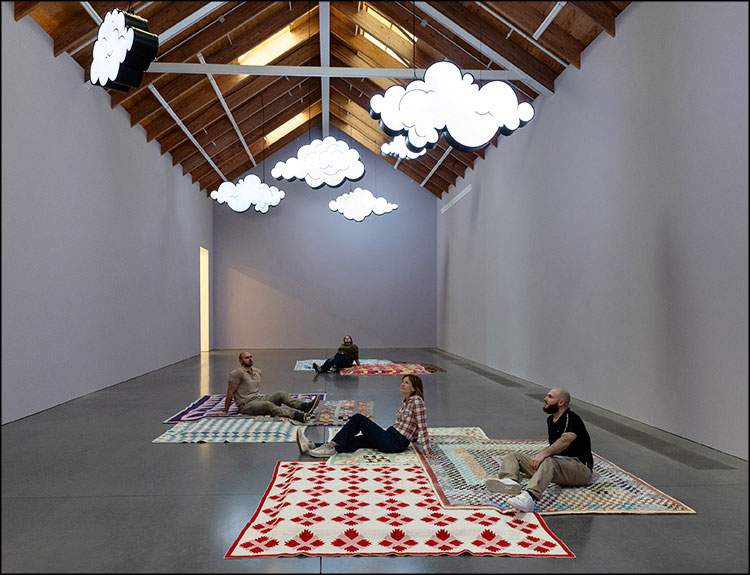
The first gallery is a manifestation both dramatic and mesmerizing of his preoccupation with clouds. “Unsui (Cloud Forest),” from 2025, consists of illuminated clouds made from aluminum, acrylic, LEDs, and a timer that are suspended from the ceiling. On the floor are quilts — another signature element of his work — deployed over padding. Viewers are encouraged to sit or lie down and look at the clouds. The walls are painted lilac at the artist’s request, which “creates a very calming energy,” Erni said.
After graduating from Morehouse College in Atlanta in 1992, Biggers moved to Japan for three years. While there he became interested in Buddhism and began to meditate. In the video he refers to the sand mandalas that are part of the Buddhist practice and often contain images of clouds.
“As I learned to speak Japanese, I learned the word ‘unsui,’ which means cloud water or sky water, but it also refers to a monk who has recently finished training and is now wandering the countryside to find a new place to practice.” Noting that “unsui” has become a mantra for him, “I’ve started to put that in the artwork, sometimes in a graphic way, sometimes in a more illusory way, because for me ultimately the cloud represents infinite potential.” And, one might add, drift.
While in Japan, Biggers began collecting fabrics and quilts, which figure prominently in his “Codex” series, installed in a second gallery. He was drawn not only to their textures and compositions but also to the stories that were ingrained in them. While it might be apocryphal, he heard that some of the quilts played a role in the Underground Railroad, apparently having hidden messages or codes for enslaved people trying to flee to the North.
He sometimes refers to himself as a “quilt whisperer” because he accumulates antique quilts and hangs them in his studio. “It’s less important to make a new quilt,” he says, “and it’s more important to respond to the history and the handwork and the aura of an existing quilt.”
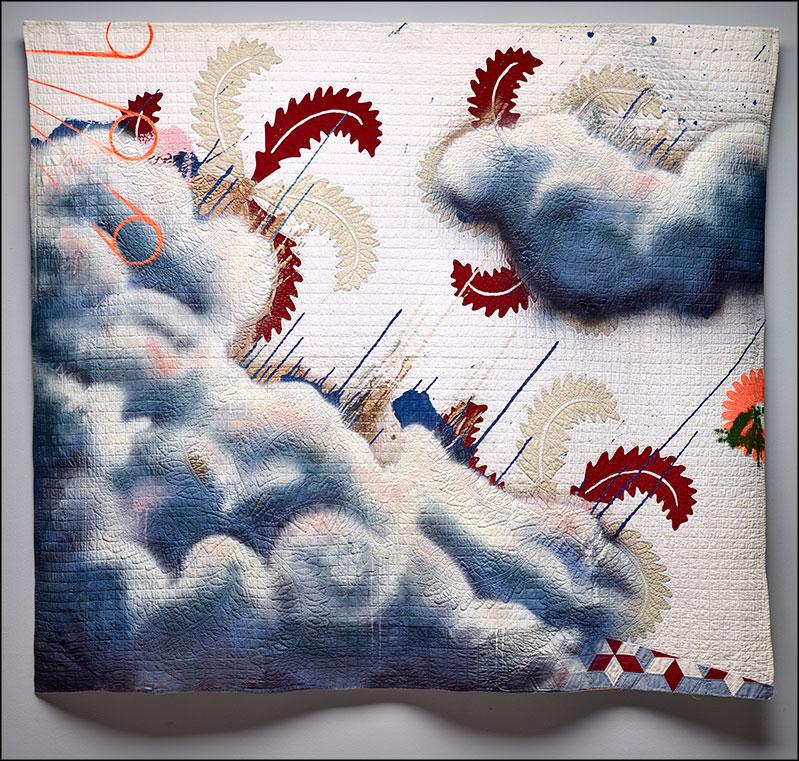
He began to apply spray paint to the quilts, in some cases drawing lines or affixing found objects. Clouds appear on most of the works in the “Codex” gallery, most prominently in “Sirocco,” which is a hot wind from the Sahara that blows, or drifts, across the Mediterranean into southern Europe.
“Again, it’s the idea of something going from one part of the world to another, or from one culture to another,” said Erni. While the spray paint covers most of the colors in “Sirocco,” it brings out the structure. “You see very clearly the structure of the stitching, whereas the color is completely gone.”
The same gallery includes “Also Known As,” a wall sculpture made from antique quilts, wood, and gold leaf. A complicated structure, it consists of hard-edged squares and triangles, each containing a section of one of three different quilts that he cut apart and added to the armature. The geometry and structure of the piece recur in his work, reflecting his embrace of different materials.
Courtesy of the Dallas Art Museum, Dallas Art Fair Foundation
There are two departures in the “Codex” gallery. Intrigued by Frank Stella’s black paintings, Biggers embarked on “Daju,” a shaped “canvas” made of antique quilts, assorted textiles, and mixed media cut and patched together. It’s his first patchwork piece and it features clouds. The work’s title refers to a complex communication system in northeastern Africa, which he learned about when he was traveling there. “There are so many layers,” said Erni, “the components of the work, the materials, the cultural references, and then his own hand.”
The second outlier is “Lo-Phi.” David Castillo, his gallerist in Miami, challenged him to transform a quilt into a tapestry. Biggers had been working on a “crazy quilt,” a dense work with a lot of unusual patterns. He took the finished piece to a workshop in Guadalajara, Mexico, where it was made into a tapestry that is darker and more densely patterned than much of his other work.
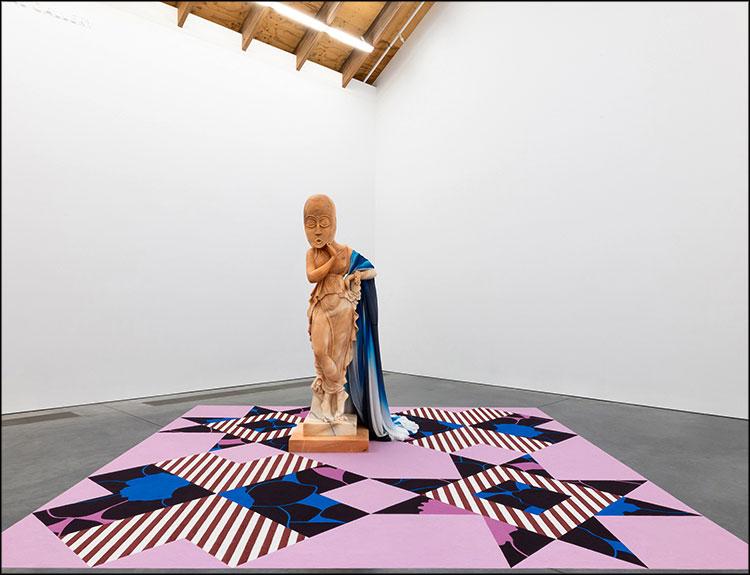
The third and final gallery includes “Adrift” (2026), a quilt collage he assembled from scratch from different pieces of fabric he had in his studio. The design of “Adrift” is the starting point for a piece of the same name made from colored sand poured directly onto the gallery’s floor and, over 10 days, arranged into an elegant and colorful geometric pattern by his team.
While Biggers was in Japan, several monks from Tibet came to the local museum in Nagoya, where he was living, and created a sand mandala. His own works in sand over the past two or three decades were inspired by that visit and by his study of Buddhism.
“Those monks made the mandalas over hundreds of hours,” Erni said, “and after they were seen they just swept it all out. So for Sanford it was a metaphor for how you can put so much work into something, it’s arduous, it’s beautiful, and then it can be gone in one second.”
While “Adrift” is beautiful in itself and could be a complete work, Biggers has placed within it “Mirror,” an eight-foot-tall marble figure on a marble base. That figure is part of his “Chimera” series, a chimera being something composed of disparate or impossible parts. In the case of “Mirror,” the style of the marble figure is Greco-Roman, but its face is an African mask, also carved from marble.
Jenny Gorman Photo, “Mirror” on Loan From Aliya and Aren LeeKong
“Sanford talks about cultural hierarchies, so we always think of these Greco-Roman sculptures as being classical and elevated, as opposed to African masks, which are much more tribal,” Erni said. “So he’s elevating the mask, and by putting it with the sculpture, he says there has always been a lot of crossover in these cultures, which were not just pure Roman or Greek.” Just to mix it up even more, when you walk behind the sculpture, you see the back of the woman’s head is Greco-Roman.
But there’s more. “I wanted to combine sand with a marble sculpture,” Biggers says. “For me that is pushing opposite materials together.” At the same time, he noted that while we think of marble as something solid and sand as something loose, in the end sand can destroy the marble. “A lot of the marbles we see from antiquity we consider monochromatic, but they actually had painted surfaces, gilded surfaces, with bright colors. Those were eroded by sand. Placing the marble sculpture in the middle of the sand is in a way an alpha-omega kind of metaphor.”
Biggers will be at the museum on Sunday afternoon at 2 to conduct a tour of the exhibition. (Sunday is Community Day at the museum, which is free and open to all.) Other future programs are a curator-led tour on July 24, an artist talk on Aug. 16, and an artist-led tour on Sept. 4.
The exhibition, which will continue through Sept. 13, has been co-curated by Scout Hutchinson, the FLAG Art Foundation associate curator of contemporary art.