Ross Watts is no stranger to the Madoo Conservancy in Sagaponack. He was the exhibition manager and archivist there from 2004 to 2014 and installed every exhibition during that period.
He was back there last week, where a visitor found him installing another show — his own. “Ross Watts: 4321” will open on Saturday with a reception in the venue’s summer studio from 5 to 7 p.m. and continue through June 28. In fact, because he doesn’t have a dedicated studio space, he has been making work there for the past few weeks as well.
Literary references come easily to Watts, who mentioned David Foster Wallace, Jorge Luis Borges, Roberto Bolaño, and Paul Auster, whose epic novel “4321” gives the show its title.
Watts hadn’t read that novel until relatively recently. “We used to live in Park Slope, near where Auster did. I found out he died a little more than a year ago while I was installing a show at The Church in Sag Harbor, where they had his typewriter. I thought maybe I should just take a look.”
The novel explores the notion of biography through four parallel, alternate realities of the life of a single individual.
Each of the book’s seven chapters is divided into four parts, each representing a different version of his life.
“I like the idea of creating these multiple narratives through a singular perspective,” Watts said, “but also the reverse of creating a singular narrative from multiple perspectives.”
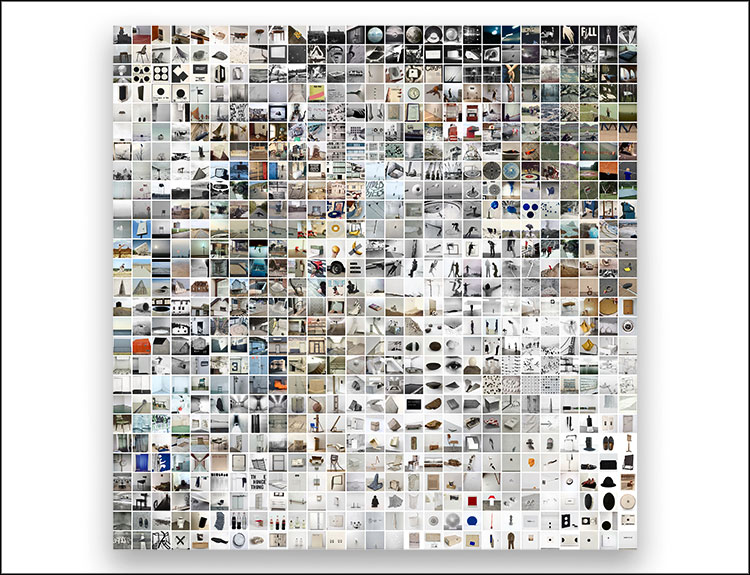
Which brings us to “For a second I thought I was falling . . . “ — a 64-by-64-inch photo montage made up of 729 equally sized square archival pigment prints mounted on a panel.
He started appropriating images during the pandemic. “I was on Instagram, and I was saving any image just because I wanted it. Then I really started to like the way it looked when I looked at these saved collections.”
That piece and other related ones have a gestalt quality, which describes the concept that the whole of something is greater than the sum of its parts. Or, put differently, each one is a single narrative from multiple perspectives yet at the same time multiple narratives — the images — from a singular perspective: Watts’s. You see each piece as a whole, yet you can also read each one frame by frame.
Because Watts is choosing the images, the autobiography component comes into play. One is of Marcel Duchamp’s readymade “Fountain” (1917), a porcelain urinal. Another features the signature of Jonas Mekas, a filmmaker and godfather of avant-garde or “underground” film. A third appears to be a poster from Michelangelo Antonioni’s film “Blow-Up.”
“I had never seen ‘Blow-Up,’ so I went to a friend’s house and watched it and it was this amazing film in every way. I do think things like that experience become part of the process,” and of the piece.
The exhibition includes representatives of other series of work. Several rock-like shapes are actually created from paper by cutting, stacking, gluing, and then carving them into oblong forms. He has also made similar shapes carved from the pages of books, as well as blocks of plaster with books buried inside.
Another series features handwritten texts on paper that are so tightly written, with no space between words, that they border on the illegible. (He learned a few years ago that ancient Latin and Greek texts were written for scholars without spaces between the words.)
He is about to undertake transcribing a Borges story, “Pierre Menard, Author of the Quixote,” an obituary of a writer whose greatest work, which nobody ever saw, was the ninth, 18th, and a part of the 22nd chapter of “Don Quixote.” “The story questions the idea of authorship,” Watts said. He is going to copy those same chapters, in Spanish, “because I want that experience of writing letters without meaning.”
Clearly an obsessive quality links much of Watts’s work. The written pieces, like the photo montages, are discrete framed images that are built from an almost infinite number of components. As such they are visual objects with a strong conceptual underpinning.
As for the installation, which was not complete by the time of the visit, it aims to engage with the entire space. Two of the photo montages are high up on one wall flanking a large painting by Robert Dash, “bringing Bob’s work into the show. Things aren’t separated out in the same way I’ve always felt the space often determined. To break the boundaries of the space a little bit feels really good.”