Midwinter brought an icy stillness to Lazy Point in Amagansett last week, with one exception: an unassuming house on Shore Road.
At the D’Amico House, the former residence of Victor and Mabel D’Amico, those inside are looking both forward and back. Forward, with plans well underway for summer classes at the Art Barge, which the D’Amicos brought to Napeague Harbor in 1960; and back, ensuring that the D’Amicos’ legacy is not only preserved but documented and cataloged for posterity.
Victor D’Amico, who died in 1987, was an artist and founding director of education at the Museum of Modern Art in Manhattan. Mabel, who died in 1998, was an artist and, over more than five decades, an art educator. The D’Amico House, which they built in the 1940s, serves as a kind of museum of the couple’s vast, multidisciplinary work, and while it is filled with examples of their art, much of it incorporating found objects like glass and wood, the house also contains a trove of materials that collectively forms a record of the lives of two passionate creators.
Helen Simpson, a first-year student at Bennington College in Vermont, is a Virginia native with roots on the South Fork who visits for a few weeks in the summer. At Bennington, academic requirements include Field Work Term, a real-world internship, or “six weeks in the middle of winter where you work in the field of what you’re interested in,” as she described it to a visitor last week.
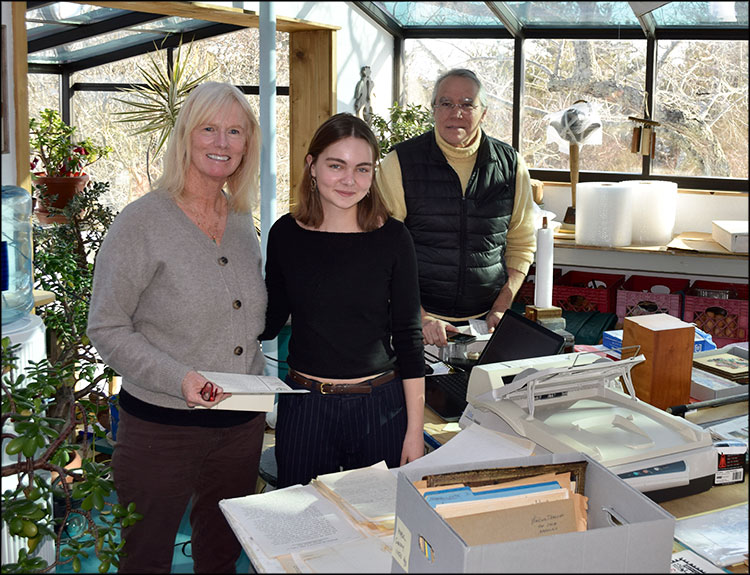
She is nearing the conclusion of her first Field Work Term, for which she chose the D’Amico Institute of Art, where she is cataloging books and digitizing a wealth of materials documenting the D’Amicos’ lives and work. Last week, she, along with Christopher Kohan, the D’Amico Institute’s director, and Jacqueline Tyrrell, its technical curator, were busy before a table filled with newspaper clippings, brochures, and other materials, including a map depicting the route the D’Amicos took by car from Milan, where the Children’s Art Carnival that Victor spearheaded while at MoMA was exhibited, to Rome.
An Air France voucher documents their trip from Rome to Paris, from which they returned to New York and their house on Napeague Bay. The Children’s Art Carnival traveled, in 1963, to India, which is captured in photographs adorning the D’Amico House, and from which the couple continued east, to Hong Kong, Bangkok, Japan, Hawaii, Los Angeles, Chicago, and New York, Mr. Kohan said. They were devoted to bringing art to the masses, firm believers in the creative potential of all people and the humanizing force of art.
“You can really do anything,” Ms. Simpson said of her first Field Work Term, “because you’re just starting out. I cold-emailed a bunch of different places, including here. This was the one that really worked out, and I think it worked out for the better.” Her interests lie in art history and archival work, she said.
“It’s perfect for new eyes, objective eyes, to look through all this,” Mr. Kohan said of the materials Ms. Simpson is cataloging and documenting. “It helps us greatly to also see what we have and how we decipher it.”
Her mother was born in Southampton, and her grandfather grew up in Amagansett. “I’m having a full-circle moment,” she said, “because growing up, my family had a painting by Ray Prohaska of Hicks Island,” which looms in the spectacular view from the house’s expansive north-facing windows. “It’s fascinating to see all this ephemera.”
“I always knew that I was interested in art history and art preservation, just because it was held to such a high standard in my family,” she said. “I was surrounded by that. My home was a gallery, my grandparents’ home was like a gallery. It was cool to be surrounded by that.”
She is using a scanner and laptop on loan from the East Hampton Library. “Mabel clipped every little article about an exhibition that she had in New York, or here at the galleries,” Mr. Kohan said. “It’s a wonderful archive of how artists lived, how they worked.”
“The first couple of weeks, I was really digging into the books, going through all the books that Mabel and Victor were gifted, and their personal books,” Ms. Simpson said. “A lot of stuff from the MoMA. It was fascinating to look at all these old things from the MoMA, the art education, and how that was frozen in time but is still so relevant. As we’ve worked more on the archive boxes with the personal documents and artist statements and gallery announcements, it’s just so cool to see all this stuff. It’s fascinating to read Mabel’s artist statements, her inspiration from the sea and everything she saw from her home. And she writes about it so poetically in her artist statements.”
“Having somebody able to be here for six weeks is fantastic for us,” Ms. Tyrrell said. The collection will be made available to the public, she said, though exactly how is to be determined.
“It’s so fascinating,” Ms. Simpson said. “When I was going through all the books, I would read sections about Victor and Mabel, and learn about them. There’s just so much to learn. This is such a special opportunity.”