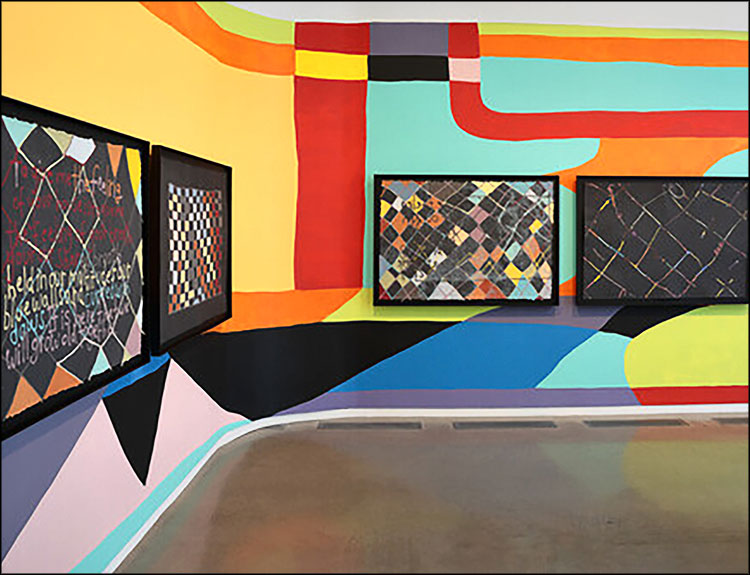
“Dear Mazie,” an exhibition inspired by the life and work of Amaza Lee Meredith, the first known Black queer woman to practice architecture in the United States, will open Saturday at 6 p.m. with a reception at The Church and remain on view there through Dec. 27.
The group show, which celebrates Meredith while reflecting her continued relevance through the work of contemporary artists, designers, and architects, has been curated by Amber Esseiva, senior curator and director of curatorial affairs at Virginia Commonwealth University in Richmond, where it originated.
The Church’s first hosting of a traveling exhibition organized by another museum, it comes to Sag Harbor after a stop at the California African American Museum in Los Angeles.
The show features commissioned works by AD-WO, an art, architecture, and urban design practice directed by Emanuel Admassu and Jen Wood, the Black School, an experimental art school founded by Shani Peters and Joseph Cuillier III, and Practise, a graphic design studio run by James Goggin and Shan James. Other artists are Lukaza Branfman-Verissimo, Kapwani Kiwanga, Abigail Lucien, Tschabalala Self, and Cauleen Smith, and the show’s Sag Harbor iteration will include newly commissioned works by three East End artists, Donnamarie Barnes, Michael Butler, and Hank Willis Thomas.
Born in Lynchburg, Va., in 1895, Meredith obtained her teaching credentials from the Virginia Normal and Industrial Institute, now Virginia State University, in Petersburg. She later received bachelor’s and master’s degrees in art education from Columbia University.
One of her most important works, Azurest South, designed in 1939 at Virginia State University, was named in 1993 to the National Park Service National Register of Historic Properties. It was an anomaly for Virginia, according to Julie Langan, director of that state’s Department of Historic Resources. “At the time . . . we were still extremely traditional; everything looked Colonial. To have something [in the] International Style was a notable departure.”
If the name “Azurest” rings a bell, it’s because in the 1940s the Azurest Syndicate subdivision was founded in Sag Harbor’s Eastville area by Maude Terry, Meredith’s sister, and managed by the sisters with James P. Smith, a civil engineer, Dorothy C. Spaulding, an attorney, and her husband, James Spaulding.
Azurest North, a subdivision on 20 acres, was envisioned as a place of refuge, creativity, and Black excellence on the South Fork. Lots were sold to investors who built cottages there, including at least two designed by Meredith: Terry Cottage, which belonged to Maude Terry and was designed with format aspects similar to Azurest South, and Edendot, a Prairie Style building that belonged to the Spauldings.
That Meredith’s influence remains woven into the cultural history of Sag Harbor is reflected in her portrait as one of the local icons depicted by Eric Fischl on The Church’s windows.
“ ‘Dear Mazie’ embodies The Church’s mission to connect art, history, and community through exhibitions that deepen our understanding of the place we call home,” said Sheri Pasquarella, its executive director. “Amaza Lee Meredith transformed Sag Harbor through her vision, courage, and creativity. Her contributions continue to reverberate here, and are of both regional and national importance. We are honored to welcome this remarkable exhibition to the very community where so much of her legacy continues to resonate.”
“Meredith imagined architecture not simply as the construction of buildings, but as the creation of spaces where people could live with dignity, joy, and freedom,” said Esseiva. “The artists in ‘Dear Mazie’ extend her vision into the present, demonstrating how her work continues to inspire new conversations about belonging, design, and collective futures.”
A panel discussion will happen before Saturday’s reception at 5 p.m., when Esseiva will be joined by Jessica Bell Brown, executive director of the Institute for Contemporary Art at V.C.U., to discuss Meredith’s legacy, the impetus for the show, and the nature of the curatorial undertaking.
Esseiva is a Swiss-Senegalese-American curator and educator who specializes in organizing contemporary art exhibitions and programs by national and international midcareer artists. In addition to her position at V.C.U., she is the curator at large for the Studio Museum in Harlem.
Before her current role at V.C.U., Brown was curator and department head at the Baltimore Museum of Art, where she helped transform the collection. Her writing has been featured in several artist monographs and catalogs, and she has also held positions at the Gracie Mansion Conservancy and the Museum of Modern Art.
After the talk, guests will be led upstairs for a first look at the exhibition. Tickets to the panel are $10, free for members, who are required to R.S.V.P.
Green Architecture Pioneer
As a bridge between The Church’s previous show, “This Land: Considering the American Landscape,” and “Dear Mazie,” Randolph Croxton, an architect, author, preservationist, and pioneer of green architecture, is up next in its Knowledge Friday series on Friday at 6 p.m. He will discuss his story, sharing the experiences that shaped him and how a fascination with Sag Harbor has led him to protect and honor its integrity.
Croxton began his architectural career with I.M. Pei and Partners and went on to found Croxton Creative Architects in 1978. The firm received the profession’s highest award for design excellence, the American Institute of Architects’ 1984 National Honor Award, as well as the 2005 U.S. Green Building Council’s Award for National Leadership for establishing the founding principles and practices of green architecture in America.
A Sag Harbor resident, Croxton serves as an elder at the Old Whalers Church and on the board of Save Sag Harbor, and has been instrumental in the 1994 designation of Old Whalers as a National Historic Landmark.