
WILLIAM MILLER: Seeing the Beauty in Trees
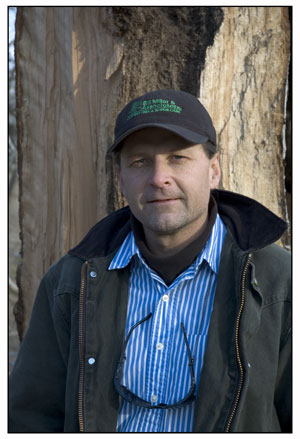
"I consider myself to be a twig and bud man, and we're not talking about the beer," William Miller said on a cold and wet December afternoon.
"This gray light is the best" he said. "What other people call a rainy day, I call a beautiful day."
The owner of Bill Miller and Associates, a custom tree, shrub, and hedge care company, he was speed-walking from his upstairs office on Sag Harbor's Madison Street to look at a hackberry tree in a courtyard below. "Without the glare of the sun, subtle colors come out," he explained as he stood coatless out in the weather.
"Rain restores its beauty. It's like running water over a rock. The brilliance comes back."
A rare East End native, the hackberry next to the Youngblood gallery is close to a century old. Mr. Miller has left it untouched, and the reddish-purple drupe taps at the gallery's picture window when the wind blows.
For the hackberry to survive, no other tree can grow within a couple of hundred yards. It's a loner. "Maybe it's about respect. I admire it," he said. If someone tried to take a saw to it, "I would defend that tree."
"They're tough and sensitive, reminds me of a human being," said Mr. Miller, who in 1977 had "a profound falling-in-love experience with trees." During summer vacation as an Ohio State University student, he took a job with the state, putting gypsy moth traps on trees, which entailed spending hours driving from county to county.
"I knew I needed something to keep me awake" on the often 200-mile trips, he said. So he bought a Peterson Field Guide - the tattered copy is still in his possession - and started teaching himself about trees.
On the open roads of Ohio, a tree can often be spied a mile away, he said, and he "fell in love with the silhouettes" from miles away. At first he had a hard time telling an American sycamore from a tulip, but he started to collect twigs to compare to the pictures in the tree guide, and the following semester he signed up for classes like "woody plants in winter," his favorite.
The "next wave of falling in love" ensued. "Truly, the veil had been dropped. Everywhere I looked there was something new."
The beauty of plants is easy to overlook, Mr. Miller said. "Everybody can [see it] but they need to have their hand taken." A first step, he said, is "consciousness" - of slender or thick branches or trunks, of colors and of changes in color.
To help his clients see the beauty in their own backyards, Mr. Miller "breaks a garden down," or assesses its greenery, he said. Pictures of his 11-man crew adorn the walls of his two-room office space. Some show men, in harness and hard hat, attached to trees like pandas on bamboo. Others are aerial shots of the crew and the company fleet -in one, the crew members are lying in the dirt forming a circle around the bucket truck.
Pinecones decorate the conference table, and numerous copies of "The Pruning of Trees, Shrubs, and Conifers" and "The Tree Identification Book" line the bookshelves. "I'm a major book hound, an educator," he said as he gave away yet another copy of the pruning book. "I'm all about cultivating interest and curiosity."
He has a reputation as a "master pruner," yet is opposed to the "undoing of beauty." There is, he said, an "art to subtraction - the important thing is not what you do, but what you don't do."
He said he is interested in all plants, from "massive beech trees to the vines," and that he enjoys incorporating "concepts of design when you're working with what's there."
"It's all about revelation. It's about balance, contrast, color," he said.
"Keep the oaks out there" is what he prefers. "Is removal necessary? Yes. Well-thought-out removal is even more necessary," he said. He has spent "the better part of 30 years learning when to cut," he said. "I hope it wasn't a waste."
It takes years to build his clients' gardens, said Mr. Miller, who started his business in 1986. "If you can't give me some time, don't bother with me. I'm one of the slowest people around. I started out slow, and I'm getting slower."
Time allows the opportunity to see natural beauty develop, he said. "Not only what's in front of your eyes, seeing where the plants and the garden are going. It's seeing into the future a little bit."
He has trained many of his arborists, and he said he is proud of them. He was quick to point to a framed newspaper clipping about A.J. Remy, the New York State tree-climbing champion in 2001 and 2003, who is one of his employees.
Work becomes more dangerous in the rain, but his staff works in it anyway. Far from dampening his own enthusiasm, the rain simply brings it out.