Debate on Moral Matters

Debate on Moral Matters

By
Christopher Walsh

VoteHamptonNY, a nonpartisan interfaith initiative formed by the East Hampton Clericus in April to promote voter registration, engagement, and turnout, will host a forum for the candidates for East Hampton Town Board tonight at 7 at Calvary Baptist Church in East Hampton.

Councilman David Lys, the Democratic and East Hampton Unity Party candidate, and Manny Vilar, the Republican and Conservative Party candidate, will discuss issues at a forum moderated by the Rev. Walter Silva Thompson, senior pastor of Calvary Baptist and a member of the Clericus.

The candidates will address such questions as “How does your personal moral compass inform your legislative agenda?” and “How do you feel about the marriage of faiths and governance? Do churches have a role in working for the common good of all citizens?” Questions will also touch on the lack of “partisan parity” on an all-Democratic East Hampton Town Board, the candidates’ core constituents, and their plans to improve the town and the role they see for community members in their plans.

At an event announcing VoteHamptonNY, Mr. Thompson described the initiative as “a moral campaign” to ensure that residents understand the value of civic engagement through voter registration and the exercise of their right. “The sociopolitical and economic climate in our country calls for our communities to communicate with one another,” he said, “to work together and build accountable plans to educate, engage, organize, and mobilize its citizens along with working to keep its elected officials morally and politically accountable.”

The East Hampton Clericus comprises religious leaders from Wainscott to Montauk.

Success With Less Spraying

Success With Less Spraying

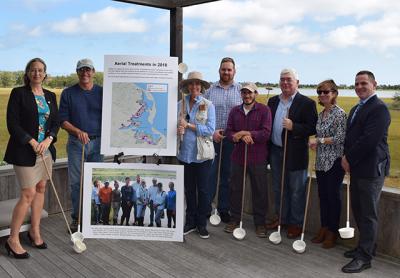
Suffolk County Legislator Bridget Fleming, left, with county, East Hampton Town, and Nature Conservancy officials celebrated a trial program that saw a large reduction in the use of methoprene to control mosquitoes at Accabonac Harbor.
Christopher Walsh
By
Christopher Walsh

A pilot project that resulted in a dramatic reduction in the aerial application of methoprene, a mosquito larvicide, over the wetlands surrounding Accabonac Harbor last summer was celebrated on Tuesday at the residence of Edwina von Gal, founder of the Perfect Earth Project, in Springs, where government officials including Suffolk County Legislator Bridget Fleming, East Hampton Town Trustees, and the county’s director of vector control gathered.

A joint effort that brought together the county, the trustees, the Nature Conservancy, and the town’s Natural Resources and Planning Departments resulted in targeted application of methoprene — which conservationists fear is harmful to nontarget species including crustaceans — based on weekly mosquito larval sampling and its conveyance to the county’s Department of Public Works, allowing less, and less frequent, application. 

With student volunteers, Susan McGraw Keber and John Aldred of the trustees oversaw some 6,000 samples taken over the county’s 11-week spraying season. Samplers sent data to Matt Grasso of the Nature Conservancy, who consolidated the data and forwarded it to the Suffolk Department of Public Works’ vector control division. Tom Iwanejko, the director of vector control, and his staff reviewed the data and issued directives to the county’s helicopter pilots to alter spray patterns based on those data. 

Of the 6,000 samples, “only 544 were positive for larvae,” Ms. Fleming said on Tuesday. Importantly, “the larvae were found at the upper edge of the marsh, which meant that a 195-acre spray area that went right to the surface waters was reduced to 95 acres. Right off the bat, we eliminated any spraying near the harbor itself and reduced by over half the area that was treated. Because of this reduction, there was a reduction of 50 percent of the methoprene that was used.” 

For four weeks of the 11-week season, no spraying at all took place. The county saved approximately $18,000 thanks to the program. 

The volunteers and trustees also discovered physical characteristics of the wetlands, such as a sunken boat that was harboring breeding larvae. The trustees dismantled and removed it, eliminating one breeding “hot spot.”

“When I was first elected in 2015, one of my top priorities was to reduce or eliminate methoprene spraying,” Ms. Fleming said, “not only here but throughout the county. Not only because I see it as a problem because of unintended consequences and secondary impacts on other aspects of the environment, but also because many people pushed me to do that.” 

With the sun shining on the harbor behind them, Ms. Fleming and Kevin McDonald of the Nature Conservancy contrasted the cooperative effort to reduce methoprene’s use with a toxic atmosphere in Washington, D.C. 

“We are at a time in our country where disagreement so often and so quickly moves toward personal attacks and paralysis,” Ms. Fleming said. “That’s what was happening on the methoprene argument for years: One side said ban it, and the other said public health requires that we eliminate mosquitoes and this is the way to do it, and never the twain should meet. We never got any progress, because the two sides were so entrenched in their silos.”

“It is hard to miss the moment we are in nationally,” Mr. McDonald said, “where everything is a bloodbath over everything.” The pilot program, he said, demonstrated that “a third way to address this issue” was possible.

“I’m saving money at the end of the day,” Mr. Iwanejko said. “I’m happy about that. And we reduced pesticide use. . . . I’m hoping that we could use this project as a springboard . . . to look at restoration of wetlands we don’t need to treat any longer.”

Mosquitoes can carry West Nile virus, Eastern equine encephalitis, and other diseases. As of Friday, 141 mosquitoes and 12 birds collected in Suffolk County this year have tested positive for West Nile virus. Five human cases have been reported, and one horse that tested positive for West Nile died. 

Ms. Fleming said that she hoped the program would be replicated in other areas where the county has traditionally sought to control mosquitoes with blanket application of methoprene. “It’s not the end, but it’s a very good start,” she said. “We hope not only to make this program more robust, but to share it with other communities who aren’t necessarily attuned to the dangers of pesticides.”

‘Everyone Is Afraid,’ OLA Tells Town Board

‘Everyone Is Afraid,’ OLA Tells Town Board

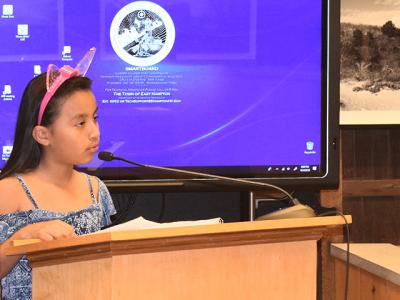
Angie, a fifth-grade student in East Hampton, told the East Hampton Town Board that she worries that her mother might be hurt or deported.
Christopher Walsh
Immigrants ask for protection in uncertain times
By
Christopher Walsh

“Todos tienen mucho miedo.”

Patricia’s message — everybody is very afraid — was delivered, through an interpreter, to the East Hampton Town Board last Thursday. 

Organizacion Latino-Americana of Long Island, a nonprofit that promotes social, economic, cultural, and educational development for the region’s Latino communities, had urged people to attend the meeting.

Most who heeded the call were immigrants or their advocates, who relayed, through more than an hour of gripping testimony, what they, their families, and acquaintances have experienced over the last 18 months. 

At a Southampton Town Board meeting on Sept. 25, OLA, as the group is known, called for enacting legislation it is drafting, the Peaceful Communities Protection Act, that would codify a policy of noncooperation between the town Police Department and the federal Immigration and Customs Enforcement, or ICE. 

“It is not enough to sigh and lament the federal bad guys who are picking off nonviolent members of our community in an unprecedented ‘open season’ approach and say that we are doing enough,” Minerva Perez, OLA’s director, told the board. “Local law enforcement agencies are being pulled into the fray, and it’s harming our communities. . . . This is a time like no other. All minds and all hearts are needed at this leadership table to navigate our town through this difficult and dark time.”

The Trump administration’s hardline policies regarding undocumented immigrants, and remarks by the president that many construe as racist, have fostered a climate of terror among the South Fork’s Latino community, its effect dramatically played out at Town Hall as one speaker after another testified to their fear of interacting with law enforcement or government officials, fear of racism among the town’s residents, fear even of leaving home. 

The fear of being detained for a nonviolent offense, such as driving without a license, brings consequences, they said: people too apprehensive to report a crime to the police, traumatized children who wonder if their parents will disappear. “The bad and violent people are not afraid of anything,” Patricia said. “But the good people are very afraid.” She did not provide her last name.

“I worry that one day when school’s over, my mom won’t be there to pick me up because bad people hurt her, or because she saw a crime and they’re trying to hurt her or something,” Angie, an East Hampton fifth grader, told the board. “When I see her every day, I feel better knowing she’s still here. But sometimes it’s not the same for other kids. Sometimes their parents get hurt or get deported, and I worry it will happen to me, too.”

Angie, poised and mature beyond her 10 years, was born at Southampton Hospital. Her parents are from Ecuador. “I feel afraid sometimes that police officers are going to arrest my mom and deport her back to where she came from and that I’m going to be without her. I really worry about that stuff,” she told The Star after the meeting. “I really want to be with my mom.”  

“It’s not comfortable to feel nervous and scared every single day,” she said. “It’s really a lot of work, and puts a lot of stress on you.” 

An emotional Councilman David Lys, himself the father of a fifth grader and whose father immigrated from Indonesia and became a United States citizen, told the girl that “You should never live in fear,” that “we will make sure that our town is safe for all. . . . Don’t ever stop being brave.” 

Supervisor Peter Van Scoyoc told Ms. Perez and other speakers that the Police Department does not honor detainer directives issued by ICE or Customs Border Protection. “The only case in which we would hold somebody would be if there’s a judicial warrant in place, that there’s probable cause that the individual has previously been convicted and previously removed from the country, and that specifically there was a serious crime involved,” he said. “Our basic premise is that unless every member of this community feels safe to call police, to report a crime against themselves or others, none of us are safe.” 

The supervisor noted multiple contributions by immigrants and “so much to gain from the diversity of our community,” and the irony of the present circumstance in a town that has welcomed immigrants for 370 years. “To break apart that fabric of our community and the investment that we’ve all made through schooling children and others, that is truly something that we support pushing against,” he said.  

He pledged to review the proposed legislation put forth by OLA and compare it with the town’s current policy, which he said, is closely aligned with it. “We don’t ask for immigration status for anyone stopped for any reason. . . . We understand the impacts of having people fearful of their status in reporting crimes, against themselves and against others. Those who have citizenship and don’t have any potential issues with that are at risk when people observe crimes against them and are not willing to come forward to testify.” 

Andrew Strong, OLA’s counsel, said he was pleased to learn that the present policy and proposed legislation are similar, but said that there are practical reasons to codify a policy. More than 12 municipalities have been successfully sued as a result of honoring administrative retainers — “ICE does not indemnify towns,” he said. For that reason, the New York State Sheriffs’ Association and the state attorney general have both recommended that local law enforcement not honor administrative warrants, he said. 

“As a nation we are going through a moment right now of unprecedented negative rhetoric and a policy assault on some of the most vulnerable members of the community,” Mr. Strong said. “For that population, this is a moment of unimaginable crisis. It’s critical to say publicly, ‘these are our values: tolerance, community, and affording basic human rights protections for everyone living here peacefully.’ ” 

Legislation “makes a meaningful difference to the people that are caught in this atmosphere of fear that is unfortunately pervasive,” Mr. Strong said. “Now is the moment. The crisis is here. There’s hard work to do.” 

Political Briefs 10.18.18

Political Briefs 10.18.18

By
Star Staff

Town Board Candidates to Debate

East Hampton Town Councilman David Lys and his challenger, Manny Vilar, will meet on Tuesday at 7:30 p.m. at the East Hampton Library in a debate presented by the East Hampton Group for Good Government.

Mr. Lys was appointed to the town board in January to serve the remainder of Peter Van Scoyoc’s term, following Mr. Van Scoyoc’s election to supervisor last year. Mr. Lys, who changed his party affiliation from Republican to Democratic, is now seeking election in his own right. He also represents the East Hampton Unity Party, formed this year. 

Mr. Vilar, the founding president of the Police Benevolent Association of New York State, is running on the Republican and Conservative Party ballots. He ran unsuccessfully for supervisor last year.

The debate will be televised on LTV’s channel 20.

 C.W.

Three League Debates Loom

The League of Women Voters of the Hamptons has scheduled three debates ahead of the Nov. 6 election. 

Next Thursday from 7 to 9 p.m., two debates will be held at the Hampton Bays Senior Center. State Senator Kenneth P. LaValle, a Republican, and Greg Fischer, his Democratic challenger, will debate first. Another pitting Assemblyman Fred W. Thiele Jr., a member of the Independence Party, against Patrick O’Connor, his Republican challenger, will follow. 

The candidates will make timed opening and closing statements and answer questions posed by a panel made up of representatives of the Press News Group, The Sag Harbor Express, the League of Women Voters of the Hamptons, and the Hampton Bays Civic Association. Members of the audience can ask questions, too. Susan Wilson, the league’s co-president, will moderate. 

Representative Lee Zeldin and Perry Gershon, who is challenging him in New York’s First Congressional District, will face off on Oct. 29 from 7 to 9 p.m. in the Hampton Bays High School auditorium. The candidates will make timed opening and closing statements and answer questions submitted by the panel and the audience. Cathy Peacock of Amagansett, who is co-chairwoman of the league’s government committee, will moderate. 

It is expected to be their only in-person debate of the campaign. Mr. Zeldin, a Republican seeking a third term in Congress, and Mr. Gershon, a Democrat and a first-time candidate who lives in East Hampton, addressed voters separately in an event hosted by the New York League of Conservation Voters on Monday in Riverhead. 

The New York State League of Women Voters maintains an online voter guide, accessible at votingnewyork.org or my.lwv.org/new-york-state. C.W.

The Supe Solarizes Himself

The Supe Solarizes Himself

By
Christopher Walsh

With warnings about catastrophic climate change growing ever more urgent, the Town of East Hampton has moved proactively, having set a goal to achieve its energy needs from renewable sources. 

On an individual level, Supervisor Peter Van Scoyoc is leading by example. Last summer, he took advantage of the town’s Solarize East Hampton program to install photovoltaic panels on the roof of his house in Northwest Woods. 

Through a request for proposals, the town selected GreenLogic Energy as its designated solar installer. The company conducts a free assessment to ensure that a property receives adequate sunlight, Mr. Van Scoyoc said this week. “The condition of your roof is important,” he said. “You want to make sure it will outlast the expected life of the panels,” 20 to 25 years. 

“From that point, you look at your electric bill,” he said. “You want to balance your current or projected electric usage with the amount of generation that you have on the roof. You don’t want to produce considerably more than you’re using — the idea is to offset and generate an equivalent amount, reducing your electric bill to the basic service charge.”

Through net metering, in which solar panels are connected to a public-utility power grid and surplus power is transferred onto it, utility customers can offset the cost of power drawn from the utility. Mr. Van Scoyoc likened the system to a cellphone plan’s rollover minutes. “If you create a surplus during some portion of the year, it gets banked into your account so in periods of rain or shorter days, you get the credit of those banked hours on your electric bill,” he said. 

The Van Scoyocs were using around 11,000 kilowatts of electricity annually, the supervisor said. “We sized our system to basically produce that much, based on the amount of sunshine per day.” 

Installation and inspections were a simple process, he said, lasting just a few days. “The contractor took care of all permitting,” he said. “We only had to sign a few papers.”

A $5,000 state rebate, and another on the federal tax return, meant no out-of-pocket costs, Mr. Van Scoyoc said. GreenLogic arranges loans to cover the cost of the installation, payable with the rebates. “The idea is to get your loan payments at or below your monthly electric bill,” he said. “We more than did that.” 

At the same time, the Van Scoyocs took advantage of a rebate for installation of a variable-speed swimming pool pump and a free Nest thermostat through the South Fork Peak Savers program, and changed all lightbulbs to LED. “As a result of all those cost-saving measures, we are producing about 20 percent more electricity than we are currently using, on average, since installation,” the supervisor said. The monthly electric bill, provided the solar array produces as much or more electricity than is consumed, is $14.10. 

An app provides data on daily, weekly, and monthly electricity usage as well as the amount of carbon dioxide not released into the atmosphere from the burning of fossil fuels. 

“I would encourage residents all over town, if you can, take advantage of it,” Mr. Van Scoyoc said of the Solarize East Hampton program.

The Candidates on Morals

The Candidates on Morals

Manny Vilar, left, and David Lys, right, answered questions from local clergy during a forum last Thursday sponsored by the East Hampton Clericus.
By
Christopher Walsh

Two sons of immigrants presented a case for their election to the East Hampton Town Board last Thursday as the East Hampton Clericus hosted David Lys and Manny Vilar at Calvary Baptist Church in East Hampton.

The civic forum, in which the candidates answered questions posed by the Rev. Walter Silva Thompson Jr. of Calvary Baptist Church and the Rev. Ryan Creamer of Most Holy Trinity Catholic Church in East Hampton, was part of the Clericus’s VoteHamptonNY initiative, a nonpartisan, interfaith effort to encourage voter engagement. 

But an otherwise measured discussion about leadership and morality was punctuated, at its conclusion, by mention of President Trump. While Mr. Vilar sidestepped a question from a member of the East Hampton Town Democratic Committee as to why he had supported Donald Trump’s candidacy in 2016, he drew the evening’s loudest applause with a call to rebuke partisan division and a plea for tolerance and respect. 

Mr. Lys, who was appointed to the town board in January to complete the term of Peter Van Scoyoc following his election to supervisor, and Mr. Vilar, the founding president of the Police Benevolent Association of New York State and a 2017 candidate for supervisor, were queried on topics including how their moral compass guides them and the church’s role in governing. 

To the question of his moral compass, Mr. Vilar, whose father immigrated from Portugal, spoke of his desire to “promote legislation that uplifts the downtrodden, the financially disenfranchised, to fight against intolerance.” The cost of living in East Hampton demands an examination of policies “to try and create an environment that’s going to be good for our community,” he said. 

At a median salary of $40,500, the average town employee cannot afford to live here, Mr. Vilar said. “East Hampton Town government needs to start with its employees” and find a way to elevate all salaries, even if incrementally. The best way to raise a community is through economic initiatives and policies, he said. “If everybody has a job, they can afford to live, they can spend more time with their families. . . . It gives them the freedom to volunteer in their church, to volunteer for their civic organization.”

Mr. Lys, whose father came to the United States from Indonesia, agreed that some staff positions in the town’s government are undervalued but pointed to the recently unveiled tentative budget, which includes an almost $1.3-million increase in employee salaries and benefits, and the new Live Here, Work Here initiative meant to interest residents in working for the town. 

In addition to his family, “My moral compass has been molded by the residents of the town in the 42 years I’ve lived here,” he said. “I’m not a Johnny-come-lately,” he said. “I’ve been actively involved for the last decade . . . not for political or personal gain, but for what I felt was right, that I felt was the good thing to do for the Town of East Hampton.” 

Mr. Vilar said that the Democratic supermajority on the town board is a detriment to having diversity of thought. “I believe we need to have an objective voice,” he said. “We need to have someone in there that’s maybe not of a different mind-set, but a little diversity, a little understanding.” He and Mr. Lys both live in Springs, he said, and share many mutual friends. “And that is a good thing regardless of who gets elected, but it’s good to have a little diversity, just having people from a two-party system alive and well.”

Mr. Lys, who recently changed his party registration from Republican to Democratic, said that the present town board is in fact diverse. “Saying we’re all Democrats is just putting labels on individuals,” he said. “We’ve got individuals on the town board right now that come from different walks of life, different ethnicities . . . parishes, families, hometowns, different life experiences.” They don’t always get along, he said, “but we always come to a decision we think is correct because we did our homework.” 

The candidates agreed that houses of worship have a role in the common good. Mr. Lys noted that the Springs Food Pantry is based in that hamlet’s Presbyterian church, and that the church was a pillar of the town from the time of its 17th-century origins. “This community was founded that way,” he said. “We went back to the places we felt safe at, and we all felt safe at church. You want to talk about moral compasses? It started at church.”

Mr. Vilar quoted Theodore Roosevelt. “To educate a person in mind but not morals is to educate a menace to society,” he said. “We have to work closely with our religious establishments and religious communities within the town. I believe there’s a strong connection between government and faith.” 

J.B. Dossantos, whom East Hampton Democrats elected to represent the 14th election district, which encompasses the Calvary Baptist Church, then asked Mr. Vilar why he had displayed campaign signs and voted for Mr. Trump. “Evil does exist,” Mr. Vilar said. “It exists in our society and it works in insidious ways. We must always be vigilant to guard against the voices of intolerance and hatred. As a society, we must protect the weak, the infirm, those that are victimized, and the downtrodden.” 

To the gathering, he revealed, apparently for the first time, that racist and anti-Semitic graffiti had been discovered in Montauk over the last several weeks. Again he quoted Roosevelt, and asked that residents of the town, “regardless of who you vote for and what your political leanings are,” reject partisanship. “Give evil and hate no quarter, love your neighbor as if they were your own family,” he said. “Be respectful, compassionate, empathetic, and understanding. Be vigilant at all times against intolerance. Rebuke those that would divide us by ethnicity, religion, lifestyle choice, or political preferences.” 

His remarks drew loud applause, over Mr. Dossantos’s objection that Mr. Vilar had not answered his question. After the forum, Mr. Vilar told The Star that he had voted for Mr. Trump, but he denied having displayed campaign signs for him on his property. 

Despite the unexpected turn at the discussion’s conclusion, Diana Walker, an organizer of VoteHamptonNY, said that “This is a happy day in my life. . . . I hope that we truly are providing an environment, thanks to Pastor Thompson and to everybody here, with a sense that it is ‘Love thy neighbor as thyself.’ We’re trying to do that.”

Town Nears Styrofoam Ban

Town Nears Styrofoam Ban

By
Christopher Walsh

The Town of East Hampton appears set to follow the lead of East Hampton Village in enacting a ban on polystyrene products, commonly referred to as Styrofoam. 

On Tuesday, Councilwoman Sylvia Overby told her colleagues on the board that polystyrene foam, typically used in food packaging, is a petroleum-based plastic that has been identified as a potential carcinogen by the federal Department of Health and Human Services and the International Agency for Research on Cancer. The federal Environmental Protection Agency, the Food and Drug Administration, and the Occupational Safety and Health Administration have all set styrene exposure levels, she said. 

Styrofoam has historically been difficult and costly to recycle, Ms. Overby said. “What you see, that’s the only product it will ever be,” she said. “We cannot make it into anything else; we can’t recycle it.” It biodegrades poorly, she said, and in landfills it “will be there 500 years from now, probably longer.” Polystyrene can also be very toxic when burned, she added. 

The proposed legislation mirrors that passed by the village board in April, which took effect on Aug. 1. That law bans possession or sale of single-service articles consisting of expanded polystyrene, including but not limited to food in single-service articles. Sale of polystyrene loose-fill packaging and coolers are also prohibited in the village. 

Exemptions include polystyrene containers used for prepackaged food that have been filled and sealed prior to receipt by a food service establishment or store, and polystyrene containers used to store raw meat, including seafood, pork, and poultry. 

The town’s recycling and litter committee unanimously supported the proposal, Ms. Overby said. The business committee was to review the proposed legislation today, she said, after which it could be scheduled for a public hearing ahead of a vote to adopt it. 

It will be important to alert business owners should a ban be enacted, said Supervisor Peter Van Scoyoc, so they do not order more as existing stock is depleted. Councilman David Lys said that he would present the proposed legislation to the fisheries advisory committee to see if it would impact fishermen. 

“I think it’s a worthwhile effort,” Mr. Van Scoyoc said of the proposal, adding that many establishments have already ended the use of polystyrene. 

In other news from Tuesday’s meeting, Len Bernard, the budget director, and Charlene Kagel-Betts, the chief auditor, updated the board with minor modifications to the town’s tentative $80.7 million budget. “What you have now is a preliminary budget,” Mr. Bernard told the board. 

A notice for a public hearing that will be held at the board’s Nov. 1 meeting is to be included in next week’s issue of The Star. The board is tentatively scheduled to vote to adopt the budget on Nov. 15.
Lys Leads Vilar in Dollars

Lys Leads Vilar in Dollars

By
David E. Rattray

According to figures filed earlier this month, the Democratic candidate for East Hampton Town Board, David Lys, has a substantial financial edge over his Republican opponent, Manny Vilar.

The precise depth of Mr. Vilar’s war chest was not available; his campaign committee missed an Oct. 5 reporting deadline, according to data from the New York State Board of Elections.

Mr. Lys’s hoard of campaign cash could be cut into, however, due to donations that exceeded the amount individuals can give to a single candidate. The error was first brought to light by local Republicans.

In all, the Friends of David Lys reported $31,000 in apparently excess contributions from eight individuals, the largest $10,000 in August from Katharine J. Rayner of East Hampton. In East Hampton Town general election races, the maximum is $1,000. Gifts to party committees and PACs have higher limits.

The over-the-limit filings were a bookkeeping mistake, Christopher Kelley, one of the Town Democratic Party leaders, said this week. The Friends of David Lys was intended to be a multi-candidate committee, he said; however, when it was created, it was identified as supporting Mr. Lys alone. This, Mr. Kelley said, was an inadvertent error.

Mr. Kelly said the party is in process of setting up a multi-candidate committee, at the direction of the Board of Elections, to be called Campaign 2018, to which the money above the single-candidate limit would be transferred. He disputed the Republicans’ characterization of the donations as in excess. 

“Friends of David Lys was always openly raising and spending money and reporting on behalf of almost 30 candidates, including the committee races. This allowed each donor to contribute $1,000 per candidate for the primary and $1,000 for the general election,” Mr. Kelley said in an email.

“As you know, it is our historical M.O. to use a single multi-candidate committee in our election campaigns,” he said.

As of the Oct. 5 reporting deadline, the Friends of David Lys and East Hampton Town Democratic Committee together had about $54,000 available.

The East Hampton Town Republican Committee reported about $15,200 in the bank in its October filing, most of it carried over from the 2017 campaign. In his July statement Mr. Vilar said he had just under $2,800 in his election fund.

With Election Day on Nov. 6, spending on behalf of both town board candidates has been robust. Friends of David Lys reported expenses of more than $18,000 after their man fended off a primary challenge from David Gruber of East Hampton.

The East Hampton Town Republican Committee spent $7,300 during the same period, according to its board of elections filing.

A final financial pre-election report from the committees must be submitted by Friday, Oct. 26.

Scallops on November Menu

Scallops on November Menu

Recalling that a Sunday opening day to scallop season in 2017 was “like a scallop festival,” as Rick Drew described it, the East Hampton Town Trustees voted to open the season on a Sunday (Nov. 11) this year as well.
David E. Rattray
By
Christopher Walsh

The East Hampton Town Trustees have set Nov. 11 as the opening date on which scallops can be taken from waters under their jurisdiction. 

New York State announced Nov. 5 as the opening of scallop season in state waters. The trustees typically open waters a week later to allow additional time for scallops to spawn. The season will end on March 31, 2019. 

Last year, the trustees opened waters under their jurisdiction on a Sunday, when use of a dredge or other powered device is prohibited. The idea, said Francis Bock, the trustees’ clerk, was to allow everyone an opportunity to harvest the hotly anticipated delicacy. “I think it was an overwhelming success,” Mr. Bock told his colleagues at a meeting on Friday. “I still hear a lot of feedback.”

“It was a great day on the water,” said Rick Drew, “like a scallop festival.” With that in mind, they voted unanimously to open the waters on Nov. 11, a Sunday. 

The town’s shellfish ordinance sets a daily limit of five bushels per day for commercial licensees. Two or more people holding commercial permits and occupying the same boat may take in the aggregate up to 10 bushels per day. “Two or more persons, only one of whom holds commercial permit and occupying the same boat while taking escallops, may take in the aggregate not more than five bushels in one day,” the ordinance reads. 

Those with noncommercial licenses are allowed one bushel per day; three or more such persons occupying the same boat may not take in the aggregate more than three bushels per day. Bushel bags are sold, for $1, in the trustees’ office at the Lamb Building on Bluff Road in Amagansett. 

The consensus last year was a modest rebound in the population of bay scallops, New York’s official state shellfish, after two consecutive years of disappointment. In recent years, the population has been impacted by factors including blooms of rust tide (cochlodinium). While not injurious to humans, rust tide can be harmful to shellfish and finfish. Predation by marine life including crabs and conchs has also hurt, and is worsened by sparse habitat such as eelgrass. Warmer water temperatures may also contribute to the falloff.

The town’s shellfish hatchery, which was established in the wake of algal blooms that decimated shellfish populations in the 1980s, seeds local waters with scallops, oysters, and clams.

Businesses on Alert

Businesses on Alert

Proposed parking rules called a ‘slippery slope’
By
Christopher Walsh

Concerned that the formula by which parking requirements are determined may not adequately address actual needs for some businesses, the East Hampton Town Board is proposing a zoning code amendment that would change that formula for bars, taverns, or restaurants that are accessories to resorts or motels. 

Business owners are taking notice, particularly in Montauk. 

An email from the Montauk Chamber of Commerce on Monday implored its membership to attend a hearing on the code amendment tonight at 6:30 at Town Hall. “The businesses need to attend and speak up,” it reads, “because this code change may very well, at some point, negatively affect your business.” 

The impetus for the proposed code amendment, Supervisor Peter Van Scoyoc said Tuesday, was the board’s recognition that “if existing businesses, which may not even meet their parking under code now, wish to add additional amenities and create additional traffic to their place of business, that there be a provision that they meet those requirements for parking to not further burden the community with overcrowding.”

Included in the proposal would be a statute limiting the area of certain uses. “A resort, transient motel, semipublic facility, or club may have an accessory use for incidental service, such as restaurants, bars, retail shops, etc.,” a legal notice reads. The total aggregate area devoted to such accessory use is not to exceed an area equal to one-third of the aggregate floor area. 

The amendment should not have been considered “without significant input from the business community,” Paul Monte, the Montauk chamber’s president, wrote in the email on Monday. “This type of change to the code can easily become a slippery slope resulting in the loss of significant grandfathered rights to all types of businesses and a great loss in property values to many commercial properties.”

“There have been comments made around town that this is targeted at one specific business,” Mr. Monte said, an apparent reference to Hero Beach Club, formerly the Oceanside motel, which seeks to add a restaurant and bar. “However,” Mr. Monte added, “it can and will have a significant impact on many businesses in Montauk. If you are currently pre-existing, nonconforming in any respect and have grandfathered rights on your property, this proposal should concern you.” 

An anonymous letter to the town board, however, supports the proposal, detailing a litany of concerns about Hero Beach Club, located at the west end of Montauk’s downtown and the entrance to the village. “We were pleased to learn that the East Hampton Town Board is attempting to be proactive in its efforts to control chaos and prevent further destruction to the quality of life in Montauk,” it reads. “How long before the roadway in and out of town becomes as treacherous as the roadway from the Montauk Railroad Station to Surf Lodge during July and August?” 

The proposed code change, Supervisor Van Scoyoc said on Tuesday, is “definitely not” specific to Hero Beach Club. Rather, he said, “It’s targeted to a whole class of businesses.” 

The areas of concern may be concentrated in Montauk due to the number of motels there, the supervisor said, but the issue applies to “any business that might add some other use or amenity.” 

The hearing is expected to draw a crowd.

On a separate matter, another group, OLA (Organizacion Latino-Americana) of Eastern Long Island, a nonprofit organization that promotes social, economic, cultural, and educational development for the region’s Latino communities, is urging people to attend tonight’s meeting. 

OLA is asking for public testimony related to “the treatment and protection of vulnerable and nonviolent, contributing members of our East End communities,” according to a flier it is distributing. 

The group is advocating legislation establishing a barrier between the East Hampton Town Police Department and the federal Immigration and Customs Enforcement agency, as well as requiring every police car to have a dedicated cellphone for live interpretation. It also wants the board to ensure that the Police Department has clear policies about traffic stops and checkpoints so that residents are not targeted based on race, ethnicity, or assumptions about immigration status. OLA is asking that people sign up to speak at tonight’s meeting. 

“Families are being separated right here in our towns as a result of inconsistent policies, unnecessary cooperation with ICE on nonviolent offenses, a criminalizing code that serves as a harassment tool for anti-immigrant groups, and increased enforcement on traffic violations that are landing people in Suffolk County jail and then in deportation proceedings,” the flier reads. 

OLA organized public testimony at the Southampton Town Board’s meeting on Sept. 25. The political leadership of that town and East Hampton, the flier reads, “promised they would not enact the worst of all policies — deputizing local police as ICE agents,” however “they have not taken the necessary steps to protect the peaceful and good members of our amazing community.” 

Also on the agenda tonight is a public hearing on the Wainscott hamlet study, which is covered elsewhere in this issue.