
The Mast-Head: On Montauk Circa 1908

The Mast-Head: On Montauk Circa 1908

The Montauk Lighthouse visitors’ log from August 1908 to September 1910
By
David E. Rattray

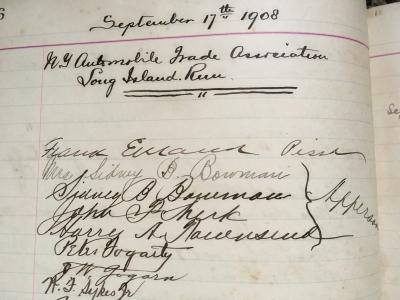
Looking through a box in the Star attic the other day, I noticed a narrow, cloth-bound ledger that looked interesting. A handwritten note tucked inside the front cover identified it as the Montauk Lighthouse visitors’ log from August 1908 to September 1910. Whoever had left the note indicated that the entries included an “auto run” in 1908, complete with the makes of the cars.

Flipping through the pages, I had the vague memory that someone had asked about this log some time ago, that it had belonged to a grandparent who had left it at The Star years ago and whose family had wanted it returned. I asked around; no one could remember who that might have been.

Chas. Wright of Brooklyn’s name is the first entry in the log, written in a big cursive hand on Aug. 22, 1908. The last entry is Mrs. H.C. Hoyt of Bensonhurst, on Sept. 26, 1910.

Local names appear by the plenty. My grandmother, who was called Nettie Edwards in those days, visited the Lighthouse on June 13, 1909, with her aunts Phoebe and Minnie Huntting. 

In July 1909, among the visitors to the Lighthouse signing the book were four members of the Roosevelt family, including John Ellis Roosevelt, a first cousin of President Theodore Roosevelt, who had left office just months earlier.

On Sept. 15, 1910, my great-great-grandmother’s name appears in a steady hand as Mrs. J.B. Edwards, Amagansett L.I. The 1908 N.Y. Automobile Trade Association Long Island Run arrived at Montauk Point on Sept. 17. About 27 people listed their names, alongside the makes of their vehicles. Unlike the other visitors’ signatures, theirs are hard to read, perhaps reflecting the long, hard miles they had traveled in their Rainier Motor Car Co. models, but if I can read one name correctly, a person named Anderson.

It was only after I put a photo of my grandmother’s signature on Instagram that the facts about whose logbook this was became clear. Barbara Borsack noticed the post and phoned to ask where I had found the logbook. Her father had lent it to my grandmother shortly before his death in 1974 of a stroke. Time intervened, and about a decade ago, Barbara inquired about it. I kept a Post-It on my desk for a while on the chance that it might turn up, but that, too, fell victim to time and disappeared.

The log had come into Barbara’s family via her great-great-grandfather James Scott, who was the keeper of the Light until 1910. Barbara’s great-grandmother had grown up in the Lighthouse as a young girl and recalled that visitors could be seen miles off over the treeless plain as they made the journey. There was often time enough to get something cooking so that they could have a hot meal ready by the time the guests arrived.

Now, Barbara plans to stop by the office to collect it. She told me she would look through it for a few days, then find it a secure home where it might in the future be accessible to the public.

Point of View: Paying Attention

Point of View: Paying Attention

He could read as fast — or faster — upside down and backward than you or I can read right-side up and forward
By
Jack Graves

I remembered Tony Demmers as I tried this morning to read upside down and backward the headlines of The New York Times’s first section that Mary, as usual, was reading with avidity.

Even with more avidity than usual, for it’s hard for common, everyday, ordinary people these days to keep up with all the goings-on, from the horrific to the banal, which confront you in about equally mind-boggling portions.

You’ll want to know something about Tony Demmers. He was the one who put the lines of type in the galleys in the hot-type days, and he could read as fast — or faster — upside down and backward than you or I can read right-side up and forward.

I can do it a bit, though Tony was way out of my league. He read more right-side up and forward than I did too.

Anyway, I could make out enough this morning to gather that the investigation as to whether you-know-who as a private citizen was tweeting with an enemy government before he was, in fact, elected to office (long live the Logan Act of 1799) might, in the end, be so vexing as to prompt a missile exchange with North Korea — to divert us, if you will. Just a wild surmise. Always jumping to conclusions. Pay no attention.

Is reality any different from our dream world? Which is half of our lives really, or almost half of mine inasmuch as I tend toward narcolepsy. I can go 10 hours easy, more if pressed. Mary, on the other hand, is often sleep-deprived inasmuch as she pays more attention than I. In a movie we saw recently, “Lady Bird,” the nun — a good one in this case — said that to love and to pay attention were, she thought, the same thing. Mary pays more attention, she loves more, which is why, I think, she has trouble sleeping.

The liberal judge Harry Pregerson’s last words were that he was sorry he could no longer help people. Mary is like that. Her example is clear. We must connect. Not because we want an enemy government to tilt the election toward us in return for . . . (we’ll have to wait for the answer to that one), but because it is simply the right thing to do. 

Connectedness without the con. That is life to her as it should be lived. That is her truth, and it is beautiful. And it is why, when it’s so easy these days to be distracted, she pays attention. 

The Mast-Head: Buried in the Road

The Mast-Head: Buried in the Road

Main Street, East Hampton, in the days of horse and buggy, with the South End Burying Ground visible on the other side of a frozen Town Pond
An early show of contempt for 'popish rituals'
By
David E. Rattray

In the early days of the East Hampton settlement, then known as Maidstone, no fence surrounded the South End Burying Ground.

This would not be particularly notable, except that in those days the area on both sides of Town Pond was the main thoroughfare, for people and livestock alike. David Gardiner, who had lived nearby and reflected on this in 1840, found it odd that over the years the graves had been exposed to the intrusions of cattle and to depredations of all kinds, as he put it.

Gardiner published his “Chronicles of the Town of Easthampton” in 1840 in The Sag Harbor Corrector, and the series was assembled into a small book in 1871. The book was reprinted in 1973 at Isabel Gardiner Mairs, one of his descendant’s, expense. Copies of that edition are free for the asking at the Amagansett Library, Nellie’s, an Amagansett antiques shop, and we have a few copies here at The Star office.

That the burying ground was actually in the public highway interested Gardiner greatly, and got him to speculating that it could have been explained as the product of the early residents’ stern religious views.

“What the object could have been in thus locating it, at a time when land was of little value and all equally accessible can only be conjectured,” he wrote.

“Burial grounds are considered holy by the Romish church, and the zeal and bigotry of that day was so intolerant of all papal customs, that the puritans were generally disposed to adopt the reverse of what they considered the superstitions of that church.” Burying their dead in the road, Gardiner supposed, might have been intended as a show of contempt for popish rituals. 

 At some point before 1840, when Gardiner’s account of the early days appeared in The Corrector, the town trustees had decided enough was enough and that the cattle that came to Town Pond to drink or that were being driven past it on their way to the meadows on Montauk were no longer welcome among the graves.

Today, a picket fence surrounds the burying ground with wooden steps at either end, which you have to climb to visit the graves. Small signs indicate that dogs are now not welcome. The cattle that do pass by do so aboard trucks.

The Mast-Head: When There Was No Coal

The Mast-Head: When There Was No Coal

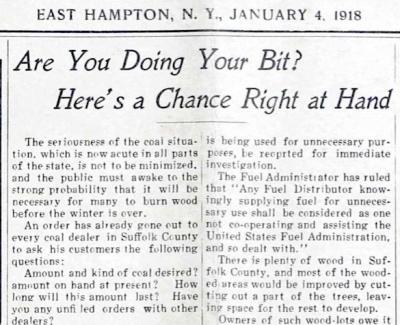
Part of the front page of the Jan. 4, 1918, East Hampton Star, from the East Hampton Library Digital Long Island collection.
The 1917-18 coal shortage was the result of a bottleneck in transportation
By
David E. Rattray

Coal was in short supply as 1917 came to an end. I did not know this until recently, when I was reading the front page of a copy of The Star that was scanned and digitized by the East Hampton Library.

L.E. Terry, the local fuel administrator under a federal wartime program, wrote what amounted to the lead article on the Jan. 4, 1918, issue. In it, he outlined the strict questions that coal dealers had been ordered by Washington to ask each customer to determine if anyone might be hoarding coal. Printed cards would soon be distributed for coal buyers to sign, attesting that they were only ordering enough for their immediate needs.

If conditions persisted, East Hampton residents would soon have to burn wood for heat, Terry wrote.  Suffolk County had plenty of that, and wooded areas would benefit from cutting, leaving new growth a chance to spread out. It was, he argued, the patriotic duty of wood-lot owners to cut wood themselves or allow someone else to do so. Owners of wood lots who refused should be reported, he wrote.

Wood lots were an old idea in East Hampton. Most of the families who established footholds here in the 17th century were granted them by the town trustees, acreage not suitable for farming but from which a supply of timber and wood for heat and cooking could be maintained. On old maps, land ownership in Northwest Woods appears in long, narrow blocks; these were the wood lots, though they now are broken up to accommodate houses and driveways, pools, tennis courts, and such.

The 1917-18 coal shortage was the result of a bottleneck in transportation more than a reflection of a drop in mining or soaring demand. Even though coal producers were increasing their output at a remarkable rate, wartime production had placed new demands on the nation’s rail system, making it difficult for all that newly mined coal to get where it had to go. Then, an early season blizzard that brought the Northeast to a standstill crimped the supply further.

Coal and the transportation pinch are thought to be one of the reasons President Wilson decided to nationalize the railroads at the end of December 1917. They would return to private control in 1920.

At the time of the 1917-18 coal crisis, some newspapers speculated that coal’s day would soon end and that a century later, its use would be abandoned. Though that day may still come, and nobody much uses coal to directly heat their house today, coal fuels a large share of the electricity produced today. And most of it is still carried by rail.

Point of View: Evocative Art

Point of View: Evocative Art

I’ve become concerned lately about what the doctor says is “a slightly elevated cholesterol reading,”
By
Jack Graves

A large sculpture across the street from my window reminds me of a pork chop, and pork chops remind me of foodstuffs which, while tasty, aren’t necessarily good for me. 

That’s not to say I don’t like the sculpture, mind. It’s evocative, it’s monolithic. It could be South America, for instance . . . or a pork chop. 

Anyway, I’ve become concerned lately about what the doctor says is “a slightly elevated cholesterol reading,” which is no surprise inasmuch as I’ve been eating omnivorously for months (Kitty’s torte, about which I wrote at Thanksgivingtime, being just one of many examples), counting on a small daily dose of pravastatin to rid me of the bad stuff without triggering the shakes.

(I’m never quite sure, by the way, which it is, the HDL or the LDL, but what the L.)

It’s the snacking at The Star, I know. Its rickety small kitchen table is the frequent repository of so many things — berry pies, chocolate chocolate cakes, carrot cakes with that piquant sour cream icing, macadamia-nut cookies, soft, stinky cheeses — that aren’t good for you, but which are tempting nevertheless, and my fingers have tended to stray, toying with their confections, pinching, caressing, fondling as I have passed by. (Cast a cold eye, huntsman, cast a cold eye.) Recently, I publicly acknowledged that I was a preprandial predator, but no one seemed to care, the profile of a weekly journalist not being so prominent as to rate universal opprobrium, I suppose. 

It’s become sort of a game with me, a diversion, if you will, this peaking and valleying of cholesterol counts, as it was with that weird haracter on “The Office.” Like Sisyphus, minus the mountain and the boulder (think Dreesen’s doughnuts) and the physical exertion for all eternity.

Mary always reminds me Camus said concerning Sisyphus that it came down to what he was thinking about on the way down the hill. I’m on the way down the hill now, as it were, and what I’m thinking about is Haagen-Dazs. Cherry vanilla mostly. I got the last pint of it at Round Swamp on their last day. Mary said she’d never tasted anything so good when I held the spoon out to her. 

That was the last spoonful she was to have of it.

I can’t go on, I must go on, but in order to butteress . . . buttress, rather, my will, I’ve made an appointment with a clognitive therapist.

“From your lipids to God’s ears,” I can hear Mary say.

Connections: The Nanny State

Connections: The Nanny State

Unchecked expressions of unfiltered emotion
By
Helen S. Rattray

Children are taught to control their impulses, to think before they do or say something adults might consider bad. In my case, I certainly have learned over the years not to act as impulsively as I did when I was 3 or 4 — though I have to admit that I never quite got down pat the bit about making sure you really want to say something before you actually say it.

Now let us consider President Trump.

Political commentators, talking heads, and a panoply of professionals in the psychiatric fields have chimed in about his impulse control, or lack thereof. If you and I say something without thinking, it can have any range of effects, from the comedic to the offensive. But when the president of the United States erupts with unchecked expressions of unfiltered emotion — explosions of anger or wounded pride — the results, obviously, are on a much more fearsome scale. 

Recently, President Trump retweeted three videos from an anti-Muslim hate group called Britain First without bothering to find out what the group stood for or what the British people might think of it. Following this, in the words of Jake Tapper, the CNN anchor, “concerns about the behavior and judgment” of the president “consumed a great deal of time in Parliament”; the United States Embassy in London was “bracing for violence because of the president’s impulse-control issues.” 

Steve Schmidt, an adviser to the administration of George W. Bush who was the manager of John McCain’s 2008 presidential campaign, was even more scathing. “Clearly,” Mr. Schmidt was quoted as saying, “we have a 71-year-old president of the United States who has the impulse control of a little child, who feels aggrieved, who’s resentful, who’s a constant victim.” 

The “she said/he said” exchange that followed between President Trump and Prime Minister Theresa May made it clear that the president is content with whatever he blurts out, and that he cannot admit a mistake.

While we’re discussing toddler-stage emotional-development milestones, how about the related concept of delayed gratification? Depending on which source you consult, Mr. Trump has been accused of sexual harassment by 11 or 16 women. Last week, he started calling the “Access Hollywood” audio tape — in which he spoke unforgettably about his free pass, as celebrity, to grab women by the private parts — a fake, even though he had previously admitted it was indeed him on the recording. Children of 3 or 4 typically cannot stop themselves from reaching to grab candy when it comes into view, but what about a grown man who reaches out to grab women he’s never met before but considers attractive? 

Psychology Today says that you can help  youngsters learn to regulate their emotions by certain time-tested strategies, like being a good role model; getting children to talk about their thoughts and connecting them to their feelings; offering them limited but positive choices that allow them to develop a sense of self-confidence as independent decision-makers, and offering consistent discipline with a system of expressed expectations, rewards, and consequences.

President Trump isn’t going to appreciate any attempts at parental-style behavior mentoring from anyone on the Democratic side, but some senior figure in the G.O.P. might get results by taking on the role of stern father, strict mother, or super nanny. I wish Senator McCain were healthy enough to discipline Mr. Trump with the requisite pats on the head and raps on the knuckles. It might just have worked.
Point of View: Leaf Sucker

Point of View: Leaf Sucker

Suck them away, suck them away.
By
Jack Graves

Leaf sucker, leaf sucker,

What do you say?

Do me a boon, visit me soon,

Suck them away, suck them away.


Leaf sucker, leaf sucker,

Do as you did 

In the village today,

For all that we pay

You’d think we’d see more

Coming our way.


Leaf sucker, leaf sucker,

Don’t pass us by,

We’ve raked to the road

By our humble abode,

There they will lie,

There they will lie.


Bagging’s a pain, 

There’s a strain 

In my ass,

I’m middle class,

Please come up here fast,

It’s starting to rain.


Five hundred clams

I shelled out last year,

My neighbor did, too,

He’s moved to Cape Fear.

Isn’t it queer,

Isn’t it queer.


Town coffers are full,

Or so it’s been said, 

not in the red, not in the red.

Wife says you’ve sold them,

And if that is so,

Borrow the village’s,

And give it a go,

For I am half dead, I am half dead.

Connections: White House Gifts

Connections: White House Gifts

Thank you, Santa!
By
Helen S. Rattray

For some forgotten reason, I receive “1600Daily” emails, which come from the White House and offer a spin on the news that contrasts totally with that of the information sources I more regularly rely on.

According to Tuesday’s “1600Daily,” President Trump wants us Americans to know that we have already gotten an early Christmas present, thanks to recent Republican legislation: The Dow Jones Industrial Average closed on Monday at a record high (24,290), because traders were, the bulletin said, “buoyed by news from over the weekend that Republican senators had voted to pass sweeping tax-reform legislation.”

Another early Christmas present for which we should be happy, as noted by the same “1600Daily” broadside, was the announcement by President Trump, on a visit to Salt Lake City, that he was radically shrinking the boundaries of the Bears Ears and Grand Staircase-Escalante national monuments, which are home to countless Native-American historic and archaeological sites. Only the “smallest area compatible with the proper care and management” of the archaeological treasures would be preserved; these public lands were being sacrificed in order to “increase economic growth and prosperity, especially in rural communities, by allowing grazing, commercial fishing, logging, and in some cases, mineral development.”

Thank you, Santa! 

For some reason, though, those grinches over at the Sierra Club just won’t get into the holiday spirit. “Trump’s order represents energy interests that wouldn’t hesitate to start logging, drilling, fracking, or mining in these treasured lands,” read a press release from the Sierra Club, which also quoted a spokesman for the Navajo Nation, who put it this way: “They want to go after coal. They want to go after petroleum, uranium, potash. They want to clear all the timber.” 

I guess I am a Scrooge-like ingrate, too, because I cannot muster any feelings of thankfulness for the gift of commercial exploitation of our national monuments. I still love my country, and especially its wild places and wide-open spaces: “I love thy rocks and rills/Thy woods and templed hills,” as we used to sing in “My Country ’Tis of Thee,” back in elementary school.

I have been making my own lists, and checking them twice, and have been pondering what sort of Christmas present we should send to the jolly old man who occupies the White House. What do you think: a tax strike? Or another protest march?


Point of View: Beside Ourselves

Point of View: Beside Ourselves

O’en knew the drill
By
Jack Graves

O’en, our cream-colored golden retriever who doesn’t retrieve, but who is as handsome as all get-out, has taken great strides forward.

Frankly, we had begun not to take Matty Posnick, ARF’s trainer, all that seriously when he would say not to worry, that O’en, who had until fairly recently treated training sessions as mixers requiring him to work the room, would come around. 

Mary’s thrown her back out a couple of times in trying to restrain him. He loves everyone equally and fervently, and is as strong as an ox.

A half-trained dog would have been all right with me, yet, as I say, he’s made great strides of late, to such an extent that we’re thinking that one day we might be able to put the leash aside, knowing he’ll be responsive to verbal commands. I see Bill Fleming’s golden retriever walking along beside him and, though usually I’m not, I’m envious.

I hadn’t been to training for a while, leaving that (among myriad other things) to Mary, and so even though she’d told me he’d improved markedly in the past couple of weeks, I was unprepared yesterday for what greeted my eyes in the Wainscott Farms greenhouse — an ever-attentive O’en, regal-looking as always, but also, wonderful to tell, utterly undistracted by all the distractions. 

There were at least a dozen dogs in the class, an intermediate one that O’en had had to repeat. One barked incessantly and a couple, German shepherds, were, frankly, a bit scary. But O’en was serene, staying, paws crossed idly in front of him, when he was asked to stay, fixing Mary with soulful stares when asked to “watch,” and coming neatly around to heel when Mary moved her left leg backward before clicking her heels together and lowering a treat.

Matty was right! All of a sudden, it had clicked. O’en knew the drill. 

Mary, who more than once in the past year had thought seriously, the steep fee notwithstanding, of sending him “to the monks,” is beside herself. 

As am I. As is O’en. As are all three of us.

The Mast-Head: On a Town Pond Perch

The Mast-Head: On a Town Pond Perch

It would make the ultimate, if cheesy, Christmas photo for the cover of The Star
By
David E. Rattray

There was a traffic jam on Tuesday morning on Main Street. A lone heron had found a happy roost on a Christmas tree stuck in the middle of Town Pond, and several drivers had stopped for a look.

I knew what was up in advance because my sister had phoned while I was getting a cup of coffee and left a voice message about a great blue heron atop the tree that has blue lights and that it would make the ultimate, if cheesy, Christmas photo for the cover of The Star.

By the time I got there about a half-hour later, Main Street was at a stop. Two people had pulled over on the James Lane side as well and were on the pond’s edge taking pictures with their phones.

When I got to the office and described the scene, Jane Bimson, one of our sales representatives and a good photographer, volunteered to get a photo. Taking a real camera with a lens that stood a chance of getting a decent shot, she headed out the door.

There have been plenty of herons around these days, it seems. The other morning, early, I had to slow my truck to give one that had been standing in the middle of Napeague Meadow Road a chance to rise and slowly fly off in a southerly direction, where a second heron launched itself from a tree and winged it off to do the same.

Earlier in the fall, a couple of people and I stood around in stunned awe looking across Folkstone Creek on Three Mile Harbor at several dozen herons that had paused to rest during migration. 

Herons have an interesting way of making a living, it seems to me. They are stone-cold killers, grim reapers of the swamps, whose strategy of stillness gives them an enigmatic air. Think of it: They stand for as long as it takes, knee-deep in water or amid a grassy meadow, then in an instant sweep down and grab a fish or other creature in their beaks.

At my friends Michael and John’s country place outside of San Francisco once, I watched a great blue hunting squirrels on the lawn. To my eastern eyes, accustomed to herons hunting fish, this seemed some kind of abomination. When I pointed it out, Michael told me they do it all the time.

 It’s hard to imagine that Town Pond, where the Christmas heron has taken up residence, has much for it to eat. A short flight away, Hook Pond is loaded with minnows, perch, and carp. Why this particular bird finds Town Pond appealing instead, I can’t say. Could be it’s bored and likes all the action. The view is fine, I’ll give it that. I hope it sticks around.