Another Bass-Filled Month

Another Bass-Filled Month

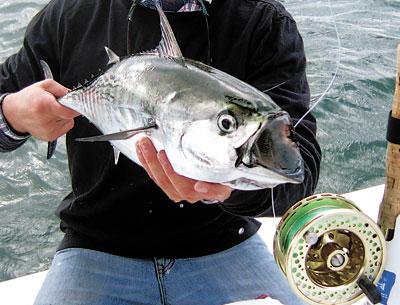
To prove what’s possible around Montauk Point these days, Edward L. Shugrue III visited it with a guide, Ken Rafferty. This false albacore was caught on his fly rod.
Ken Rafferty
This is the time of year when serious surfcasters get serious
By
Russell Drumm

   Word has come that John DeMaio, a veteran Montauk charter fisherman, died on Monday morning in Florida. He had a number of boats during his tenure as one of Montauk’s more successful chartermen. They were all named Vivienne after his wife, who survives. A complete obituary appears elsewhere in these pages.

    This is the time of year when serious surfcasters get serious, and so far Mother Nature has provided fish to get serious about. October 10, 2011, will be remembered as one of the more amazing days for a surfcaster to have been in Montauk. Huge schools of striped bass congregated around Montauk Point. All the signs are there for another bass-filled October within casting range.

    At Montauk Point during the week, schools of bass, with a few bluefish mixed in, swam within range of Turtle Cove, then past the stone revetment in front of the Lighthouse, and on to the North Bar area on either side of the top of the tide. With few birds showing, the arrival of the schools was telegraphed by rods bending in succession along the line of casters that, as usual this time of year, especially on weekends, can be shoulder-to-shoulder,  with an expletive or two thrown in for good measure. 

    Newcomers to the Point’s precarious rock ballet and crossed-lines-untangling tango can get hot under their $1,200 designer wetsuits. Best to relax, not easy when your neighbor’s bucktail takes a wrap on your line and swings like a pendulum, threatening its integrity just as you’re reeling a 20-pounder to within reach.

    And then, when you bring the fish over the rocks with the help of a rush of white water, there’s the challenge of getting it before the next wave breaks on your head, and when it does break on your head, the challenge of holding on to a freshly revived, muscular, 20-pound striped bass that has lost all sense of humor.

    On Sunday, Ken Rafferty, a light-tackle and fly-fishing guide who fishes from Montauk this time of year, visited the Point with a fly-rod-toting Edward L. Shugrue III.

    “We went out from about 1:30 to almost 7 in the evening. There were blitzes everywhere, lots of albies (false albacore), striped bass, and one bluefish. He had a grand slam,” meaning his client’s catch consisted of each of Montauk’s three favorite fall inshore fighting fish. They often show up at the same time, the bluefish attacking a balled-up school of prey, bass swimming below to catch the scraps, and the false albacore swimming circles around the prey as though to corral them before rocketing through the school for a mouthful. It’s an impressive phenomenon, one that often stops fishermen in their tracks. 

    “I’ve had anglers who have fished all over the world, but who have never been here for this. They can’t believe what they’re seeing. They can’t even cast. They just stand there with their mouths open,” Rafferty said.    

    The veteran fly guide said Mr. Shugrue, his client for the day, was an experienced fly fisherman. “He’s one of the longest casters I’ve ever seen in my life.”

    Rafferty was at the helm on Sunday and approached the Point with its phalanx of surfcasters in front of him and a healthy southeast swell behind. “The swells wouldn’t let the boats go too far in. But his casts are so long I was able to get him into some dangerous spots, he’d hook up, and I’d back us out. The first blitz must have been a city block wide. The waves were brown with bass and bait.”

    Big schools of bass continued to circle the Point on Monday. “Crazy good,” was how Harvey Bennett of the Tackle Shop in Amagansett described the fishing. On Monday he took a client out behind Gardiner’s Island aboard his Moon Pie boat.

    “We had 17 false albacore in the evening behind the island. I took a guy who had never hooked up before.” Bennett reported finding big porgies in Gardiner’s Bay and bluefish at Sammy’s Beach beside the Three Mile Harbor inlet and at Accabonac Harbor. He reported big bluefish schooling along Napeague’s ocean beaches.

    The Montauk SurfMasters tournament for striped bass is in full swing. Using a live eel, John Bruno found a 40.3-pound bass on the north side of Montauk Point on Friday to take the lead in the contest’s wetsuit division. Klever Oleas’s 26-pounder has him in first place in the wader division. In the women’s division, Cheryl Lackner and Christine Schnell sit in first and second places with 11.8- and 10.7-pound bass respectively. Dylan Lackner, fishing in the youth division, is at the top of the heap with a 13.5-pound bass.

Nature Notes: Cold-Blooded Crabs

Nature Notes: Cold-Blooded Crabs

Fiddler crabs are cold-blooded. They don’t have to keep their body temperatures up, as long as they don’t let them drop below freezing.
Thomas E. Mahnken Jr.
In nature, October is a busy time
By
Larry Penny

   In less than two months it will be winter. Fall is the season for harvest and storage, in preparation for the cold months ahead. Very few of us maintain root cellars these days; we depend upon supermarkets and mom-and-pops to “store” our vittles. But in nature, October is a busy time. Those creatures that stay on to brave the sleet and snow are in full preparation.

    In my yard the non-migratory bluejays have been hiding acorns here and there for two weeks now. Gray squirrels, which also remain active all winter, are doing the same. How these cachers remember where they put things is beyond me, as I have a very hard time trying to remember where I put away much larger objects, and sometime I forget entirely. I guess if my life depended on it, I would not forget.

    Even the hibernators and semi-hibernators among the local mammals store up food. Chipmunks are notorious for putting away edibles in their hibernaculae, even providing special chambers for foodstuffs. They occasionally wake up during the long winter’s nap and want a bite to eat and don’t want to leave their cozy retreat to look for it.

    White-footed mice act similarly. They are more likely to snooze away in your house or outbuilding, or in a birdhouse or tree nest, than underground. Beavers are vegans, they keep a supply of greens in their lodges. Bats hang around for most of the winter and go hungry.

    But what about the crabs? They don’t migrate. The cold might kill them dead, especially if they freeze. Well, at least, all of our inshore crabs — the blue, the lady, the mud, the fiddler, the marsh, the spider — are in a salt water environment to begin with, and salt water is the last of the bathing liquids to freeze. Crabs are also poikilothermic, that is, cold-blooded. They don’t have to keep their body temperatures up, as long as they don’t let them drop below freezing.

    Fiddlers and marsh crabs that occupy the spartina peats and sandy edges of salt marshes retreat into their peaty holes and go to sleep. The holes in the sand are filled in and will remain that way until the warmth of spring in April wakes their dwellers up and urges them to unseal their winter quarters. At such time, a human observer will notice little mounds of pre-digested dirtballs at the entrance of each round hole.

    Marsh crabs are scarcer and larger. I’ve only seen a few in my lifetime, in the marshes at Scallop Pond in North Sea. However, in the last few years, Nicole Maher of the Nature Conservancy, who is studying the change in elevations of salt marshes here and there on Long Island in relation to rising sea level, has found quite a few of them in the marshes of Accabonac Harbor. They are secretive and not as gregarious as fiddlers and have much larger holes. They utilize the cavernous nature of the peat layer to survive and stay cool in the winter.

    Cancer crabs, the large ocean reddish ones, stay active all winter, as the bottom of the ocean never approaches freezing at this latitude. But the famous blue crab, Callinectes sapidus, which translates appropriately into beautiful-swimming-savory crab, and its cousin, the lady crab, also a swimmer, and an infamous biter of clamming toes, become dormant, digging into the sands and silty bottom sediments the way diamond-back terrapins and eels do, very often in the very same neighborhoods.

    Crab biologists in the Chesapeake Bay, which produces 50 percent of the annual blue-claw crab landings, have been pulling dredges through these sediments systematically during the winter since the early 1990s. They have discovered that it is a good method for gauging the crab population-to-be, come spring. 

    Female blue crabs, the ones with the wide “telson” on the underside of the shell, are the last to go under as they first have to attend to reproduction, some of the steps of which also resemble that in turtles. The males copulate with the females (at such time crabbers that catch them call them “doubles,” the males on top, females on the bottom), but the sperm is kept in storage until November, by which time the females have moved to saltier water, closer to the mouth of the estuary. They can store viable sperm for up to a year, in the way that many females turtles can. The fertilized eggs hatch into swimming larvae which occupy the water column. The females are free to dig under to spend the winter in a quiescent state.

    What about spider crabs? They move into deeper water and like to feed on bay scallops. Better catch those remaining male blue-claws while the crabbing’s good and they’re still above the bottom, not into it.

Revenge of the Fish

Revenge of the Fish

Malcolm Frazier, a sculptor, completed this bronze boat and fisherman 13 years ago to memorialize local fishermen lost at sea. Its pedestal is engraved with over 100 names. The sculpture, erected seaward of the Montauk Point Lighthouse in October of 1999, got a thorough cleaning last week.
Russell Drumm
What goes around, comes around
By
Russell Drumm

   Do you believe in fish revenge? Whales are not fish, of course, but Moby Dick is perhaps the best example of how, at sea, what goes around, comes around. If, like Ahab, you toy with fish to find meaning in life without the proper respect for the deep and its critters, you too will get yours.

    A Moby Dick-like finale played out in front of dozens of surfcasters at Turtle Cove just west of the Montauk Point Lighthouse last Thursday.

    October is when the “mosquito fleet” — the name given the flotilla of small, outboard-powered platforms favored by those casting light spin-tackle and fly rods — swarm the waters around Montauk Point. In good years like this one, the shallow sea teems with striped bass, false albacore, and bluefish, all feeding aggressively on any number of prey species. Their appetite blinds them to everything but their prey.

    Schools become tight, frothing boils, mindless feeding frenzies. The frenzies in turn morph even the humblest fishermen into apex predators, blind to all but their prey, becoming massed armies of surfcasters, navies of fly casters, lures flying in all directions in place of teeth.

    And so it was last Thursday afternoon when a boater in the delirious throes of catching a false albacore ran into and capsized a kayaker who was also fighting a falsie. Chris McCarthy, one of the surfcasters looking on from shore, said neither man dropped their fish. They continued their separate frenzies, one wet, one dry.

    Of course, the scene was a lot more humorous than the sight of Ahab disappearing beneath the waves, pinned to the white whale by his own harpoon warp, but it was not funny to the United States Coast Guard. A Coast Guard small boat responded to the incident and brought the boater back to the Montauk station for questioning and a lecture on the dangers of placing the pursuit of fish above good seamanship. Fortunately, no one was injured.

    Boats from the mosquito fleet always seem to get in trouble this time of year, usually when the helmsman drives too close to shore in pursuit of fish without bothering to glance over his or her shoulder to check for waves. In the days that followed last Thursday’s revenge of the false albacore, the Coast Guard has patrolled the pack.

    Protecting people from themselves becomes even more difficult when, as in one episode a little over a week ago also at the Point, a wetsuited surfcaster swam offshore in search of a rock to stand on while bucktail hooks cast into a stiff crosswind by a dozen or more surfcasters splashed all around him.

    All of this is because the waters around Montauk Point have been awash in fish for the past few weeks. This week’s colder weather should get the bass moving west and south on their fall migration.

    As of Tuesday, Gary Krist had climbed into first place in the wader division of the Montauk SurfMasters tournament with a 29.15-pound bass. Klever Olea and Atilla Ozturk have second and third places with 26 and 20.6-pound bass respectively. John Bruno holds onto first place in the wetsuit division with a 40.3-pounder.

    Christine Schnell’s 18-pound striper has bested Mary Ellen Kane’s 14, and Cheryl Lackner’s 11.8-pound fish in the women’s division. The top youth competitors are James Kimm and Dylan Lackner, both with bass weighing 13.5 pounds. Phillip Schnell’s 13-pounder puts him in third place. Witt Holmes and Brian Damm sit in first and second places with 13.8 and 10.2-pound fish.

    In the Star Island Yacht Club’s striped bass and bluefish competition over the weekend, the heaviest bass caught by a private boat was a 40.8-pounder found by the Lori Marie, Capt. Keith Salisbury doubling as both helmsman and angler. Among competing charter boats, Jim Weiderman angling from Capt. Barry Kohlus’s Venture reeled up a 34.1-pound bass to capture first place.

    Harvey Bennett of the Tackle Shop in Amagansett reminds us there are still big porgies swimming in Gardiner’s and Fort Pond Bays.

    He reports “tons, bucketfuls of bottlefish,” that is, a great deal of blowfish, around the old Navy dock, also known as the Hangar Dock in Fort Pond Bay. The blowtoads, as they are known in Bonac, can be caught on porgy or flounder rigs. And, he reminds light-tackle and fly-fishing casters that Montauk Point is not the only place to find schooling false albacore. They can be found in Gardiner’s Bay as well.

    For hunters in the crowd, a reminder that woodcock season opened on Oct. 1, as did the bow season for deer in Suffolk County. The special shotgun season will run through January, weekdays only as usual. Just in time for Thanksgiving, the hunting season for wild turkeys in these parts will run from Nov. 17 through 21. The bag limit is one bird of either sex per day. Small upland game, squirrels and rabbits, can be hunted from Nov. 1 through Feb. 28.

The Stripers Are Back

The Stripers Are Back

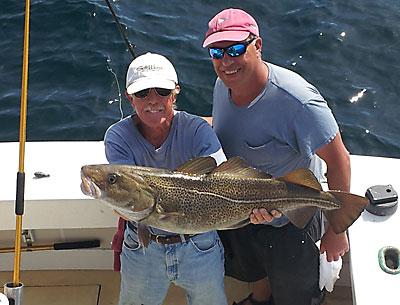
Butch Maher, left, first mate on the charter boat Blue Fin IV, showed off the 25-pound cod caught by the angler Robert Macbarb of East Hampton on Sunday.
Capt. Michael Potts
“The fish have moved back to Montauk”
By
Russell Drumm

    In the words of Chris Miller of the West Lake Marina, “the fish have moved back to Montauk.” Miller was speaking of striped bass, big ones. There was a 50-pounder brought to the scales and a number of stripers in the 30 to 40-pound range.

    After last fall’s shortage of large fish, organizers of the annual Montauk SurfMasters Fall Classic hope the bass stick around for a while.

    Because the striped bass migration looks to have begun early, the tournament will begin and end one week sooner than last year. The hard-fought contest to see who can catch the biggest striper (and bluefish for young entrants) will start at 12:01 p.m. on Sept. 15, and will come to a close at noon on Nov. 25.

    The deadline for applications is 10 a.m. on the 15th. Applications can be downloaded from montauksurfcasters. com and are also available at Gaviola’s Market, Star Island Yacht Club, and West Lake Marina. The entry fee is $260 for the adult men’s wader and wetsuit divisions. The women’s fee is $160. There is no entry fee for the kids and youths divisions.

    As usual, there will be two main categories, wetsuit and wader. No boats, prams, rafts, balloons (they can carry a line far offshore on the right wind), kites (the same), flippers, poling, swimming, drifting, floating, or trolling to access any rocks, sandbars, reefs, or rips. The following rocks are off limits, Weakfish Rocks, Jones Rock, Bluff Rock, Bragan’s Rock, Northbar sandbar, and Whistle Rock.

    “The beach came alive this week. Bass over 30 pounds in town last night on bunker chunks,” said Scott Leonard of the Star Island Yacht Club (a SurfMasters tournament weigh station along with the West Lake Marina). By “town,” Leonard  was referring to the south-facing beaches in downtown Montauk.

    He reported bluefish “up front” at the Montauk Point Lighthouse, as well as a superior fluke-fishing trip Saturday on which three compadres caught 13 keeper fluke, the smallest weighing six pounds. With a bag limit of four 19.5-pound fluke per person, per day, it goes without saying that one of the fluke had to be returned to the briny.

    Paulie’s Tackle shop in Montauk reported bass at Camp Hero State Park over the weekend, and a bunch of small weakfish on the ocean side of Napeague. Sand worms and clams lured the weaks.

    West Lake Marina reported a 42-pound bass caught at the spot known as the Elbow on an eel early Monday morning. Frank Dalli was the angler on the Carla Maria boat. 

    Michael Potts, captain of the Blue Fin IV charter boat, has been doing some very productive summertime cod fishing. Potts reported catching between 50 and 60 cod in the 5 to 15-pound range with regularity. He also predicted the big ocean swells generated by Tropical Storm Leslie far out in the Atlantic will “screw me up big time.” The seas are sure to keep most boats at bay.

    “I had a charter that wanted to try for cod the second week of August. I started southeast of Block Island and worked down and caught at several spots near Coxes Ledge.” Potts reported that Bob MacBarb of East Hampton wrestled a 25-pound cod off the bottom, and Jon Diat of Sag Harbor caught a 15-pound pollack on a diamond jig. “Excellent cod fishing,” Potts declared.

    A friend was remarking on the steely beauty of Fort Pond Bay just after dusk on blue-moon Friday. He said it reminded him of how the water looked in the opening sequence of “Jaws,” when the girl flung off her clothes and swam out to the buoy.

    A 1,600-pound great white shark washed up dead at South Shore Beach in Westport, Mass., over the weekend. The same day, authorities closed the beach at Nauset Beach in Cape Cod after several great whites were spotted close to shore.

    A rumor has been floating around that a gill netter who set off Napeague in recent weeks hauled his gear after a two-hour set and found four species of shark, a thresher, brown, sandbar, and the scariest, a 300-pound tiger. Efforts to confirm the rumor have been unavailing, but geeeez!


Nature Notes: What a Difference

Nature Notes: What a Difference

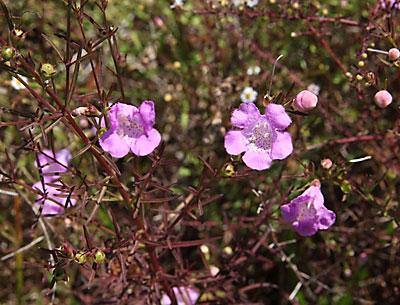
In late summer Montauk grasslands were once pink with a thick covering of sandplain gerardia blooms. Now the plant is federally endangered.
Vicki Bustamante
Montauk had just about every kind of habitat found elsewhere on Long Island with the exception of pine barrens
By
Larry Penny

   Norman Taylor was a well-traveled botanist and the curator of the Brooklyn Botanic Garden. In 1923 he published a monograph on the flora of Montauk, subtitled “A Study of Grassland and Forest.” He probably picked Montauk because it was largely undeveloped and had the second largest prairie on Long Island, and it was topographically varied and bathed with seawater on three sides. Montauk had just about every kind of habitat found elsewhere on Long Island with the exception of pine barrens. It had stuff along the ocean that the rest of Long Island’s oceanfront expanse lacked, namely, tall bluffs, stuffed with clays and glacial erratics.

    Behind the bluffs was a dwarf forest, a heath land, not unlike those for which Ireland and the British Isles are known. Many of the area’s early European inhabitants, who came from heath lands in the Old World, identified these spots as moors.

    In Taylor’s time Lake Montauk was still the largest freshwater pond on Long Island. It sat between extensive “downs” to the east and west. Hither Woods was just recovering from almost 200 years of woodcutting and grazing, and was still dotted with grasslands. The only mature forest, per se, was the Point Woods, which covered most of the south half of Montauk west of the Lighthouse.

    Because the glacier and its aftermath had deposited so much clay over the land, the soils were impervious. Water from rains mostly ran off in ditches towards the ocean, Lake Montauk, Oyster Pond, Big Reed Pond, and Fresh Pond, thus the name “Ditch Plain.” Much of the precipitation was trapped in depressions, kettle holes and such, creating numerous little ponds, swales, and flattish meandering wetlands.

    Russell Stein, a former resident of Montauk and ex-East Hampton Town attorney, aptly called Montauk a “Swiss cheese,” owing to its perforated land surface. Geologists called it “knob and kettle” topography.

    Not counting algae, liverworts, mosses, mushrooms, and the like, Taylor recorded over 400 different plant species, many of which were pressed and deposited at his botanic garden and are still housed there today. Vicki Bustamante and I are tracing his steps to see how the flora has changed since his time.

    Except for First, Second, and Third Houses and an inn near the Lighthouse, the only other structures of note were the Life-Saving Station at Ditch Plain and the four sisters designed by Stanford White on the bluffs to the east of the station. Taylor could stand on the top of Fort Hill northeast of Fort Pond and see clearly all the way to the Lighthouse. There was nothing but grasslands to block his view. He remarked how in late summer these grasslands were pink with a thick covering of sandplain gerardia blooms.

    Ironically, a little more than 70 years after his study was published, less than 100 of the plants were left, and a species once plentiful had been reduced to such a low number that it became the second New York State plant species to be declared federally endangered.

    The grasslands — what’s left of them — are also still home to several plants now considered almost as rare by the New York State Heritage office in Albany. These include the bushy frostweed, which can be found on the Nature Conservancy’s “Montauk Mountain” west of Fort Pond, and the New England Blazing Star, which graces Shadmoor Park. Taylor also found the “cloudberry,” a rare species of blackberry that is alpine in habit. It hasn’t been recorded since, but we are hopeful that a few will turn up. The closest living ones to Montauk are high up on Mount Washington in New Hampshire and other northern New England and Canadian peaks.

    Montauk is also orchid-rich. It has at least seven different species and several species of native lilies, including the trout lily, Turk’s Cap lily, wood lily, and Canada lily, but you have to do a lot of scratching here and there before you’re able to find one.

    Montauk is probably the richest area in the country with respect to shad coverage. It has four different species, the common one with multiple stems, Amelanchier canadensis, the smooth shad, Amelanchier laevis, the intermediate in height shad, Amelanchier intermedia, and, lastly, the diminutive Nantucket shad, Amelanchier nantucketensis. The next nearest spot for them is Nantucket Island, where they were first discovered.

    Over the last half-century or so some southern species have taken up residence in Montauk. These include the southern red oak and the Hercules’ Club, a scruffy tree with pretty white flowers and numerous thorns to keep the deer away from the flowers and leaves.

    The oak and American holly association is very rare on Long Island and much like some oak-holly communities along the Jersey shore. Montauk is fern-rich, too, especially in the wetlands and water edges associated with Big Reed Pond in the county park. There are at least 10 different fern species in Montauk, including the rare Massachusetts fern and Interrupted fern.

    The Walking Dunes west of Hither Hills are a miracle in themselves, with two species of orchids and a host of bog plants dominated by cranberries.

    Parts of the dunes resemble the sunken forest of Fire Island, as the sand is continually moving to the south-southeast and the pitch pines and other trees and shrubs in its path are being slowly buried. One of the rarest orchids in the western hemisphere is a mere stone’s throw away from these dunes.

    Since Lake Montauk was opened to Block Island Sound during the occupancy of Carl Fisher in the 1920s, Fort Pond has taken its place on the Long Island leader board of freshwater ponds. It is second in size behind Lake Ronkonkoma. With sea level rise, it is steadily creeping up. It has a little island in its northeast area, once called Brush Island because it was covered with woody plants. It now is largely underwater and all of the woody plants are dead. The only American basswood tree that Taylor was able to locate in Montauk happened to be on this island, along with some other broadleaved tree species.

    Taylor’s list includes less than 10 species that are foreign or exotic, perhaps even invasive. Only a few of each, however, were found, including barnyard grass, trees-of-heaven, yarrow, bindweed, Kentucky bluegrass, chickweed, and a few others. No Asiatic bittersweet, Japanese knotweed, mugwort, dandelion, Tartarian honeysuckle, mile-a-minute weed, lamb’s ear, Japanese black pine, Eurasian phragmites, Japanese honeysuckle, and the like.

    Vicky and I have been keeping track of the invasives as we go along. So far there are at least 50 on the list, and some, like the phragmites, have taken over whole plant communities. On Sunday Vicki reported that she had found black swallow-wort at Shadmoor, a new one for Montauk and one that can take over the world if left to play.

    If Norman Taylor were with us today, he might not believe what he experienced. If he were alive and botanizing Montauk in July or August of 2012, he might have tossed it in. If you’re a naturalist, it’s better to be early than late.

Fall Tournaments Abound

Fall Tournaments Abound

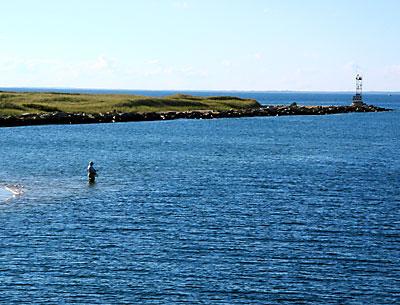
A lone surfcaster worked the channel to New Harbor on Block Island on Sunday.
Russell Drumm
Locals getting down to the pleasures of early fall
By
Russell Drumm

   Sighs, and other expostulations of relief from the summer hordes, are being heard on either side of Block Island Sound, and from locals getting down to the pleasures of early fall, including the annual spate of fishing tournaments.

    The last glacier dumped the same rock skeletons that form the rolling hills, ponds, and kettleholes of Block Island as it did to make Montauk. They say we were connected way back when. Over the weekend strong ocean swells generated by Tropical Storm Leslie coursed between here and there, with striped bass and bluefish schooling in the shallows to feed on all manner of small prey.

    Light-tackle casters took up positions along the channel into Block Island’s New Harbor, or paddled their fishing kayaks just outside the harbor mouth, where feeding blues were boiling on Sunday afternoon. Fourteen miles to the west, casters were finding bass up to 35 pounds under the Montauk Point Lighthouse, with steady action during the night beginning a week ago. 

    Atilla Ozturk reported seeing terns and gulls hovering over the shorebreak all along Napeague on Monday morning, a sure sign that the small fish hunted by striped bass and bluefish are in the wash, and a good sign for those entering the annual Montauk SurfMasters fall classic surfcasting tournament.

    The tournament will begin at noon on Saturday. The deadline for submitting applications to the West Lake Marina or the Star Island Yacht Club is 10 a.m. that same day. 

    Speaking of Star Island, Scott Leo­nard, the go-to guy for fishing tackle, won the striped bass part of a multi-species tournament held from the yacht club on Friday and Saturday. The winning bass was a 47-pounder reeled up on Friday from the Top Gun boat, which also caught the second and third place stripers, 43.5 and 42.2 pounds. Leonard said Top Gun was fishing at the Great Eastern spot and in the Pollock rip using live eels and croakers.

    Star Island also weighed in over 30 bigeye tuna in the 150 to 218-pound range. The first and second-place fish in the bigeye tuna competition were a 219-pounder caught on the Fish’n Addiction and a 197-pound bigeye from the Bolshevik boat. The White Water boat brought back a bigeye weighing 186 pounds for third place.

    The boat Tonto won the yellowfin tuna contest with a 66-pounder. The Done Deal boated 65 and 64-pound yellows for second and third places. The first and only finisher in the shark division was a 176-pound mako caught from the Deeper boat. The tuna were caught in Hudson Canyon far to the west, a long haul unless you own a boat capable of speeds over 60 m.p.h.

    The yacht club had a separate bluefish division. Instigator took first and second places with 12.8 and 11.8-pound blues. Lil Marlena took third place with a bluefish weighing 9.8 pounds.

    Not to be outdone, the Harbor Marina on Three Mile Harbor held its 14th annual snapper derby on Sunday. In the 3-to-8-year-old competition, James Bradley, 6, took it all with a 4.1-ounce baby blue. Sarah Marie Dern, 12, took top honors in the 9-to-12 division. Her snapper weighed 4.9 ounces, and Khloe Goncalves, 14, caught a 7.3-pound snapper bluefish to win against all comers in the 13-and-over division. Contestants got to make fishprints out of their catches if they chose to get inky. 

    Coming up is the 11th annual Montauk Redbone Celebrity Tournament, Sept. 19-21 from the Montauk Yacht Club. This is a benefit tournament to raise money toward a cure for cystic fibrosis. The tournament targets striped bass, bluefish, and false albacore using light tackle and fly rods. Contestants look for the three-species “blitzes” that occur this time of year.  

    Ken Rafferty, light-tackle and fly-fishing guide, reported bluefish finning “like sharks” off Gardiner’s Island near Eastern Plains Point. He brought Stephen Talkhouse employees out on Friday to catch the blues. Rafferty said he would bring his bigger boat to Montauk for the fall run of false albacore.

    And, if the usual humdrum kinds of fishing no longer excite, you might take a look at George Lombardi’s YouTube video called “Stalking the Man in the Gray Suit,” shot while he was fishing from his kayak off the ocean side of Napeague. “The Man in the Gray Suit” is the Australian way of saying, “Shark!”

Nature Notes: Natives Are Winning

Nature Notes: Natives Are Winning

During the 12-plus years of grow-back at Sammy’s Beach, very few alien plants have managed to find a niche, and the replanted area is practically free of invasives.
Vicki Bustamante
Sammy’s Beach was named in the East Hampton Town Code as one of the four original “nature preserves”
By
Larry Penny

   In 1999, an area two times the size of a football field was dug out of Sammy’s Beach in East Hampton to accommodate dredge spoil from the Three Mile Harbor inlet and channel. The hole was big enough to accommodate nearly 100,000 cubic yards, but the dredge job produced less than a fifth of that.

    Four years earlier, Sammy’s Beach was named in the East Hampton Town Code as one of the four original “nature preserves.” The construction of the dredge spoil pit scarred the nature preserve badly and half of the town’s populace, including residents from nearby communities, was up in arms about it. It may have cost the Democrats the 1999 election, as the late Cathy Lester was voted out and Jay Schneiderman of the opposition party became the new town supervisor in January of 2000.

    Ms. Lester set up a working committee to try to right the situation before her departure and the town received a grant of $137,000 from New York State to help with Sammy’s restoration. The committee formulated a plan with three main objectives in mind. The first was to return the beach and dunes to the original topography. Suffolk County, which was responsible for the dredging, paid for that heavy equipment work, which came to about $200,000, and was completed by the end of the year. Ironically, the contractor that was paid to dig the hole, was later paid to fill it in and return Sammy’s Beach to its original topography.

    Secondly, an unpaved marl road for four-wheel-drive vehicles would be constructed down the center of the site from the terminus of Sammy’s Beach Road to the west jetty of Three Mile Harbor’s newly dredged inlet. Such a road was constructed and then bordered on each side from one end to the other with a split-rail fence.

    The last phase of the reconstruction was the most difficult and, from an engineer’s point-of-view, the most speculative. The entire disturbed, re-contoured area would be revegetated with native beach and dune vegetation in such a way as to create the original look and feel of the nature preserve before desecration. The state grant would cover most of the expense. It was also decided that the native vegetation used would be gleaned from similar habitats, including what was left of Sammy’s Beach, so that the species would be as similar to East Hampton in genotype as possible.

    The bulk of the replacement vegetation was to be American beach grass, which was plentiful and which would keep the replenished dune sands from blowing into Three Mile Harbor during the winter. In the summer of 1999 East Hampton Town staff collected some 20,000 beach grass plants from different parts of the town and carted them over to Talmage Farms in north Riverhead, where Ellen Talmage and her workers planted them in a farm field prior to the fall so that they would start actively growing in their new and temporary habitat.

    Town staff studied the Sammy’s Beach flora remaining on undisturbed parts using transect analysis and other means. A list of more than 50 native Sammy’s Beach plants was generated. Meanwhile, a local gardening firm, Botanic East, run by Ron Jawin, submitted the lowest quote for raising some of these plants, such as prickly pear cactus, bayberry, Virginia rose, and the like, after gleaning them from their natural town habitats. In a 1999 floristic study there were a few southern native species of interest found. One was a blue-green beach grass, marram grass, a species in its first stage of Long Island colonization. I had first discovered this grass growing in Mattituck in sands edging Long Island Sound in 1991.

    In the spring of 1990, Ms. Talmage was successful in growing about 120,000 beach grass plants from the East Hampton originals at a total cost to the town of about $22,000. Warren’s Nursery of Water Mill submitted the lowest bid, and the entire disturbed area, save for the road, was planted in May and June of 2000 with the Talmage-grown plants and then some. At first the planted area looked like rows of corn, but as the plants spread by the sprouting of underground rhizomes, the empty spaces filled in nicely.

    A little later, Ron Jawin and workers from Botanic East planted the plants that they had raised in several circles scattered throughout out the recovery plot. It was a dryish summer. The Botanic East plants were watered regularly but, nonetheless, didn’t do so well. On the other hand, the beach grass grew like gangbusters. All the while diamondback terrapins used the spot for laying eggs, while piping plovers and least terns raised several young to fledging. But even in the fall of that year, the planting resembled a big unmowed lawn, nothing like it was prior to the hole being dug.

    Year after year, Sammy’s Beach came back by degrees. The hews and cries died away. Residents of the Sammy’s Beach community and those from nearby took it upon themselves to police and clean up the area. The road to the jetty proved so successful that the old trail that ran through the wetlands edging Three Mile Harbor was cut off without serious repercussions. I and others would visit each year to check the recovery process; it was slow but progressive.

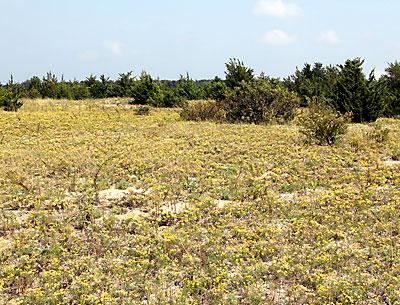
    After an absence of a couple of years I returned only last Friday as a retired citizen with a companion to monitor the situation. I was frankly amazed at how successful the recovery had been. All of the plants were in bloom or fruiting. The prickly pears were thick with fruit, figidini in Italian, the flowers of the falcate-leaved golden asters were peaking and produced a broad yellow haze that blended nicely with the blues of the marram grass. What was even more amazing is that during the 12-plus years of grow-back very few alien plants had managed to find a niche, the replanted area was practically free of invasives.

    American beach grass adores shifting sands, the marram grass prefers more stabilized situations. In the interim, although not intentionally planted, it now had become the common grass, but it worked as well as the former. Eastern red cedars had sprouted up here and there, at the very eastern end which had not been disturbed, the leaves of a low-slung bigtooth aspen, a long-lived survivor of many a storm, trembled and murmured in the southerly breeze.

    We took the southern route back. The old track had completely filled in with high marsh species, sea lavender, pickleweed, sea blite, marsh elder, saltmarsh aster and the like, a few of which are considered New York State rarities. The road since closing had filled in by itself, observing Karen Blumer’s rule, don’t plant it if it is disturbed, let it grow back on its own and the natives will win out.

Nature Notes: Birds of a Feather

Nature Notes: Birds of a Feather

Most of the birds are out foraging for insects, fruit, seeds, and the like away from residential areas
By
Larry Penny

   People have been asking, “Where have the birds gone?” There are very few birds in my own backyard here in Noyac, An occasional blue jay, robin, Carolina wren, but no steady comers with the exception of crows, which visit regularly beginning at dawn.

    On the other hand, Terry Sullivan, who lives near the water’s edge in Sag Harbor, has no shortage of feathered friends. More often than not his birdbath is filled to capacity.

    Most of the birds are out foraging for insects, fruit, seeds, and the like away from residential areas. That old adage “birds of a feather, flock together” is particularly applicable at this time of year. When songbirds migrate, they fly together, before they migrate, they gather together, feed together, and molt together. Those marvelous spring feathers that are not only perfectly hewn, but also gaudily colorful, are great for courting and defending territories, but by the time August rolls around, tend to be worn out.

    Many of the most brightly colored ones, notably the males of the species, trade in those advertising feathers, for ones that will not only get them to points south, but when there, will make them harder to see among the greens that predominate on their wintering grounds. Thus the bright reds of the male scarlet tanagers and the brilliant oranges of the male Baltimore orioles are traded in for greens and yellows, cryptic colors which will hide them as they forage among the tropical vegetation until spring sends them north.

    Competitive singing mostly has to do with inviting females and maintaining territories in the spring and early summer. Competition ends in August and song gives way to species-specific call notes that are used to keep members of a certain feather together. They are particularly useful come the Christmas count season in December. Birders with good ears don’t have to see the utterer to identify a given species; the call notes are as telltale as the bird’s size, coloration, and form. Indeed, with the advance of high tech gizmos and applications, many Christmas counters now play a given call from their smartphones, evoking a return call from a real bird.

    In late August and September we play host to four kinds of birds, according to their habits. There are those such as the mockingbirds, blue jays, cardinals, house sparrows, starlings, Carolina wrens, and house finches that overwinter here. They look the same in the winter as they do in the spring. A few, such as the mockingbird and Carolina wren, maintain winter territories and defend them with song. Then there are the migrators, ones that leave Long Island for the south and others from farther north that stop over to rest and feed before traveling on.

    Oddly, perhaps, there is a small group of wrong-way birds, southern terns and such, that reach Long Island from the south as they wander north looking for food or, maybe, just checking things out. Some of these are considered “overshoots” or “accidentals” — they’ve gone too far. Others come from the west, such as the western kingbird and the dickcissel.

    Then there are a large number of northern species including songbirds, waterfowl, seabirds, and raptors that annually overwinter here. Among them are three species of scoters, or sea ducks, the evening grosbeak, pine siskin, winter wren, Ipswich sparrow, rough-legged hawk, goshawk, and purple sandpiper, to name a few. There are one or more species for each available habitat — forest, grassland, freshwater, seawater, dunes, beaches, and shores.

    I should add that there is a fifth category of species, some of the members of which refuse to migrate south with their brethren and stay the winter here. Among them are the Canada Goose, robin, towhee, and bluebird. If they make it through the winter, they have an advantage come spring. They don’t have to fight man and the elements to make it back here to carve out territories and begin the nesting season — they’re already here.

    Among these stay-behinds and winter loiterers are birds, such as eagles, that used to breed here but no longer do. The hope is that they will stick around for the four or five years it takes to reach maturity and settle down here in one of our many open spaces. Such has already occurred during this millennium, at least a couple of times. Turkey vultures have started breeding in Montauk, and the American raven as of late now breeds in Hampton Bays.

RESCUES: A Parley Yet to Be Held

RESCUES: A Parley Yet to Be Held

“If you put up chairs and umbrellas on the beach, you can’t keep people out of the water even if there are signs that prohibit swimming”
By
Jack Graves

   John Ryan Sr. had, when the summer began, wanted very much for the East Hampton Volunteer Ocean Rescue Squad to come to a meeting of the minds with the resorts along the Napeague strip, which are not required by the Suffolk County Health Department to post lifeguards if they prohibit ocean swimming.

    Soon after a spectacular save in front of the Driftwood ocean resort just west of Hither Hills State Park in June, a save owing to the quick and effective initial response by a cabana boy, J.C. Barrientos, Ryan said Barrientos, who was not a certified lifeguard at the time, should not have been put in that position.

    He added that while he didn’t want to adopt an adversarial stance, he was hopeful that the resorts and homeowners associations along the strip between Amagansett and Montauk could be persuaded to amplify measures that would further ensure the safety of workers and swimmers. “If you put up chairs and umbrellas on the beach, you can’t keep people out of the water even if there are signs that prohibit swimming,” Ryan said at the time.

    “There’s still a risk — I’m disappointed the ocean rescue squad hasn’t done anything,” he said when questioned briefly following the East Hampton Volunteer Ocean Rescue Squad’s Gardiner’s Bay swims Saturday morning.

    In a separate conversation, Ryan’s son, John Jr., who heads the lifeguards here, said he too regretted that there hadn’t been a parley with the ocean resort owners to date. “The summer’s just flown by.”

    On the subject of saves, he said 30 or 40 swimmers had been pulled out of rip tides at Amagansett’s protected Atlantic Avenue Beach last week, and that on Aug. 4, also at Atlantic, the crew overseen by Ed Reid had saved the life of an elderly, semiconscious male. Cardiopulmonary resuscitation had been used, and, ultimately, a shock to the heart was applied with success in an ambulance on the way to Southampton Hospital.

Loads ’o’ Falsies, Weakfish

Loads ’o’ Falsies, Weakfish

Michael Salzhauer presented the false albacore he caught on a fly near Little Gull Island on Monday.
Capt. Ken Rafferty
Capt. Ken Rafferty reported that his first albie catch of the season occurred on Monday
By
Russell Drumm

   This can be an eerie time of year. Despite the 80-degree ocean temperature, or maybe because of it, we feel fall just under the horizon. One contributor to the pre-fall feeling is the false albacore, or little tunny. Each year schools of falsies arrive like clockwork, drawing light-tackle anglers to the East End.

    Capt. Ken Rafferty, who runs a light-tackle and fly-fishing guide service out of Three Mile Harbor and, come fall, Montauk, reported that his first albie catch of the season occurred on Monday.

    “There we were,” he began in typical Rafferty style. “East of Little Gull Island. We saw them last week, but by the time we rigged up, they were gone. This time we saw two schools. I had two rods rigged up. We saw them busting, so Michael Salzhauer began working the rod with a little white fly. You have to retrieve them fast. Albies’ eyes are so sharp, you have to suggest bait running. They go after it and can’t help themselves.”

    Rafferty also reported that after a hiatus caused by overly warm water, striped bass had returned to Gardiner’s Bay. “And, bluefish are really big. They don’t show. No birds diving. You can see them finning at slack tide.” Rafferty reported schools of smaller bluefish in the four-to-five-pound range farther east near Water Fence and Fort Pond Bay, Montauk.

    To the west, Ken Morse at the Tight Lines shop in Sag Harbor reported “loads of weakfish. The best run in years. There are a lot of small ones, but with a bag limit of just one, there are plenty over 16 inches,” the minimum legal size. These days Sag Harbor is also blessed with the presence of a vast number of blowfish. “I had one customer who caught 14. There are a lot of kingfish,” he said, referring to a species that looks like a Spanish mackerel. Morse said the harbor had a glut of porgies “and the snappers [baby bluefish] are incredible.”

    The Tight Lines shop will be closed Mondays and Tuesdays after Labor Day.

    Paulie’s Tackle in Montauk reports that surfcasters working the waters around the Montauk Point Lighthouse are finding small bluefish. The south-facing beaches are producing striped bass on occasion for those casting needlefish or darter lures. Bait fishermen are finding blood and sand worms to be productive on Montauk’s north side. The surprising porgy action that surfcasters have been enjoying from south-facing beaches has slowed, probably because of the recent east winds.

    Although the fluke fishing has slowed, it ain’t over. Kathy Vegessi of the Lazy Bones party boat reported that, on one trip a week ago, three anglers caught fluke in the “double digits” — 12.1, 11, and 10-pound doormats. The fluke-fishing season ends at the end of September for sportfishermen. Vegessi also reported sea bass, big porgies, and “beautiful” weakfish caught from the Bones.

    Speaking of black sea bass, the Star Island Yacht Club reports that Robert DeLuca, fishing from the Yolo, caught a huge 7.5-pound sea bass on Sunday. Star Island also reported that Dr. Steve Sachs returned from the Fish Tales section of Block Canyon with a 212-pound bigeye tuna over the weekend, and Jerry Passaretti found yellowfin in the 40-to-60-pound range.

    Chris Miller at the West Lake Marina confirmed the action in the Fish Tales. He said Greg Zwirko on the Kennebunk returned with a 53.3-pound yellowfin tuna caught there by an angler, Cathy Teller. The Kennebunk crew also caught 18 mahimahi and 6 triggerfish while fishing close to a pot buoy. A swordfish in the 100-pound class also swam by the boat, not realizing it had been hooked. It soon found out and put up a fight before shaking the hook.