Search “oldest active ocean lifeguard in the United States” and Dick Monahan’s name won’t come up. While the 84-year-old Montauker can, in fact, claim that distinction, he is happy that Guinness World Records instead bestows the honor on Ed Kiziukiewicz, 83, of New Jersey, a lifeguard since 1962.
“I would not want anybody to challenge him,” said Mr. Monahan, noting that Mr. Kiziukiewicz boasts more than six decades of continuous service, whereas he only earned his ocean certification at the age of 61. Plus, he said, “I don’t like the spotlight.”
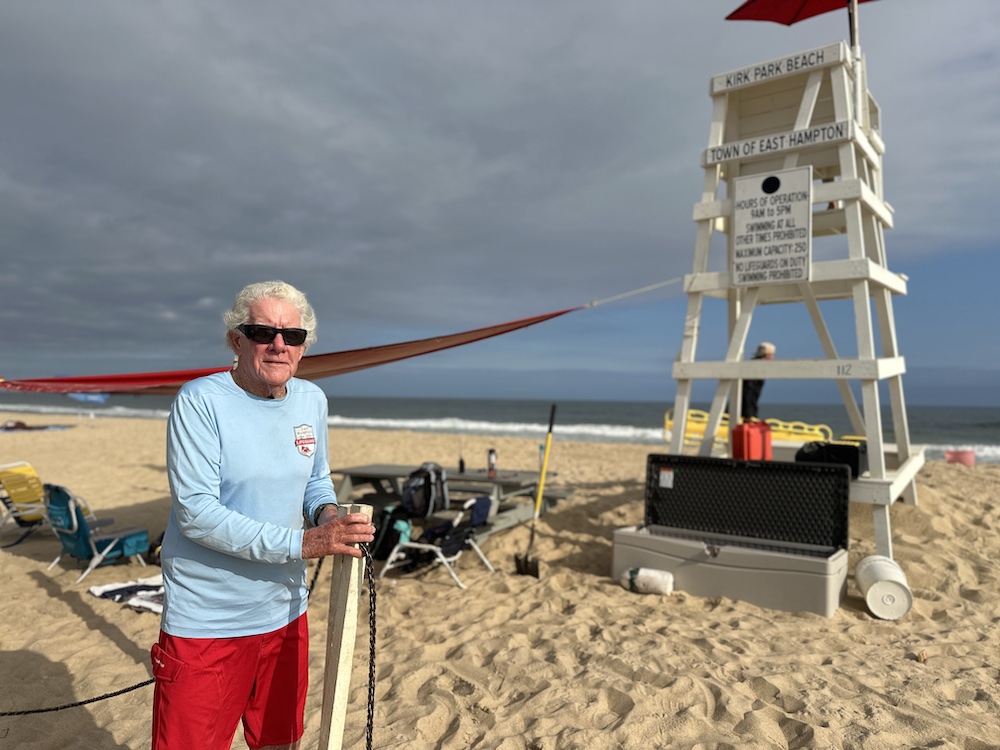
Mr. Monahan, who works at Kirk Park in Montauk, will retire from ocean lifeguarding at the end of this month, having decided not to take the recertification test this year. “I’m slowing down,” he said after deftly climbing down from the stand last Thursday. “I’m okay with that. You know, you run a four-minute mile when you’re 20 years old, but when you come to 80 a four-minute mile becomes 40 minutes. I’ve always said, ‘The older I get, the faster I was.’ It’s always been my motto. And it’s showing.”
Lifeguards work each stand in teams. The ones sitting on the stand are usually first to spot someone in trouble and alert the guards on the ground. Now, when a swimmer needs assistance, rather than diving in himself, Mr. Mohanan takes over on the stand. “I feel more productive if I let the younger kid who can run faster than me get down there. . . . It’s all part of why I’m willing to retire. . . . I had my turn.”
In addition to serving as a town lifeguard for over two decades, Mr. Monahan was integral to the founding of East Hampton’s Y.M.C.A. Hurricanes swim team, was a founding member of East Hampton Volunteer Ocean Rescue, and has been a longtime junior lifeguard instructor.
“It’s funny, as a junior lifeguard instructor, I’ve had kids come through the program who are now parents and have kids in a program,” he said. “It’s all about trying to drown-proof the community,” he added, speaking also of the new Beach Guardians water safety program for adults.
A Montauk emergency medical technician for 26 years, he has answered more than 3,000 calls and can also be credited with expanding Montauk’s round-the-clock paid paramedic coverage from summer only to year round, an issue that spurred him to run for (and win) a seat on Montauk’s board of fire commissioners in 2014. He also served on the board of the Y.M.C.A. and the Montauk Playhouse Community Center.
He has mentored hundreds, possibly thousands, of young people who have come up through the town lifeguarding ranks. “Without exception, the kids are great,” he said.
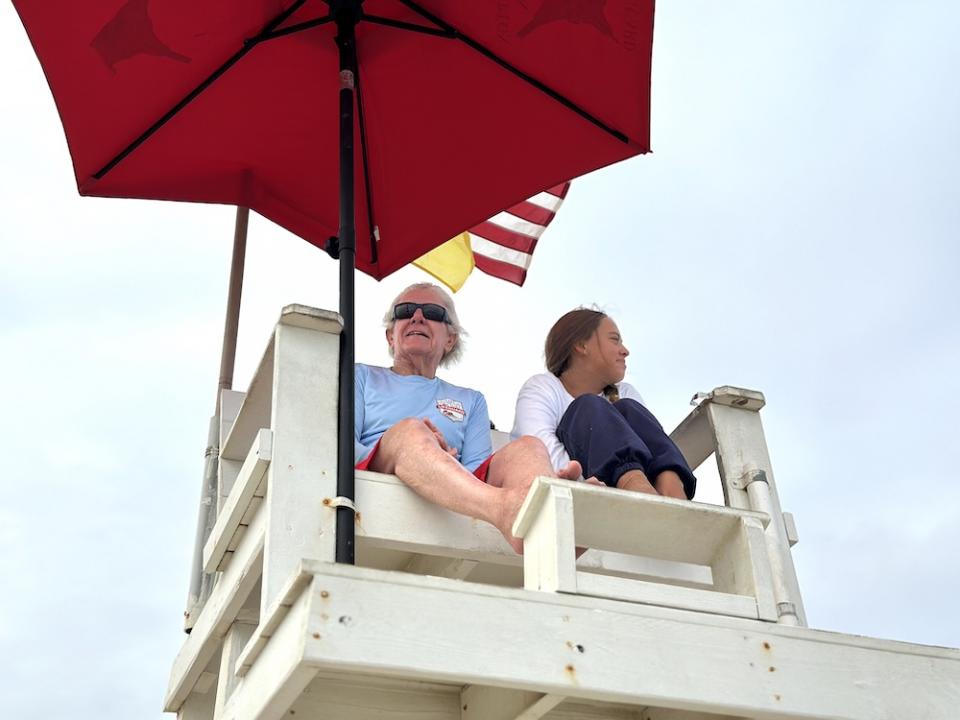
His knowledge is extensive, but he never wanted to be a captain or lieutenant, “because I wanted the kids to be the ones to take that position” and learn to be leaders. “Whenever I have somebody just coming on as a beginner, if I have them up in the stand, the first thing I say to them: ‘Did they teach you how to use the radio?’ A lot of times they’re not familiar with it, so we go through the routine of using the radio, so they have confidence if something happens.”
Spoken like a true coach.
Before swimming brought him to lifeguarding, running brought him to swimming. In 1981, “I’d gone through a change of life and I wanted to change my physical, mental, spiritual being, so to speak.” He started running, but because he had a titanium rod in his thigh, that didn’t seem sustainable. He turned instead to swimming, asking the coach at the Huntington Y.M.C.A. if he could train with the kids there. “He says, ‘Let me see you swim.’ So I did about six laps, and he says, ‘Okay. Come swim with the kids, on one condition: You’ve got to help me coach.’ “
He became a still-water lifeguard in 1982, and in 1992 took over as head coach of the Huntington Bluefish.
All the while, he was training and competing around the country at the masters level, several times making top-10 national events. At the Empire State Games in 1986, when he was 45, he set a 1,500-meter freestyle record for his age group that stood until 1992.
Mr. Monahan continued coaching for a few years after retiring from Consolidated Edison in New York City. But new opportunities were on the horizon by 2000, when he and his wife moved full time to Montauk, where they had bought a house in 1997.
It wasn’t long before the Long Island Y.M.C.A. “was hounding me to get involved with the [East Hampton] RECenter, because they were about to take it over.” Invited to speak to the RECenter board about what the Y could offer East Hampton, Mr. Monahan asked why there was no age-group swim team. “So John Ryan Sr. says to me, ‘Would you help me start a swim team?’ “ He agreed — with the caveat that he was done coaching himself — and the Y.M.C.A. Hurricanes were born.
East Hampton Volunteer Ocean Rescue, which responds to water emergencies year round, was formed not long after that, following a sobering rescue in October off Main Beach, outside the lifeguard season. Some kids got caught in a rip current and couldn’t get back to shore, Mr. Monahan recalled. “A couple of cops showed up, stripped down, and went out to get the kids, and they had trouble.” Luckily, some lifeguards arrived on scene and were able to get everyone safely to shore, but what if they hadn’t been there? That accelerated a conversation about off-season coverage and otherwise unguarded beaches.
John Ryan Sr. led the charge, again, and encouraged Mr. Monahan to take the ocean lifeguard test so he could join the team of rescue swimmers. “I said, ‘John, I’m 61 years old, I don’t think I’m going to be a good guard.’ ”
He took the test anyway in August of 2002, alongside mostly teenagers. “It comes time for the distance swim, and I was the last one in the water because I couldn’t run as fast as the kids,” he remembered, “but I surprised a lot of people and I was the second one out. . . .”
Immediately, Mr. Ryan pressed him into service, telling him that the town was going to have to close some stands in Montauk for the end of the season because they were short on lifeguards. He volunteered to help, “and two weeks later I get a check.” He had been hired without even realizing it, and served for the first eight or nine years at Ditch Plain, then downtown at the South Edison stand for another four or five years and finally at Kirk Park.
He’s been involved in countless rescues since then, but one that stands out most for him happened at Ditch, on a day when the rip current was particularly bad. He headed out to warn a swimmer that he was getting too close to the rip, “and by the time I got out there, four people were caught in that rip.” He whistled to the other guards, and by the time they got into the water, there were about 16 people caught in the rip current. “Eight guards came out to participate in the rescue, leaving the stands unoccupied, and people were still in the water,” so there was no one to keep an eye out for other swimmers in distress. Two retired lifeguards “saw what was going on, and they jumped up on the stand and whistled everybody out of the water.”
As the guards on duty brought the last swimmers in to safety on the beach, “everybody on shore was lined up watching all of this, and people started clapping,” he recalled. “Wow. Wow. That really hit me, what we had done.”
His E.M.T. training has been a huge asset on the beach in medical emergencies and he’s also a resource for other guards who don’t have that background.
He has seen lots of change for the better in the town lifeguarding program. “There was a time we couldn’t even fill [stands in] the regular season,” he said. Junior lifeguarding has been a successful pipeline for that. Also, “the scale of pay has increased, and I think that has impacted the number of people who have shown up to train as a lifeguard.”
He’s happy, too, that the town added more stands in front of “Hotel Row” in downtown Montauk. When he started as a lifeguard, Montauk had only two stands — one at Ditch, the other at Kirk Park. “We’re not at perfection yet. I always say, ‘Progress is the goal, perfection is only the direction.’ And we are making progress.”
Even in retirement, he’ll be available to help in whatever way the town’s lifeguard chief, John Ryan Jr., needs him.
How will he pass his time next summer, when he’s not on the lifeguard stand?
He’s not sure and he’s not worried about it. “I live in a day-tight compartment,” he said, referencing a principle Dale Carnegie wrote about in “How to Stop Worrying and Start Living.” It’s not that he doesn’t plan, but he doesn’t “live in the plan” and he doesn’t dwell on the past. “I just try to do the right thing, and consequently, I have no regrets.”