Robert Hefner, interviewed in these pages five years ago, was asked what he would have been if he could have been anything other than a historical preservationist. He answered without hesitation: “I’d be a boat builder.”
Speaking Saturday evening in the boat room of the Amagansett Life-Saving Station — “one of my favorite spaces in East Hampton” — he addressed an overflow audience on the topic of “The Maritime History of Atlantic Avenue.” That street, which terminates in one of the most seasonally popular beaches in town, was from 1870 to 1918 a working man’s hub focused on the capture of whales and, Mr. Hefner noted, “converting them into dollars without delay.”
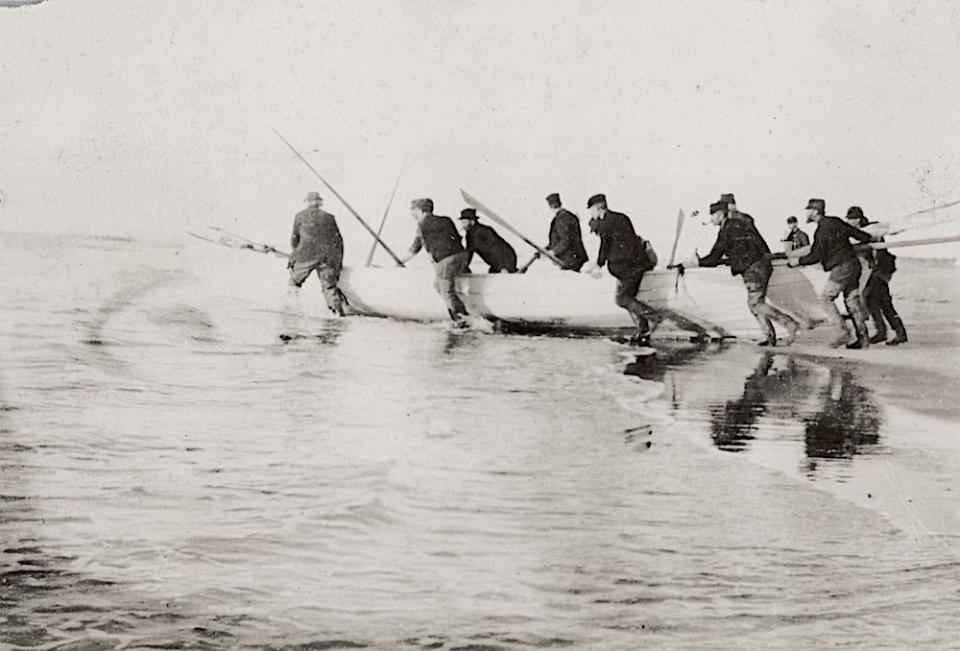
The whaleboats, with their masts, oars, and harpoons, were housed in boathouses at the top of the dunes; nearby was the tryworks building for rendering the blubber into oil.
Illustrating his three-part talk with the help of old photographs, maps, and articles from The Star and Harper’s Weekly magazine, Mr. Hefner launched into a discussion of offshore whaling with a stirring account of an 1897 whale hunt led by Capt. Joshua B. Edwards (who did not retire from deep-sea whaling until 1918, when the last whale was taken). “He loved whaling,” his son Capt. Everett J. Edwards told The New Yorker in a 1949 profile of Cap’n Josh. “Never got enough. Always wild to go.”
Three whales were originally sighted on that day, headed east. Five boats went out in pursuit, but two of the three vanished, leaving a young 40-footer behind. Off Napeague, Cap’n Josh “darted a lance into its side,” Mr. Hefner recounted as an illustration from Harper’s Weekly appeared on the screen. His brother Capt. Jesse Edwards “came up soon after and threw another iron into the whale.”
“The animal then turned completely over and twisted the lines, making the work of the crews more difficult,” he continued, quoting from Harper’s. “Then began a hand-to-hand fight between the two hardy captains and the whale, which lasted two hours and twenty minutes. Captain Joshua Edwards got so near to the whale once that he was knocked down by one of its flukes. The monster kept up a determined and dangerous fight for liberty, thrashing and tearing through the water for several miles . . . Captain Joshua throwing the iron that finally found the vital spot.”
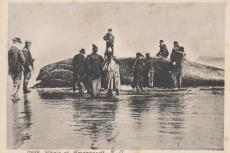
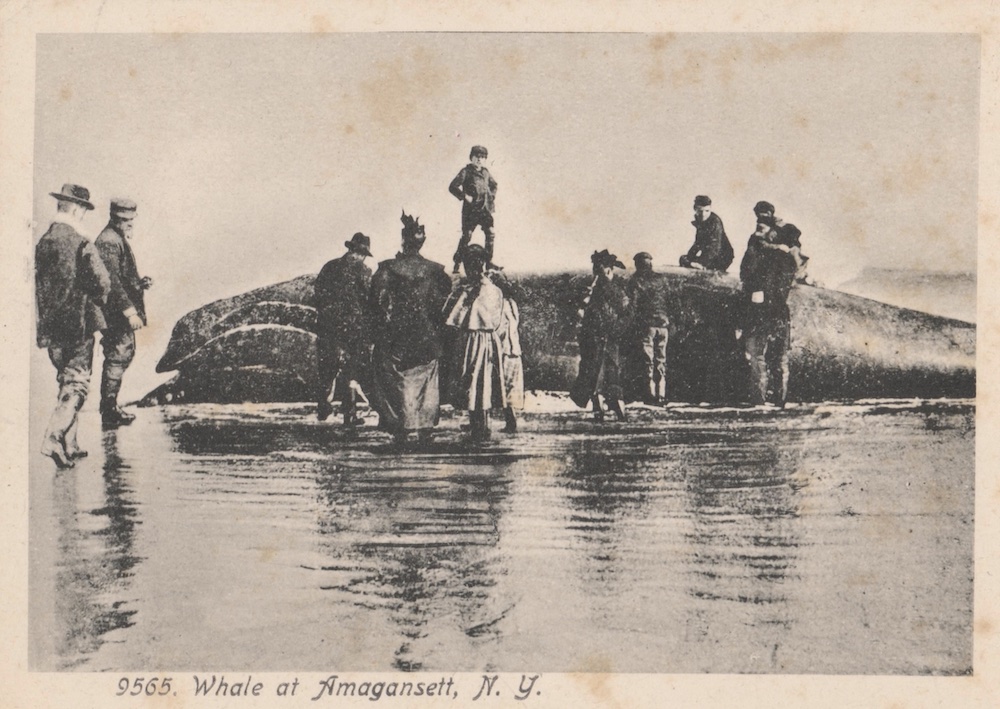
It took four boats to tow the whale the eight miles back to the tryworks at Atlantic Avenue Beach.
Most of the Amagansett whalemen also maintained its Life-Saving Station, where Saturday’s talk was held, under the command of Jesse Edwards. It made sense: Rescuing a sailor in the surf, as Mr. Hefner pointed out, “required the same boat skills as getting close to a whale.” The rescue crew patrolled the beach halfway to the Georgica station on the west and the Napeague station on the east.
On Dec. 5, 1902, crews from both Amagansett and Napeague raced to the wreck of a bark named the Alice Reed, which was carrying a cargo of salt from New York to Boston. Shortly before midnight, “an easterly storm had left the ocean rolling and tumbling with heavy seas and a high surf,” The Star reported.
“The bark struck the [sand]bar about 500 yards from shore. She came on with such force that her three masts went by the board, and three of her crew who were on the bow of the boat were swept into the sea. . . . the bark parted in the middle,” leaving seven sailors clinging to anything they could find. “Lines were repeatedly sent out over the waves by the life savers, but they fell short and could not be reached by the frenzied sailors.”
Despairing of the lines, Mr. Hefner recounted, the surfmen took their boats to the water’s edge, preparing to push through “the angry surf,” though it looked impossible, with the waves now full of “heavy pieces of broken timbers from the wreck, any one of which would have crushed a hole through the lifeboat.”
Just then, a huge wave carried what remained of the Alice Reed over the sandbar, the sailors aboard crying, “For God’s sake, save our lives!” This time the lines reached them, and they were brought to shore one by one, the rescuers wading far into the sea to help, “and many narrow escapes they had from being struck by the storm-tossed wreckage.”
The ship’s nameboard washed up on a Napeague beach in 1977, 75 years later, and was taken to the East Hampton Town Marine Museum, on Bluff Road just around the corner from the Life-Saving Station, to be part of a shipwreck exhibit.
Forward to World War II. In 1942, the Marine Museum was a U.S. Navy barracks, housing dozens of single men who worked round-the-clock shifts in a secret radio station near the shore, intercepting Nazi U-boat transmissions. (Their officers and married men were quartered at the corner of Atlantic and Bluff.)
A lot of people here know about the German saboteurs who came in from a U-boat to Atlantic Avenue Beach in an inflatable raft that same year, but judging by the many open mouths in Mr. Hefner’s audience as they listened to him describing the radiomen’s vital role in the war, very few had any idea of this important part of the road’s “maritime history.”
While the Royal Navy was busy defending the English Channel, German U-boats were attacking merchant ship convoys in the Atlantic Ocean. One such ship was the tanker Coimbra, torpedoed on Jan. 15, 1942, 60 miles off Montauk Point. That happened about five weeks after the U.S. entered the war, by which time, said Mr. Hefner, U-boats had already sunk 1,107 allied ships.
The U-boats maintained nonstop radio transmissions to their headquarters, which was their “greatest vulnerability” and eventual downfall. Along with three other East Coast “direction-finding” stations — in Winter Harbor, Me., Cheltenham, Md., and Jupiter, Fla. — Amagansett would intercept and transcribe those messages and transmit them to Navy headquarters in Washington. “The directional information went to the submarine tracking room [Waves were in charge there], and the coded messages to cryptanalysts,” Mr. Hefner said. Putting them together, the Navy was able to pinpoint the locations of the enemy submarines.
That intelligence, said Mr. Hefner, which was relayed to warships escorting merchant ship convoys, “proved to be the key to allied victory” in the Battle of the Atlantic, which has been credited for ensuring the survival of Great Britain and making possible the transfer of American troops, tanks, fuel, and supplies for the D-Day invasion.