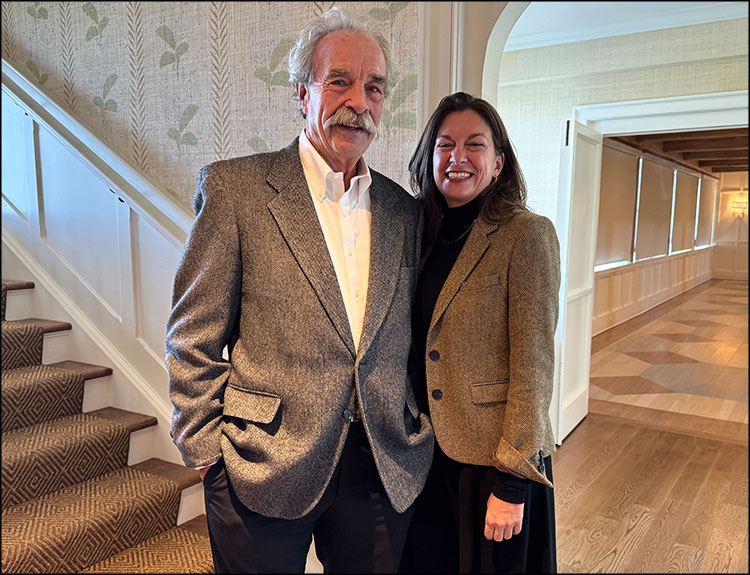
“In trying to understand the past, we learn more about where we’ve come from, which helps us to better understand where we’re going,” Michael Devonshire told the Ladies Village Improvement Society during its 33rd annual Landmarks Luncheon, held at the Maidstone Club on Saturday.
In an increasingly homogenized world, preservation “is what makes places distinct,” he said. “Visitors see our historic places because of the authenticity, character, and distinctiveness.” East Hampton, he said, has “some wonderful local examples of absolute gems that you should all be proud of.”
A former member of the New York City Landmarks Preservation Commission, the architectural conservator and preservationist discussed what he called the cultural, environmental, anthropological, and economic values brought by historic preservation. “Preservation of the built environment is recognized worldwide as a vital public purpose that serves many cultural and societal needs,” he said.
Historic buildings “create a direct connectivity to our past that allows us to experience where history occurred firsthand,” Mr. Devonshire told the L.V.I.S., “and promotes respect for those who live in different times and in different societies and under different circumstances.”
Preservation “connects us to the lives of great men and women,” Mr. Devonshire said. Mount Vernon, George Washington’s residence in Virginia, “was under great risk of demolition by developers” when Ann Pamela Cunningham founded the Mount Vernon Ladies’ Association, “a group of ladies that was just like the L.V.I.S.,” to raise money for its purchase and preservation. “Without them,” he said, “this would probably be a condominium at this point.”
With a slide presentation, he discussed myriad projects he has worked on, including Old Westbury Gardens, the former estate of the businessman John Shaffer Phipps. The roof, he said, was recently replaced using slate from the same quarry in England where the original slate was sourced, and the great-grandson of one of the original tradesmen worked on the restoration. “Historic buildings create the connectivity to our past, allow us to experience where history occurred firsthand, and promote those who lived in different times and places.”
Historic buildings also provide “a living connection to important changes in technology,” he said, citing the United States Capitol, the dome of which is in fact cast iron and not stone. “It was one of the first uses of cast iron in the United States in an architectural setting,” he said, showing a close-up of a section of the building. “This is 190 feet off the ground,” he said, “and the amount of detail is just phenomenal to me.” The Church of Saint Mary the Virgin in Midtown Manhattan “was one of the first buildings in Manhattan to have a steel skeleton and a stone skin,” he added.
Preservation “is an inherently sustainable process,” he said. “Material quality and performance of traditional buildings frequently exceeds that of new construction.” Historic building materials and methods were adapted to local environments over generations “and performed environmentally better than those most recently constructed buildings. . . . Most traditional building techniques involve the use of local materials.” Historic preservation “is the ultimate form of recycling.”
“Architecture, to me, is one of the fine arts, and preservation is a tool through which we can save not only significant architectural styles, but . . . artistic works as well.” He pointed to the Pollock-Krasner House in Springs but also expressed concern about the deteriorating structures at the 11-acre Springs property where the Abstract Expressionist painters James Brooks and Charlotte Park lived and worked. The latter “is at great risk right now,” he said, “and to me is more evocative of the artists who lived and worked there than many others that have received more recognition.”
When people say that the Brooks-Park buildings are not restorable, Mr. Devonshire thinks of Weeksville, a free Black community founded in 1839 in Brooklyn. When working on restoration there, he was part of a not-for-profit organization that assisted with technical information and contracting. “We hired four young men from the local high school who were at risk, and two other gentlemen, and I trained them in historic preservation trades,” he said, teaching them to work with wood and metal and to make and apply plaster.
The buildings at Weeksville “were in worse condition than the Brooks-Park site buildings are,” he said, “and we were able to save these using, essentially, untrained talent.”
Preservation is “a powerful community redevelopment tool that can rapidly revitalize neighborhoods,” Mr. Devonshire said, citing Manhattan’s South Street Seaport, restored in the early 1980s, and Tin Pan Alley, in the Flatiron district, where the Landmarks Preservation Commission designated five 1850s row houses as individual city landmarks in 2019.
It’s a good investment, too, with historic districts “outperforming non-designated districts for real estate returns.” They tend to have far less market volatility, he added.
Buildings that are preserved also “connect us to the tradition of craftsmanship,” he said, citing the Dominy workshops in East Hampton Village and the Pelletreau Silver Shop in Southampton Village.
He described history coming to life at the Merchant’s House Museum in Manhattan, built by an abolitionist in 1832 and lived in by the same family for nearly a century. It was discovered that a hatch in the floor was a portal to a passageway in the Underground Railroad. Joseph Brewster, the house’s builder, also built a nearby church, which features a similar passageway. “The spirit and energy within that is just overwhelming,” he said. “It’s just frightening, realizing that at any moment, if you were an escaped slave, you could be caught and your life would be over.”
The National Historic Preservation Act of 1966, however, is under attack by the Trump administration, Mr. Devonshire said. Section 106 of the act stipulates that the federal agency overseeing a project must allow interested parties to comment on it, and must consider whether it would cause any adverse impact to a historic property. If it would, the agency must explore ways to avoid, minimize, or mitigate those impacts.
In July, National Public Radio reported that the Advisory Council on Historic Preservation, which is responsible for overseeing the Section 106 review process, is trying to dramatically weaken the National Historic Preservation Act. A draft of revisions, according to NPR, includes redefining the kinds of properties that can be considered historic and the removal of both the requirement for public comment on new projects and for consultation with Native American tribes.
The council is “packed with Trump appointees,” NPR reported, and in his second term the president has moved to remake the nation’s capital with projects including demolition of the East Wing of the White House and construction of a ballroom in its place, and a proposed 250-foot-tall triumphal arch and military complex.
“Unfortunately, the present regime in Washington, D.C., is trying to eliminate Section 106, which means that anything can happen to a historic building,” Mr. Devonshire said. “To me, that’s a devastating concept.”
Once historic buildings are gone, “no plaque, no oral history, no photographic exhibit can replace that piece of our patrimony,” he concluded. “Once our buildings are gone, they’re gone forever. We can’t be certain about what will be considered valuable in the future, so it’s important that we save our heritage buildings for that future now.”