
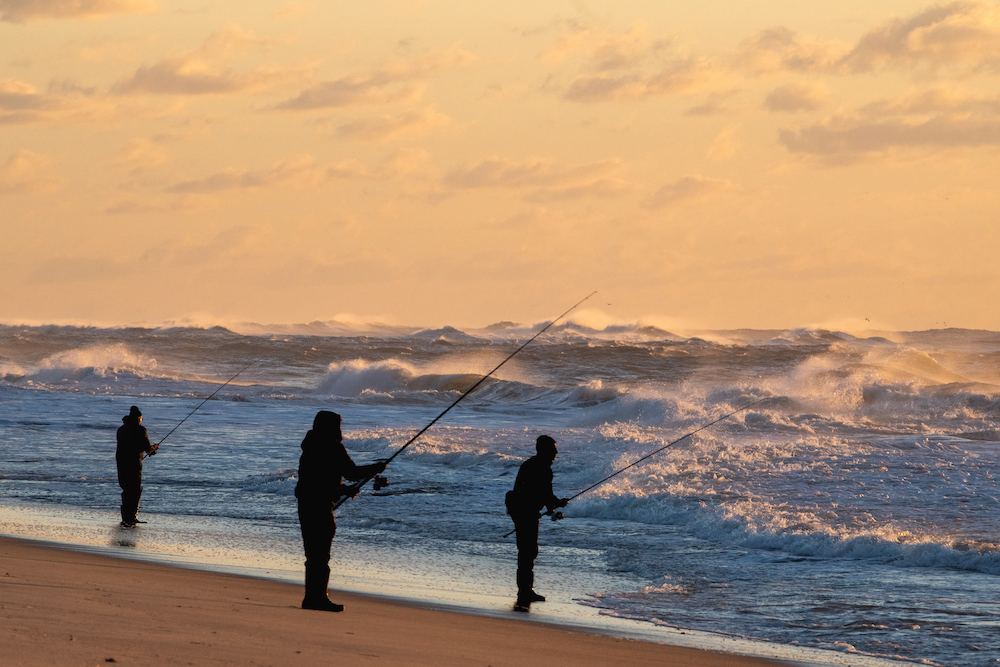
The Mr. Poseidon Montauk Striper Challenge, a fierce competition with a large cash prize, brought hundreds of competitors to the hamlet earlier this month for a catch-and-release striped bass contest that is touted by its organizer as the “biggest surf fishing tournament on the East Coast.” Critics say it left a trail of problems.
“It was one of the most horrifying things I have ever seen,” Chris Albronda of Montauk, a well-known local fishing guide, said last week.
In the wake of the tournament, some local fishermen have complained about trash-strewn beaches, flouting of beach-driving rules, and much worse.
Events spread over the course of three days offered $45,000 in cash prizes. “The mission of Mr. Poseidon is to create a platform for anglers of all skill levels and from all walks of life to come together in camaraderie and competition while promoting sustainable fishing practices,” according to its website. “Through his tournaments and events, [Mr. Poseidon] aims to foster a culture of responsible angling and raise awareness about the importance of maintaining healthy aquatic habits.”
This year, 208 people competed in the tournament, which ran from Oct. 15 through 17. The entry fee was $199 in advance or $250 in person, and the angler who caught the largest striped bass — Keith Stanis with one measuring 45 inches — got $10,000.
“Unfortunately, when you put all that money out as a first prize, you’re going to attract a lot of idiots,” Mr. Albronda said last week.
Those raising alarms about the tournament point to a host of problems: They said a dog was hit by a car and left to die on the side of the road, and a silver pickup truck with a rod rack was reportedly spotted leaving the scene; someone claimed that his truck was attacked with a sledgehammer and had to be towed away afterward.
“Once you put a big number out there as a prize . . . people get severely pissed off if they don’t win,” Brian Connor, a former president of the Montauk Surfcasting Association, said over the weekend.
East Hampton Town police said that none of the allegations could be connected to the tournament. Capt. Gregory Martin did confirm an active “criminal mischief investigation involving damage to a vehicle believed to have occurred in a Montauk resort parking lot.” He also confirmed that a dog had been struck and killed and that East Hampton Town Animal Control is assisting in that investigation.
Marine Patrol issued two tickets during the tournament to people driving on the beach without a permit, Captain Martin said, but police received no calls related to littering on the beaches.
However, he said, “these incidents, and any others having occurred during the time frame of that fishing event, do not appear to be caused by individuals actively participating in the event.”
Eric Stoumpos, a.k.a. Mr. Poseidon, said last week that complaints about his tournament are personal and have nothing to do with the competitors, who are “like a family” to him. He spoke at great length about members of the fishing community whom he has come in contact with through the tournament and also at trade shows.
He said he is clear with the fishermen who participate in the Striper Challenge: They have to keep the beaches clean.
But the tournament’s critics tell a different story. Pictures sent to The Star show some of the items collected after the three-day tournament including plastic, lures, lines, and bait. Were Striper Challenge participants to blame, or does this point to a bigger problem in the fishing community?
Bill Wetzewl, another local fishing guide, said this week that it is everyone’s responsibility to care for the beaches. He said that in addition to taking all your own trash with you, people should also pick up other litter they come across.
Mr. Albronda said he has asked Mr. Stoumpos to do more to clean up the beaches after the event, and, he added, “if that’s not something they can compromise on, we want them out.”
This year Mr. Stoumpos said he went to the beaches himself, collected trash, and even cleaned a porta-potty.
Mr. Connor doesn’t doubt that, but with such a large group competing, he said it would be impossible for Mr. Stoumpos to “be in multiple places at once.”
Critics of the tournament point to an influx of out-of-town competitors unfamiliar with local laws, including beach-driving rules and the need for permits. The Montauk Surfcasting Association has long fought for continued beach access, and Mr. Connor says that people driving illegally or irresponsibly on local beaches set the cause back.
Videos of a pickup truck sunk in the sand with water above its axle below the high-water mark at Oyster Pond made the rounds on social media that week. People quickly assumed the driver was one of the competitors, but it could have been just another demonstration of a lack of beach-driving smarts.
The association has sent Mr. Stoumpos a “cease and desist” letter asking him not to use its logo or suggest it is a sponsor of the event. Bill Jakob, a current secretary of the association, said he could not comment further due to ongoing legal matters and the possibility of future litigation.
Mr. Albronda worked with Mr. Stoumpos five years ago to build the tournament, which initially drew just 17 people. Immediately, one of his rods was stolen from his truck. That, he said, was just the beginning.
Every year, rods and reels worth thousands of dollars go missing, some said, and “every year it happens to coincide with this tournament,” said a fisherman who asked to remain anonymous, fearing reprisals.
Of even greater concern to Mr. Connor is the safety of inexperienced competitors enticed by the prize money. People who have been fishing locally for years know that casting off the rocky edge of Montauk Point can be dangerous, he said. The rocks are slippery and the surf can be rough. Experienced surfcasters wear specialized cleats, but not the newbies. “Some of these guys come out in sneakers or work boots — someone is going to end up passing away.”
Some fishermen also worry that tournaments like this place an undue burden on the already stressed fishery.
While it is a catch-and-release competition, Mr. Connor said that even in the best-case scenarios, fish often don’t live through the stress of being caught, measured, and released. “The fishery is in dire need of help right now,” he said, adding that the Atlantic States Marine Fisheries Commission was considering a 12-percent cut in striped bass removals. That plan was ultimately shelved.
Mr. Wetzel said this week that Montauk fishing “isn’t what it used to be.” And while this year and last there has been an increase in spawning of striped bass, it is still “below average.”
There are “a lot of things to blame,” Mr. Wetzel said. He recommended a temporary moratorium on striped-bass fishing until numbers increase significantly, but would support allowing catch-and-release during the moratorium.
Meanwhile, the criticisms levied at the Striper Challenge, rightly or wrongly, could serve as a call to all fishermen to protect and respect the resources.
“Montauk is still a fishing town and I want to keep it that way,” Mr. Albronda said.