“Few people are likely to forget where they were on Tuesday morning, Sept. 11, 2001,” the late Russell Drumm wrote in The Star’s issue of Sept. 13, 2001.
Twenty-five years on, the terrible events of that day remain seared into the memories of those who experienced it, whether up close in Manhattan or more than 100 miles away in East Hampton Town, on what was shaping up to be a perfect late-summer day. But we were the lucky ones: At the World Trade Center complex in Manhattan, at the Pentagon in Arlington, Va., and in a field in Shanksville, Pa., a total of 2,977 people lost their lives in what remains the most lethal act of terrorism in modern history.
“A lone young woman sat in the sun-dappled sanctuary of Most Holy Trinity Catholic Church in East Hampton Tuesday morning,” The Star reported two days after the attack, “tears streaming down her cheeks as uncertain grief enveloped her.”
“The force of a terrorist attack had begun to crumble Manhattan’s signature towers by then, killing and injuring thousands of people and casting a pall that neither this small town nor the nation had experienced, many said, since the World Wars.”
East Hampton’s Main Street, “a bustling thoroughfare all summer,” The Star reported, “became eerily quiet under a perfect autumn sky.” Apart from the stillness, the only sign that “something was very wrong Tuesday morning” was that the door to the East Hampton Presbyterian Church was ajar. The Rev. John Ames had left it open, having lit the sanctuary lights.
The town’s “intimate ties to New York City were dramatically evident throughout the day,” The Star wrote, “with people here trying to reach loved ones there repeatedly thwarted by jammed telephone circuits, as the unfolding horror aired on television and radio all day, all night, all yesterday.”
The late East Hampton attorney William Fleming told The Star that “Our world is changed forever,” and that “people are going to be much kinder to each other now.”
For a time, Fleming’s prediction was accurate. For months afterward, the terrorist attacks drew those who’d lived through it close. Throughout New York City, it was as though residents had discarded the “urban armor” common to big-city dwellers, instead making eye contact and offering kind or comforting words to strangers as a collective feeling of solidarity enveloped the wounded and anguished city.
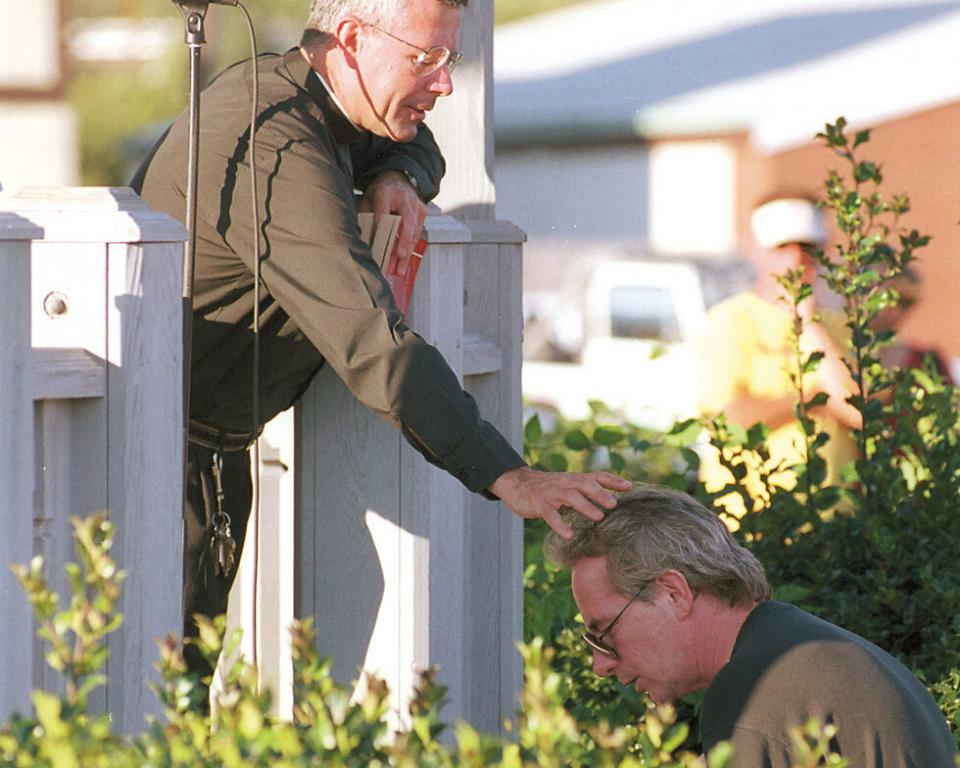
“By Tuesday afternoon,” The Star wrote, “clergy at several churches were consoling congregants, some with relatives on the planes that had been hijacked, others with loved ones who worked in one of the destroyed towers.” Nearly 100 residents attended a Mass of resurrection at Most Holy Trinity, and almost 400 more joined in an ecumenical service in the Presbyterian Church, where Rabbi David Gelfand of the Jewish Center of the Hamptons was joined by Mr. Ames, pastors from other churches, and several town officials.
“As Americans, we are the ‘holders of dreams from mixed religious heritages, as we are under this roof,’ said Rabbi Gelfand. ‘We are a nation whose heart is broken,’ he said, but we will prevail, ‘not by might and not by power, but by victory of the spirit.’ ”
Town emergency crews “worked into the night on Tuesday preparing vehicles and equipment and waiting for the signal to head west to assist at the World Trade Center disaster site in Manhattan,” The Star wrote. “It never came.”
“An overflow of volunteers” had poured into Manhattan from the tristate area. “While many local volunteers signed on to join the disaster teams, only a few, mainly veterans and those with skills in particular demand, were selected to serve should the need arise.”
David Schleifer, who lives and surfs at Ditch Plain in Montauk, was doing just that on the morning of Sept. 11, 2001. “There were three to four days of hurricane surf that week, really big,” he remembered.
Suddenly, “Rusty Drumm paddled out to me and said, ‘Call your firehouse, a plane just flew into the World Trade Center.’ ”
Just two months earlier, Mr. Schleifer had retired from the New York Fire Department after 20 years’ service. “Ladder 5 in Greenwich Village,” he recalled of his company last week. “I lost 38 close friends that day, 11 in my firehouse. . . . My friend was vaporized, never to be found.”
He went home, called the firehouse and then his girlfriend, a Greenwich Village bartender. “I was in New York that night,” he said, “and on the pile a bit after sunrise on the 12th.”
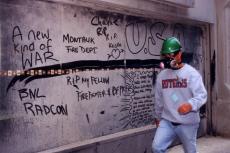
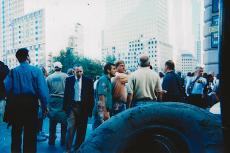
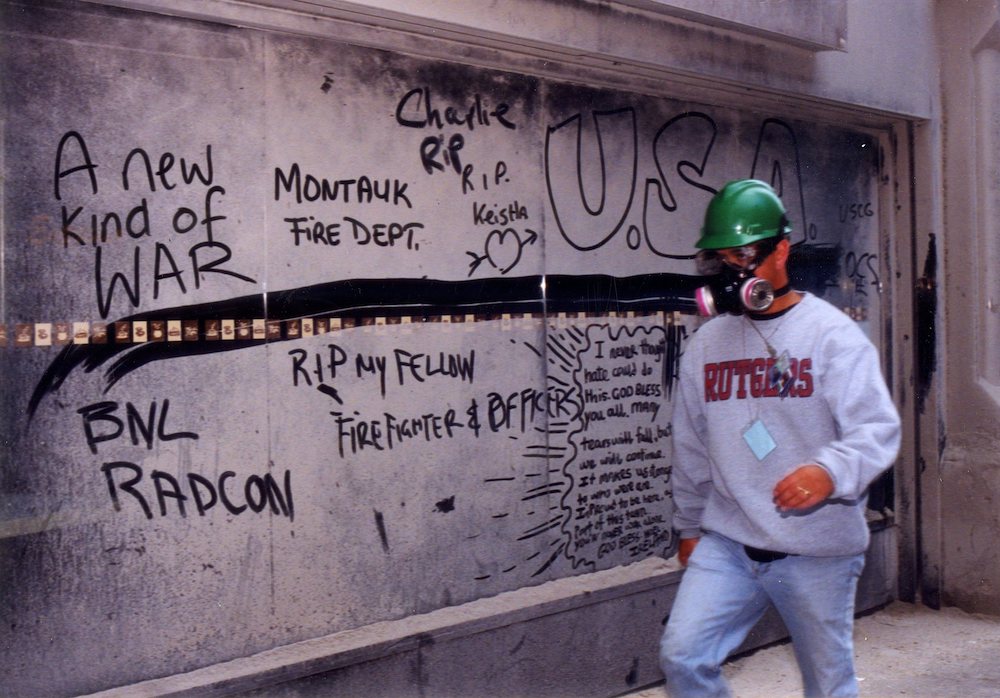
“The pile” was the collapsed, 110-story World Trade Center towers, now a mountain of rubble some 70 to 90 feet tall. “I was on the pile from Wednesday through Sunday,” Mr. Schleifer said, one among countless volunteers who, at considerable risk, searched for survivors. It was gruesome work. “The first couple of days we were climbing around the pile, going into holes with no protection, holding on to broken pipes, looking for anything,” he said. “You couldn’t find a doorknob, everything was so pulverized. Many bodies were cut in half, split in two by I-beams, legs and arms sticking out.”
On Sept. 14, “we found four guys from my firehouse.” They were among 343 F.D.N.Y. firefighters and paramedics who died at the World Trade Center. “The cream of the Fire Department crop were lost,” he said. “There were so many senior guys, rescue guys -people that were the best of our job were lost. People I knew through the ranks who would have become chiefs, commissioners. They were the fucking best.”
For this reporter, the day had started like any other: preparing to take the subway from Brooklyn’s Williamsburg neighborhood to the offices of Billboard magazine at Ninth Street and Broadway in Manhattan. The initial report on WCBS radio quoted an eyewitness asserting that a small, private aircraft had crashed into the North Tower, seemingly a terrible accident. Until about 17 minutes later, when a second plane, moving close to 600 miles per hour, crashed into the South Tower.
Dazed, this reporter was about to set out for the office, until reasoning that the subway may not be running, only later still grasping the magnitude of the event. From the roof of a six-story apartment building on Williamsburg’s south side, the North Tower was observed burning for several long minutes before collapsing amid an eruption of smoke and rubble.
As dumbstruck neighbors stood on the roof watching the unthinkable unfold before them, a garbled voice from a portable radio reported planes crashing into the Pentagon and the field in Shanksville, and in the fog of the fast-moving horror it was erroneously reported that eight commercial aircraft were unaccounted for, that the National Mall in Washington was ablaze.
From West Broadway and Spring Street, to which Lakshman Achuthan had run, “You heard huge moans,” he told The Star in 2001, describing the moments when one tower and then the other collapsed. Mr. Achuthan, who worked in Midtown Manhattan and whose family lived on the South Fork, had been on the first floor of the North Tower to attend a conference when it was struck. “The whole city moaned,” he said.
For many days, smoke poured from the site, the space where the iconic towers had stood just hours earlier now as empty as the otherwise blue sky that had enveloped them. From Brooklyn, in the evenings to follow, the Manhattan skyline -what had not been destroyed -was majestic, backlit by the setting sun that cast long shadows on a terrible new world.
For weeks afterward, walls across the city were plastered with hastily made “missing” posters, in the center someone’s beaming face at a birthday party, a graduation, a holiday gathering, and surrounding the image a despairing plea for information, for anything. Reports of 20-something widows and their fatherless infant or unborn children filled the evening news.
America’s “war on terror” quickly followed, first an invasion of Afghanistan to destroy the Al Qaeda terrorist network and overthrow the Taliban regime that harbored them, and, in March 2003, of Iraq, purportedly to confiscate weapons of mass destruction that were never found. It would be 20 years before the last American troops would leave Afghanistan. The remaining U.S. military forces are scheduled to complete their final withdrawal from Iraq on Sept. 30.
“We’ve been mourning it forever,” Mr. Schleifer said of what is commonly referred to as 9/11. Twenty-five years later, “my biggest shock would be a Muslim socialist mayor in New York City now. It’s mind-blowing.”
After a long pause, he added a final thought. “God bless America.”