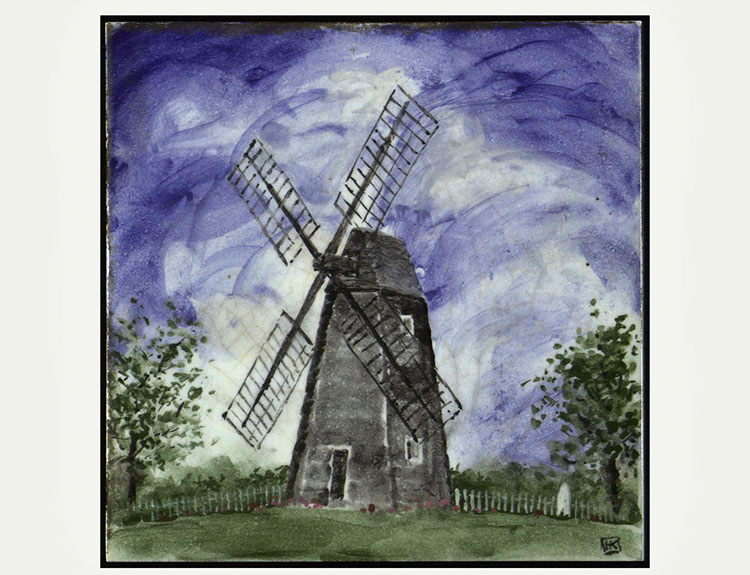
This depiction of Hook Mill was hand-painted on a ceramic tile by Hamilton King (1871-1952) at the request of Maude Sherwood Jewett (1873-1953), a fellow artist. Inspired by a group of late-19th-century New York artists known as the Tile Club, Jewett founded a new group she called the Tile Painters Club of East Hampton. The original Tile Club met regularly between 1877 and 1887 to socialize, paint tiles, and take sketching trips, including to East Hampton, where the setting inspired their work.
Other artists Jewett asked to paint a tile with a scene related to East Hampton were James Preston (1873-1962), John H. Jewett (1902-1986), Albert Herter (1871-1950), Aymar Embury II (1880-1966) and his wife, Jane Schabbehar Embury (later Benepe, she lived from 1910 to 1995), and Lawrence Larkin (1903-1993) and his wife, Roseanne Larkin (1897-1977).
The exact date these tiles were painted is unclear, but they most likely date from after Maude Jewett helped put together Guild Hall’s opening exhibition focused on the original Tile Club’s work in August of 1931 up until Herter’s death in 1950. The finished tiles were gathered in 1953 and gifted to the East Hampton Library in 1983.
The artists Maude Jewett invited to join her Tile Club Painters of East Hampton moved in the same artistic and social circles, becoming involved in local institutions like the Maidstone Club and Guild Hall. King played a key role in the opening of Guild Hall and was one of the artists featured in its first annual Members Exhibition, along with Maude Jewett and Herter. King also served on Guild Hall’s art committee.
Hamilton King, Maude Jewett, and their contemporaries considered the Tile Club of the late 1800s the founders of East Hampton’s artistic community. Jewett’s club was an homage to the long tradition of artists finding creativity and inspiration in the Village of East Hampton.
—
Christina Pellegrino is a librarian and archivist in the Long Island Collection.