Peak mosquito season is upon us and with it comes thoughts of exposed ankles, arms, sleepless nights, and window screens that need replacing.
It’s also the season of pesticide applicators promising death to mosquitoes if only you’ll fog or spray your yard with poison that persists for weeks.
Good to breathe? No.
Good for local waterways? No.
Good for your pets and children? No.
Good for pollinators and beneficial insects? No.
The good news: There’s another way. It costs almost nothing, targets only mosquitoes, won’t poison the air, kids, or animals, and it won’t run off into the bays and ponds.
It’s a mosquito bucket.
“There is no evidence that mosquito fogging controls mosquito populations anywhere in the country,” Doug Tallamy, an entomologist and author of a highly influential book, “Bringing Nature Home,” wrote in a recent post to Instagram.
“First, it doesn’t control mosquitoes, but it does kill everything else. It kills our monarchs, it kills our pollinators, it kills the caterpillars that feed our birds,” he said.
He calls “mosquito fogging” a “really serious environmental problem.”
To educate people that pesticides are not the only answer, the nonprofit he co-founded, Homegrown National Park, has an ongoing “mosquito bucket challenge.”
The only challenge involved is making the bucket, which is easy. It’s a low-bar type of challenge.
Find a five-gallon bucket that is preferably dark. Go to Amazon, search for “summit dunk 6-pack” ($8.58 and will last until October, when mosquito season ends) and buy it.
The dunks are compatible with organic gardening and contain only bacillus thuringiensis, a bacterium that kills only mosquito larvae.
Even “eco-friendly” pesticide applicators who use “organic” oils are still offering a nontargeted product that is killing beneficial insects and covering birds, turtles, and squirrels.
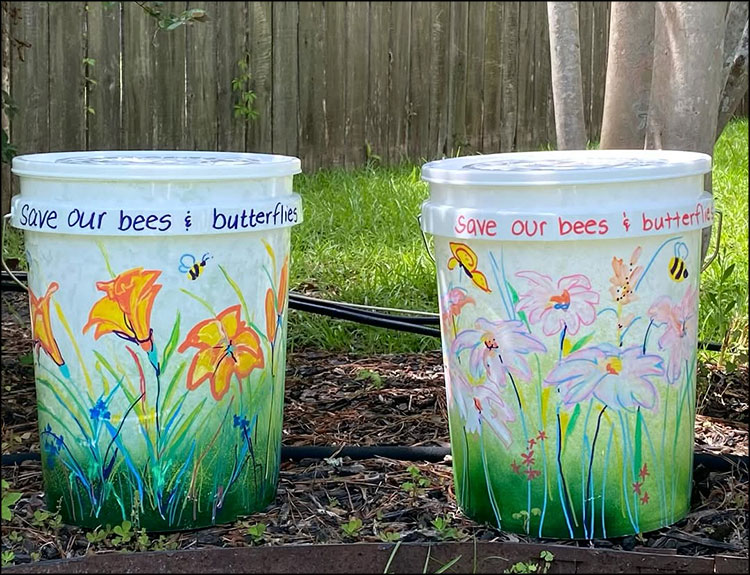
While you wait the day or two for the dunks to be delivered, decorate your bucket. Threatening words or veiled threats to mosquitoes are effective, even though insects likely don’t read.
Some people stick with “Bucket of Doom,” but the more specific “Portal to Mosquito Hell” feels more satisfying.
Simply lying to mosquitoes works well too. Try “Mosquito Swimming Lessons,” “Mosquito Sex Party,” or “Free Mosquito Ice Cream Here.”
Since we’re in the Hamptons you could appeal to the high end. “Mosquito Mansion” or “White Mosquito Pants Sold Here” are worth a try.
Have fun with it. If you would rather go with a positive message, like “Pesticide-Free Killing Machine” or “This Bucket Saves Birds,” fine.
Fill it halfway to two-thirds with water. Gather a few handfuls of fallen leaves and grass clippings and toss them in. As the leaves and clippings break down, breeding mosquitoes will be attracted and lay their eggs in the water. If you’re using a five-gallon bucket, add a quarter of a mosquito dunk. The bacteria from the dunk kill the larvae when the eggs hatch.
Place your bucket in a damp, shady area.
During this time, it’s also important to dump other pools of water around the yard so the bucket becomes the best place for mosquitoes to lay eggs. If you have a larger property, use more buckets, and keep emptying other standing pools of water.
Also make sure your irrigation system isn’t leaving puddles.
“That’s how you control mosquitoes, in the larval stage,” said Mr. Tallamy. “It’s cheap. It doesn’t kill anything else, and it works.”
Minor maintenance of the bucket is required. Check it now and then to make sure it has enough water. Monthly, dump the old water (it’s fine to dump in a garden bed) and add new water with a new chunk of dunk.
The bucket water is nontoxic to pets, humans, and fish, but if it makes you feel better, you can add a screen over the top as long as the holes are wide enough to allow mosquitoes to enter. If you don’t want to add a screen, some suggest adding a stick that is long enough to allow a fallen critter, say a chipmunk, to escape.
Finally, share an image of your bucket on the Homegrown National Park website at bit.ly/4uIOFqa.
“We want to control pest mosquitoes. We don’t want to eliminate nature,” Mr. Tallamy said.
With the money saved from not spraying pesticides, plant a new native tree. With all the recent tree die-off on the East End from the Southern pine beetle, beech leaf disease, or laurel wilt, there will be no better time to plant a tree than now.
Then, this fall, consider hanging a bat house on your new tree. In a single night they can eat anywhere from 3,000 to 8,000 insects.