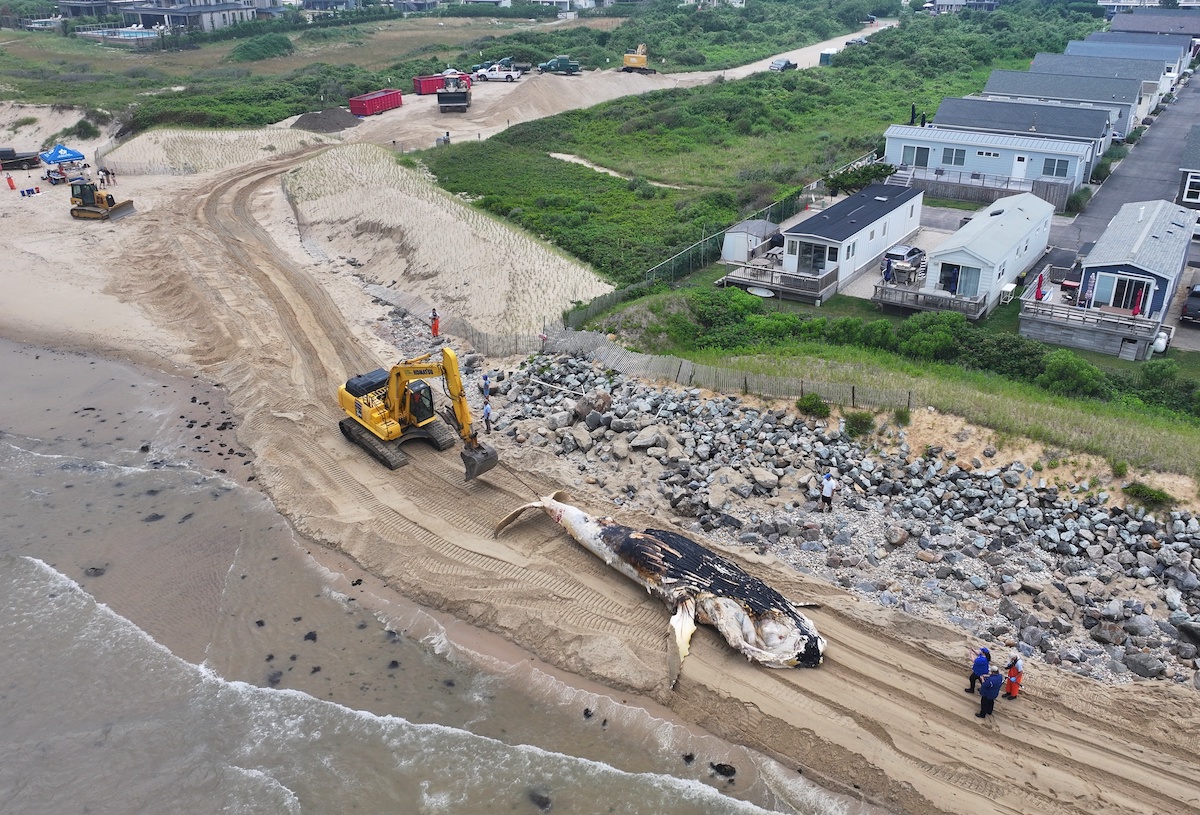
A decomposed humpback whale found on a rocky stretch of shoreline at Ditch Plain in Montauk on Friday morning was removed by Saturday afternoon, thanks to some hard work by East Hampton Town — which received an emergency permit from the New York State Department of Environmental Conservation — a contractor, and about a dozen volunteers with the Atlantic Marine Conservation Society.
Leaders of the Shinnecock Nation offered a ceremonial prayer for the whale on Saturday morning, and when it was off the beach, the conservation society's executive director and chief scientist, Rob DiGiovanni, was on hand to perform a necropsy on the animal. He estimated that the 42-foot female humpback weighed 30,000 pounds, and based on the scavenging he noticed ("most from sharks"), he guessed it had been dead for over a week. "It has to die, sink, de-gas, and then come up."
Beached whales that don't de-gas sometimes explode, launching whale chunks great distances. In 1970, in Florence, Ore., authorities used dynamite to blow up a dead eight-ton sperm whale. No one was injured, but cars were damaged by huge slabs of whale parts.
As of Monday morning, the humpback's cause of death remained undetermined.
According to the National Oceanic and Atmospheric Administration, which has been tracking elevated humpback whale mortalities since 2016, of the 129 whales examined as of last summer, "about 45 percent had evidence of human interaction, either vessel strike or entanglement."
Many of those who had been near the whale remarked on its overpowering odor.
Corey Senese, who owns and operates Corey's Wave surf school, was the first to spot the beast as he filmed his daily surf report for his Instagram feed, @coreyswave, on Friday morning. "Oh my God, it's a fucking dead whale!" he said as panned to his discovery. "And it stinks! Oh my God. This is crazy."
In a phone call a few hours later, he said it was uncommon for him to curse on his surf report (he has a 6-year-old), but justified it by saying, "A dead whale is the most unique stinkiest stinks you could smell."
"To call it putrid would be nice," said Councilman David Lys, who was present as the whale was carted off.
Mr. DiGiovanni was not particularly taken aback by the whale's smell. "It's what whales smell like when they're dead," he said, and blamed the wind direction. On Friday, south winds were funneling the odor landward, tainting the entire neighborhood at the Montauk Shores Condominiums.
Removing such a large animal is a challenge. Because the whale was 50 to 100 yards from the nearest access point and washed onto a boulder field, it was extra challenging.
Keith Grimes Incorporated, a construction company contracted by the town to perform the operation, used a bulldozer to push 600 yards of sand toward the mammal, forming a land bridge over the rocks. Tide was a complicating factor. To ensure the bridge wasn't washed away, its completion was timed to coincide with low tide and the arrival of an excavator.
"The tail end was facing west," Mr. Lys said. That made things easier for the excavator, which dragged the whale toward what's known as the Dirt Lot at Ditch Plain. A fear that pieces of it would slough off went unrealized. Once it made it to the staging area, Mr. DiGiovanni and about a dozen volunteers were there with 14-inch flensing knives.
"We go through 20 to 30 knives during a necropsy," he said. "They're not easy to cut through. Some species are easier than others. A basking shark, for example, is a lot easier to cut into than a sperm whale, which is very thick. You're out there for hours. Just imagine filleting fish all day long."
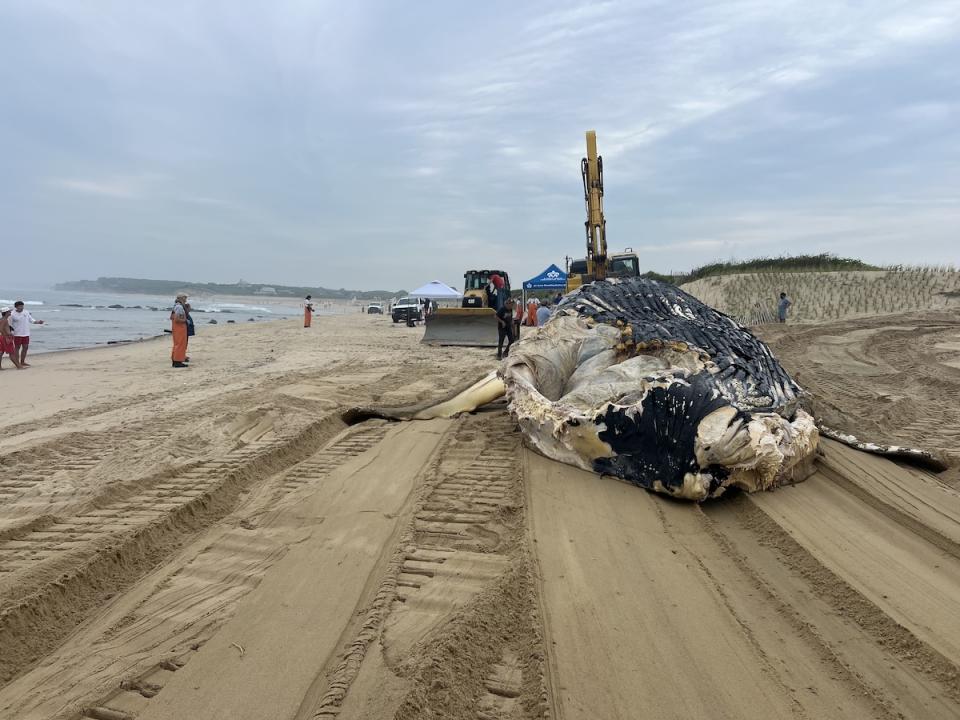
Mr. Lys said the beach was closed and the town met the whale remains with three 30-yard dumpsters prepacked with absorbent vegetation so whale liquids slick out.
"We packed the blubber and internal organs. Actually, there were more internal organs than blubber," Mr. Lys said. Each of the dumpsters was packed full and transported to the town's Sanitation Department on Springs-Fireplace Road. An off-site hauler will ultimately decide whether it makes more sense to incinerate the remains or take them to a landfill, perhaps in Pennsylvania.
During the removal process and while the whale was beached, Marine Patrol flew drones to make sure no large sharks were in the area. Mr. DiGiovanni noted a pod of bottlenose dolphins offshore. Earlier in the week, before the whale washed up, he had flown over the area and observed fin whales.
Sharks obviously scavenge on dead whales, but Mr. DiGiovanni said birds and smaller fish also take advantage. "It's an opportunistic occurrence."
He said whales are returning to the area from the south at this time of year. "This is a normal migratory route. Historically, Long Island is where shore-whaling occurred. To see whales from shore here was not uncommon before populations were depleted. During summer is when the majority come through."
News of the dead whale traveled fast on Friday, as multiple people posted videos and photographs of it on social media.
Josi Friedrich, a photographer and surfer, was immediately interested. After viewing Mr. Senese's post, she packed up her camera gear and headed out to see the whale in person and take photos. "It's very surreal, sad, and awe-inspiring at the same time," she said Friday. "It's rare we get to see these animals up close, and though the circumstances are unfortunate, it serves as a reminder of what a beautiful place we live in, and of the wildlife that surrounds us."
"It's devastating to see such a beautiful beast washed up there at Ditch," Idoline Duke said. "It may very well have met its demise from natural causes, but it's not a terrible thing for surfers and others to have to take a pause from their fun and contemplate the costs of all that we are doing to our oceans."
This may not be the last whale to wash up this summer. Councilman Lys said another whale was known to be drifting about 20 miles east of Block Island but was reportedly being scavenged by "17-foot great white sharks" and may never make it to land.
"This was my second whale," he said of the dead humpback. "In 2019, another washed up. It's sad when these majestic animals die, but if another washes up, we'll be ready for it."
Sightings of living, injured, or deceased whales or other sea life can be shared with the Atlantic Marine Conservation Society at [email protected].