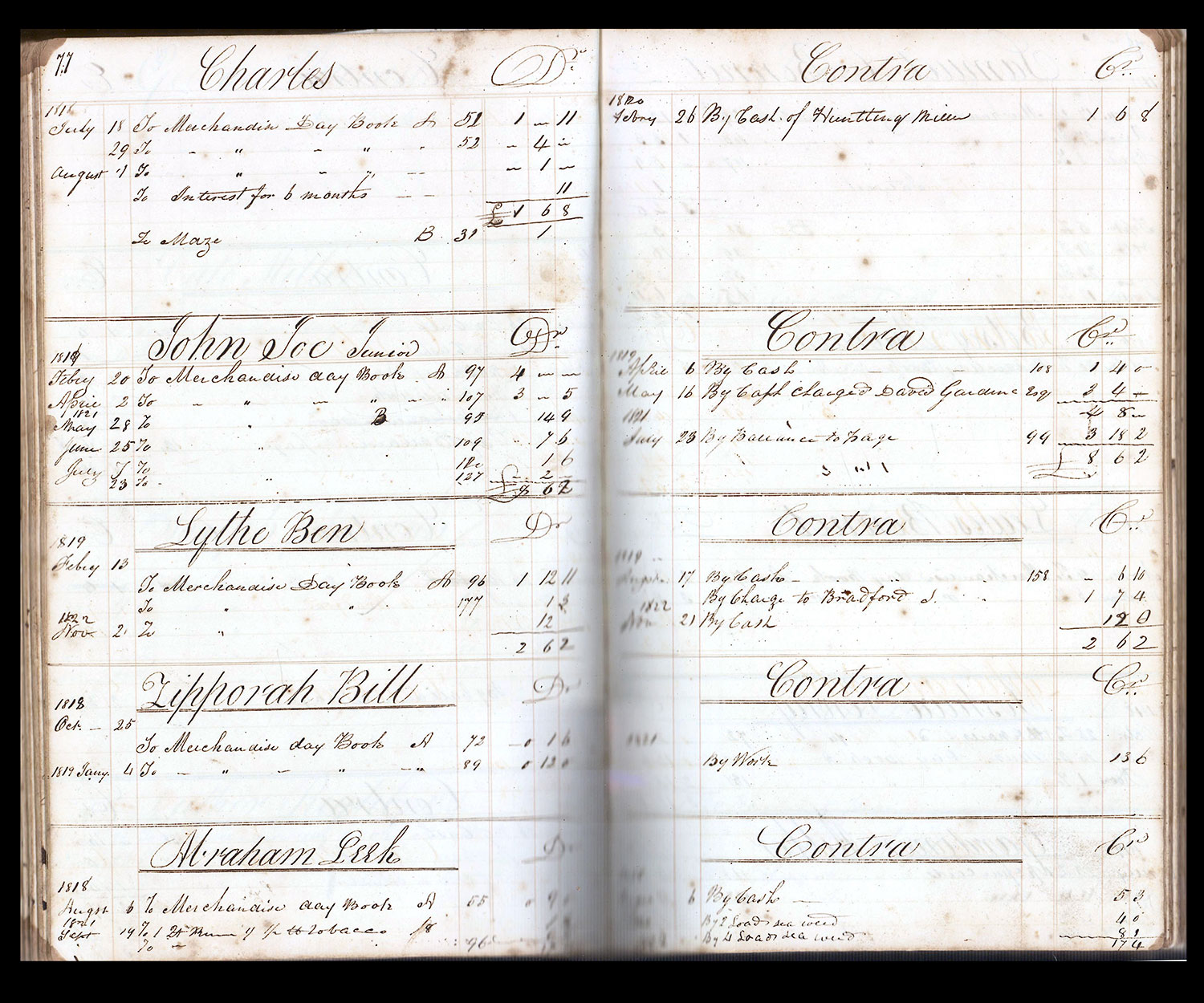
Tucked away in a barn on Springs-Fireplace Road were six account books that document transactions for merchandise such as calico, schoolbooks, and maize. The East Hampton Historical Farm Museum took stewardship of the volumes, which date to as early as 1794, understanding their importance despite being unsure of their origins.
The account books feature the names of many familiar East Hampton families, such as the Gardiners, the Millers, and the Edwards family. The account book seen here and others also contain the names of enslaved, formerly enslaved, and Indigenous residents of East Hampton, such as “John Joe Jr.,” “Pomp Gardiner,” and members of the Right, Pharaoh, and Plato families.
Although the account entries place the transactions in East Hampton, it is still uncertain who owned the books themselves. Notes inserted into the ledgers served as an important clue, with several addressed to a “D. Dayton” and “Dan’l Dayton.” One letter even mentioned a store. These inserts suggest that Daniel Dayton kept the account books and presumably operated a store in East Hampton.
Daniel Dayton (1795-1870) was the son of Jonathan Dayton (1764-1842), owner of the 1770 House. Jonathan, a merchant, held many positions in local politics, including “vendue master,” or auctioneer, of Suffolk County. According to “East Hampton History” by Jeannette Edwards Rattray, Jonathan also operated a store on his property in 1795.
Like his father, Daniel also held several roles in local government and was a sales agent for a furniture business. Notes inserted throughout the ledgers indicate that Daniel helped with his father’s business.
Initially a mystery, these account books give us a glimpse into what life was like in East Hampton during the late 18th and early 19th centuries. Despite documenting only quotidian transactions, they reveal the social networks and economic status of East Hampton residents. This is especially significant for residents with African and Indigenous heritage, whose stories are lacking from East Hampton’s collective history.
—
Megan Bardis is a librarian and archivist in the Long Island Collection.