
“You can’t take it with you,” the saying goes, but as I have gotten older, I have become more acutely aware of the truth of this statement.
When I left my Midwest home for good back in 1978, I came to New York with very little: a suitcase case full of clothes, a sketchbook, and a Guatemalan blanket I had bought at a market in Chichicastenango in the 1970s. Over the decades, as I moved from dorm room to apartments to my current Springs home, I have accumulated an abundance of things, a mountain of things, an avalanche of things, too many things!
Sometimes I catch a glimpse of the TV show “Hoarders” while flipping channels and get drawn into the horror of witnessing someone drowning in possessions and who, in their desperate need to not throw anything away, choose things over the pleas of their loved ones to get help. How can anyone be like that, one thinks, but perhaps the TV hoarders are just demonstrating an extreme version of the psychological need we all have to cling to things. It’s a matter of degree. Even without an obsessive nature, it’s easy to have things pile up and accumulate over time and be overwhelmed at the thought of dealing with them.
My mother was not someone you would call a hoarder, but my childhood home was crammed with things in every corner, in the garage, the basement, the closets, every drawer and cabinet. A child of the Depression, my mother loved going to estate sales and yard sales, and her home had a vast array of knickknacks and collectibles — antique beaded purses, sets of demitasse cups, framed Victorian poems, crocheted doilies, vases of all shapes and sizes, boxes of costume jewelry, dozens of vintage leather gloves and silk scarves, and clothes — the clothes! — some worn rarely.
Once I helped her move her winter clothes to storage boxes and got out her summer clothes, and I counted something like 18 white turtleneck tops. When she downsized to an apartment in a senior complex, her “things” needed to be reduced by 90 percent. Things were sold, donated, or given to family members. The only thing I wanted was a vintage green wooden wastebasket with a parrot painted on it. I still have it in my bedroom today.
After many happy years in her senior apartment, making new friends and living in a pretty much clutter-free environment, my mom’s health declined and she went into hospice care at a facility at age 98. Her things were reduced to a bedside table where she could reach them: the TV remote, her ChapStick, her water bottle, and her magnifying glass.
Many of my friends these days are looking to clear out unnecessary things. “Time to get rid of all the junk!” they say. And there is plenty of advice to guide one through the process. Marie Kondo promotes the KonMari Method, by which she suggests instead of looking at what to discard, determine first what gives you joy. In her philosophy, the destination is not a decluttered house, but the life you get to live once it is decluttered.
Ann Patchett wrote a famous essay in The New Yorker after helping a friend deal with the contents of her deceased father’s overcrowded apartment. To declutter her own house, Patchett started first in the kitchen, where she found three colanders, a dozen champagne flutes she never used, and more dishtowels than could easily fit in a drawer. She systemically hit every room in her house, and what she didn’t toss she donated or gave to friends (younger friends!) freeing up her own life while benefiting others.
There are books and websites on something called Swedish death cleaning, which advises the red dot method — placing red dots on items to discard and green dots on those items to keep. The goal is to avoid burdening one’s relatives with the task of going through belongings after death. Best to get your house “coffin ready,” as one of my friends put it. This friend, by the way, passed away several years ago. I think of her when I look at the gift she gave on her last visit, tiny lead soldiers in parade formation holding musical instruments. They stand on my kitchen windowsill, an example of the things in my home capable of evoking memories.
I am sentimental about certain other possessions, like my green wastebasket and my Guatemalan blanket. I cherish my Diane Mayo pots, my collection of friends’ paintings, my art and poetry books, my photo albums, a midcentury coffee table once owned by my painting teacher, a wooden stepladder I bought from a thrift store in Grand Marais, Minn., 50 years ago, a very special cream and sugar bowl set I got from a friend.
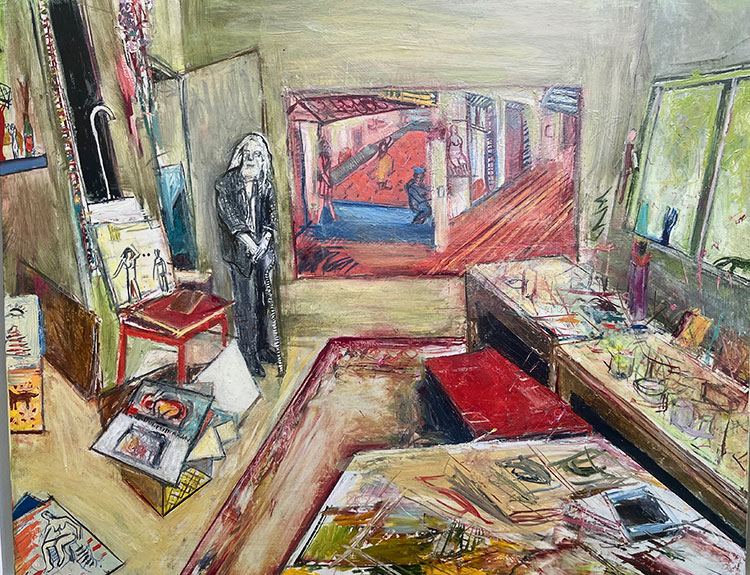
My artist friends and I have other kinds of accumulations. In addition to our households full of things, we have studios full of art — decades of sketchbooks, paintings, sculptures, flat files filled with drawings and prints, art trades from fellow artists, frames, art equipment and art supplies of all kinds. I love visiting these studios, and I have even been making a series of paintings of these spaces. While some artists are famous enough to have gallery representation that will eventually handle their estates or will even have their homes and studios turned into museums, most artists I know need to be their own archivists and have to deal with the task of cataloging their art, storing it, preserving it, selling it, giving it away, and hopefully getting it placed in collections. The Joan Mitchell Foundation provides legacy planning tools to guide artists in the process. You can’t take it with you, but perhaps your art can have an afterlife — what doesn’t end up in the dumpster.
The thing about things is that some things are more valuable than others, have more resonance, embody some kind of meaning, help preserve history, and serve as a record of our humanity in some way. After all, things often can outlast the people who owned them, and things can also outlast civilizations. In 1922, when Howard Carter peered into the opening to King Tut’s tomb, he was asked by Lord Carnarvon if he could see anything inside. “Yes!” he famously replied. “Wonderful things!”
Jennifer Cross is an artist living in Springs.