
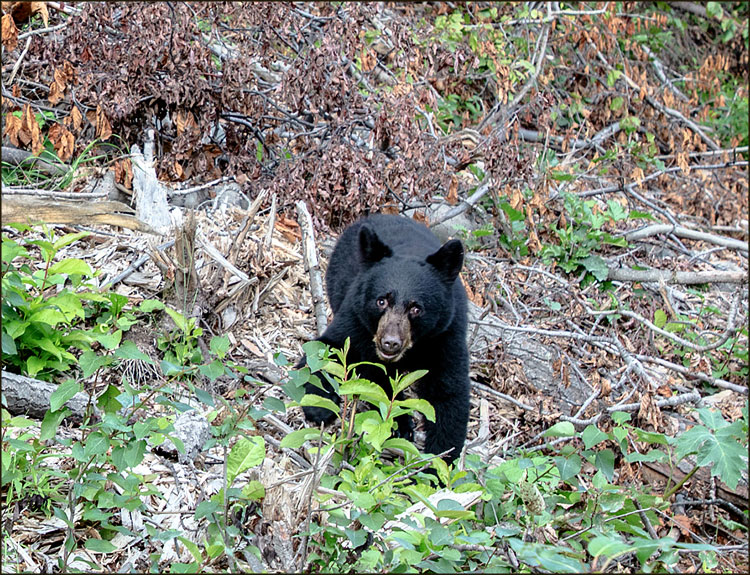
In 2003, after a three-decade moratorium, New Jersey resumed black bear hunts. The state has organized public hunts nearly every fall, killing an average of approximately 400 bears per year. The Animal Protection League of New Jersey has worked hard to stop the hunts — an effort that has included protest demonstrations.
I have participated in most of the protests, and I was arrested several times for civil disobedience. I typically stepped outside a designated protest area. Three of my arrests led to jail time (totaling 36 days). But a recent arrest was different from the others, and it was quite difficult for me.
The difference had to do with a change in the protest site. Until 2022, most protests were held at “check stations,” where hunters brought their dead bears to be weighed and examined. But the protesters found it heart-wrenching to watch the bears come in. Largely for this reason, the Animal Protection League moved the demonstrations away from the check stations to highways, where motorists can see the activists’ signs.
After this change, I felt the need to return to the main check station. I wanted to directly confront those who were promoting and supervising the hunts. I didn’t want to draw people away from the Animal Protection League’s highway demonstrations, so I would go alone.
But I wasn’t sure about the idea. For one thing, I didn’t know if a lone protest would be effective. In addition, it would cause my wife to worry. And I was concerned about my own emotional resilience. I was 80 years old and didn’t know how well I would cope with jail this time.
I wrestled with my thoughts for a year. As the 2024 hunt grew near, I felt pain in my stomach every day. My doctor said it was due to anxiety.
Finally, I decided on a plan that resolved my indecision. I would stand fairly close to where I had seen state officials. But I wouldn’t stand where I could interfere with any weigh-in operations. It would be a place where I believed I had a First Amendment right to protest. If the police allowed me to stand there, I wouldn’t get arrested. Otherwise, I would.
When I arrived at the check station, I saw that I was even more alone than I had imagined. I saw no members of the press, no protesters, no state officials — just a handful of police officers. I walked to the spot I had in mind, wearing a sign that read, “Mother Nature Is Crying.”
Three police officers rushed over. The head officer told me I had to move. He said I could choose where to go: I could stand in a more distant site or I could ride in the back seat of a police car to the State Trooper headquarters, where I would be booked. I refused to move. He brought out handcuffs and said, “Okay, that’s what you want.” I replied that, “It’s what you want; you could have let me stay where I was.” I was driven off.
I was charged with two offenses. One was disobeying a park ordinance; the other was obstructing the administration of law. The second charge was more serious because it could result in a jail sentence.
When I returned home, I emailed a few activists about my arrest, and some quickly responded to offer support. I was very grateful to them. I no longer felt so alone. The stress-induced pain lessened.
My court case began in a municipal court. I decided to challenge the charges (rather than plea-bargain), and the case dragged on and on. After a year and a half, my lawyer asked the Sussex County Superior Court’s Criminal Division to rule on a de minimis motion (meaning the harm I caused was negligible).
In the past, judges sometimes reduced our sentences for civil disobedience at the bear hunts, but they almost never exonerated us. This time the judge, Stuart A. Minkowitz, dismissed the more serious obstruction charge.
During the hearing, the prosecutor emphasized that I had failed to obey the police. But the judge pointed out that police authority isn’t unlimited. He asked the prosecutor, “If an officer told me to jump off the roof and I didn’t comply, am I now guilty of obstruction of justice?” In his written ruling, he said I would be guilty of obstruction if I did something violent or intimidating, but I did not.
The judge said he couldn’t rule on the lesser charge of violating park rules. He said it was a civil matter for the municipal court. This is where my case now stands. But the judge’s decision on the more serious charge was a victory for peaceful protest.
Meanwhile, the state plans to keep holding annual bear hunts. Animal defenders will keep trying to stop them.
Bill Crain is professor emeritus of psychology at the City College of New York and a part-time Montauk resident.