Questions remain about the potential human health impacts of contaminated drinking water at four Suffolk County Water Authority wells closest to the East Hampton Energy Storage Center.
However, one thing was clear after the release on Friday of a New York State Department of Environmental Conservation report: The source of the short-chain forever chemical known as PFPrA, which is polluting the water, was Novec 1230, a waterless fire-suppression agent that was used to extinguish a May 2023 fire at the facility.
When the Novec 1230 was mixed with up to two million gallons of water it broke down into the chemical, seeped into the groundwater, and traveled south to the water authority wellfield, according to the preliminary report. (That report is covered in detail elsewhere in today’s paper.)
It’s still there and percolating south.
At a town board meeting Tuesday, Anthony Bollasina, the section chief of the emerging contaminants unit in the division of environmental remediation for the D.E.C., admitted that immediately after the fire the D.E.C. failed to test groundwater because soil sampling for metals “did not indicate a release of battery materials from the fire.”
If forever chemicals had been released during the fire, the D.E.C. assumed they would come from the batteries themselves. “In hindsight, that’s why there wasn’t additional sampling required after that,” he said.
While understanding the source of the contamination provided some comfort and a plan for eventual removal, it was the questions about long-term health impacts that brought residents to the town board meeting Tuesday, many of them demanding long-term health monitoring.
“Data also shows that when these compounds are repeatedly consumed over time, their damage to the body can mirror other long-chain PFAS compounds,” said Olivia Baccarat, who lives on Cove Hollow Road and said she was 18 when the fire occurred. “So, to the Department of Health, while medical testing and monitoring may not seem useful to you, I believe that it’s crucial for our long-term health. We need an epidemiologist and doctors to guide us moving forward.” She worried her fertility could be impacted.
Dr. Gary Ginsberg, director of the New York State Center for Environmental Health, attempted to quell concerns, explaining that PFPrA (perfluoropropionic acid) “leaves the body quickly” with a likely half-life of two to three days.
PFPrA is built from a central chain of three carbon molecules, whereas longer-chain forever chemicals, featuring central chains of eight or more carbons, have half-lives of nearly five years. Those longer-chain chemicals have proven to accumulate in the liver and kidney “because we just have a hard time getting rid of it and it builds up,” he said.
Still, the long-term health effects of PFPrA are unknown. In fact, Dr. Ginsberg said this was the first ultra-short chain PFAS investigation that would be conducted. The only scientific work done on short-chain forever chemicals was a 2002 animal toxicology study “which had not been published in the peer-reviewed literature” but was instead “submitted by one of the manufacturers to the E.P.A.”
“Rats were exposed to a high level of it and experienced primarily, I think solely, liver effects,” he said.
Based on that study alone, the federal Environmental Protection Agency set a “toxicity threshold” for the compound of 9.8 parts per billion in 2022. New York State, he said, instead adopted an even lower threshold, used by the United States Geologic Survey, of three parts per billion. “So, we’re well below where the PFPrA target is,” he said. “Importantly, that level is thousands of times below where any known effect level occurred in the animal study.”
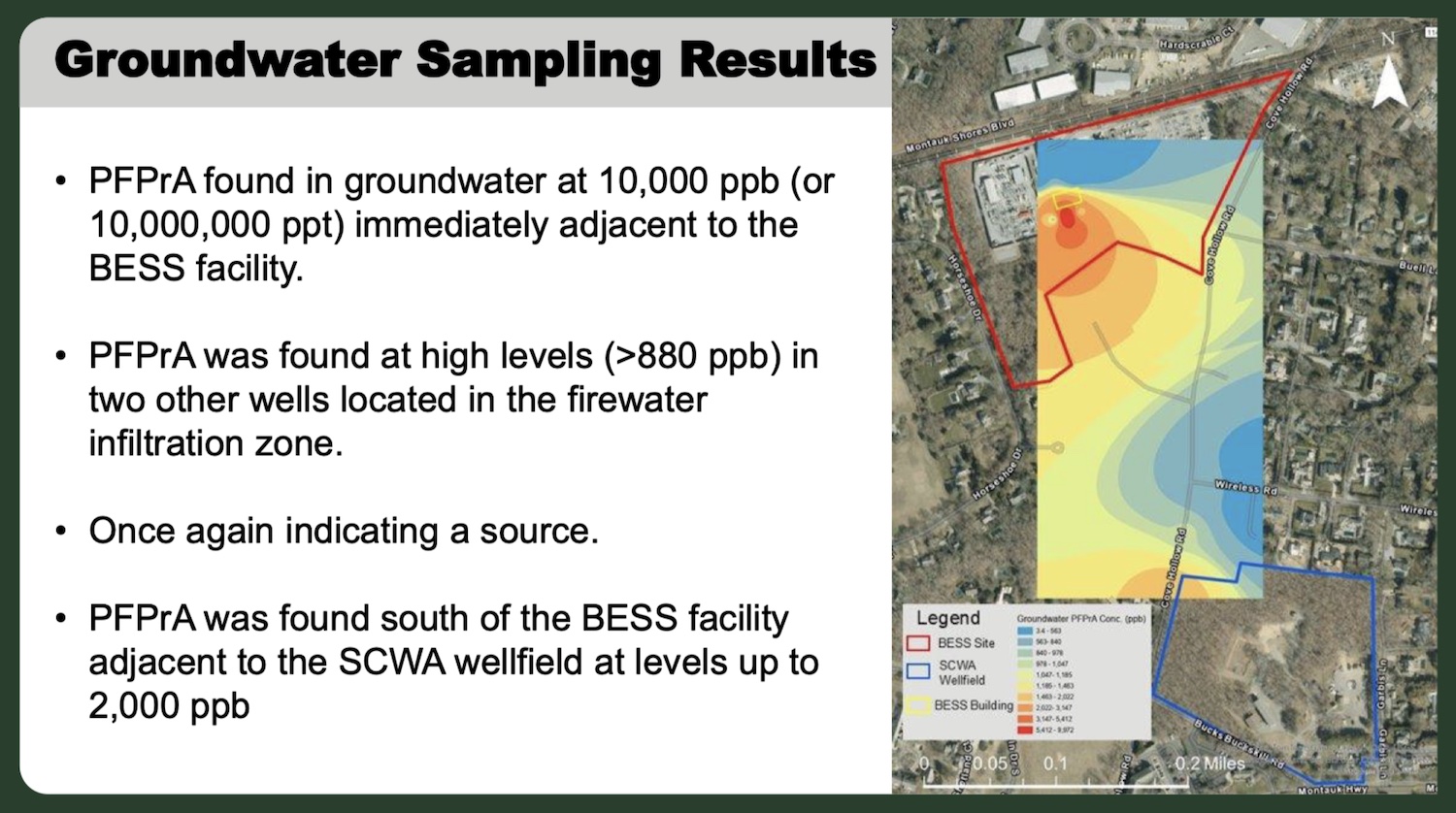
However, according to the D.E.C. investigation, soil sample results immediately adjacent to the battery storage facility showed levels of 600 parts per billion, with the groundwater sampling at an astounding 10,000 parts per billion.
PFPrA was detected up and down the soil column to the groundwater. At test wells adjacent to the water authority wells, it was found at levels up to 2,000 parts per billion.
Councilman Ian Calder-Piedmonte questioned Dr. Ginsberg on this discrepancy on Tuesday.
“We’ve spoken a lot about that three-parts-per-billion level, but the testing numbers show much higher numbers than that,” he said. “Can you speak to longer-term exposures at the levels that were actually tested?”
“We don’t know that anyone has been specifically exposed to that level,” said Dr. Ginsberg. “But at the highest detected levels in those monitoring wells, you’re using up a fair bit of the ‘margin of protection’ that we normally like to build in.”
He added that water is mixed between wells and that even if one well had very high levels, another may not and the two could be mixed. “Even within that one well field there were four supply wells,” he said.
“Are there ways to test the effects after it has left the body? Presumably there’s a chance for residual effects, even once the PFAS are no longer in the body,” Mr. Calder-Piedmonte said.
“The hallmark of PFAS in general and this one compound in particular, was liver effects,” said Dr. Ginsberg, again referring to the 2002 rat study.
However, he added that doing a health monitoring study in East Hampton may not make sense. For such a study, he said there needed to be a specific exposed cohort with a “well-characterized exposure history” based on blood and urine levels.
“Right now, we have a lot of questions and uncertainties about exactly what the blood levels may have been at the time of January, February, March, or before that,” he said. “So, we don’t have an exposed cohort with well-known biomarker levels or even certainty with what was in the drinking water. So, it’s not the ideal setup to do a health study.”
D.E.C. representatives expressed optimism that the plume and its contaminants could be cleaned up.
“There are absolutely techniques that we can use to address a plume of this size,” said Ryan Frederiks, project manager for the emerging contaminants unit in the division of environmental remediation for the D.E.C.
The East Hampton plume “is shallow groundwater, 150 feet deep, or so” and “fairly narrow.” The water authority wellfield is about half a mile south of the source.
He compared it to “the Navy Grumman groundwater plume” in Nassau County that was four miles long, two and a half miles wide, and 900 feet deep.
“If we can clean up the Navy Grumman groundwater plume, we could certainly do this,” he said.
Councilwoman Cate Rogers noted that New York State had banned firefighting suppression materials that contained forever chemicals and that 3M, the manufacturer of Novec 1230 had “stopped producing because of its PFAS.”
“Is that still being used in that facility as an addition to the water suppression system?” she asked.
Mr. Bollasina said he wasn’t sure, and directed that question to the New York State Research and Development Authority.
“Both agencies listening today are charged with protecting the public,” said Coleen Kalbacher, an East Hampton resident. “State law directs that your primary allegiance belongs to the citizens of New York. Given your actions to date, you’re both failing to fulfill this mandate.”
“In denying our request for biomonitoring and an epidemiologic study, the Department of Health argues that PFPrA clears the blood faster than long-chain PFAS,” she continued. “Yet you fail to acknowledge that even if a chemical has a short half-life, continuous daily consumption can create toxicity in the body. When one ingests PFPrA for years, that toxin is replenished faster than we can excrete it. Its toxicity profile shows that this continuous exposure can then trigger severe cellular damage. Just the nonstop processing of it alone by the kidneys can result in nephrotoxicity.”
The agencies said their investigation could be complete by the end of October, and a public information session would follow.