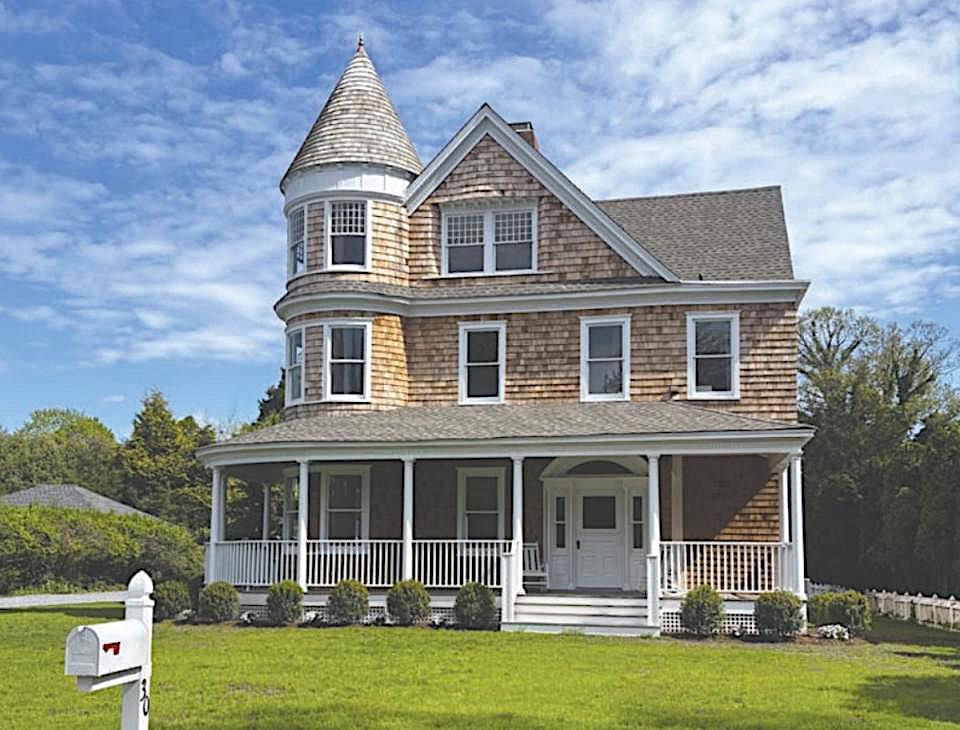
The recently restored 1896 Queen Anne-style house at 30 Huntting Lane in East Hampton Village was before the village’s zoning board of appeals when it met on Friday. The house’s new owner is seeking variances to make alterations to a garage built before the zoning code took effect, and to install swimming pool equipment within the required rear yard setback.
James Edward Huntting built the house while serving as president of the East Hampton Lumber and Coal Company, according to a 2025 article in EAST, The Star’s magazine. His grandson, Edward Tyler Huntting Jr., spent his early years and the last three decades of his life there. Described as eccentric and, in a 2024 article published online in Air Mail, a hermit with a tendency to scream and throw things at trespassers who believed the house to be abandoned, he died in January 2024.
Tom Strong, who for several years had assisted Huntting with landscaping and home repairs, restored the house to its former glory. It was sold in January, for $6.15 million, to a limited liability corporation.
The applicant has requested variances of 15 feet and 10.6 feet to increase the height of the garage, which sits on the rear yard lot line, and 4.4 feet from the side yard lot line, where the required rear and side-yard setbacks are 15 feet. Additional variances are requested to construct swimming pool equipment within the required rear-yard setback and to convert a portion of the garage into an accessory storage space 277.5 square feet in area, where the maximum permitted floor area is 250 square feet.
The property is in the Huntting Lane Historic District, and the alterations would require approval by the Design Review Board.
Richard A. Hammer, an attorney representing the applicant, noted that he has the distinction of “being yelled at by Mr. Huntting in the ‘80s, when I parked in front of his house,” before calling the application “straightforward.” An 1890s print of the house, he said, shows that its garage was originally a two-story structure located at the rear of the property. “We don’t know when the roof structure was altered to what it is today,” he said, adding that the existing flat roof is in very poor condition. “He wants to add some pitch to the roof, just so that it drains naturally.”
The D.R.B. and his client are “working out the details . . . as to what they will permit and think is appropriate there,” Mr. Hammer said. “They have no problem with the garage modifications.”
The applicant would like to use the garage to house pool equipment, he said. The garage already has a center partition, which “was set basically to provide enough room to install the pool equipment” and to allow the existing garage doors to remain without impediment. “The intention there was just to have the portion that’s not used for pool equipment be dedicated to storage.”
Billy Hajek, the village planner, confirmed that the D.R.B. had no concerns regarding the garage alterations or its reconstruction. However, “a 75-foot lap pool on this lot, they thought, didn’t appear to be appropriate. The guidelines call for swimming pools to be placed in the rear yard, and this extends up to the side yard of the house.”
But a swimming pool does not require variance relief from the zoning board, Mr. Hammer pointed out. “We’re only in front of you for the alterations to the pre-existing garage.” With respect to the swimming pool, “the architect is taking those comments and we will appear in front of the D.R.B.”
The hearing was closed, with board members seeming inclined to grant the variance relief.
Also at the brief meeting, Joseph Rose of the board, a former chairman of the New York City Planning Commission and director of the Department of City Planning, made note of the date, Sept. 11. “This is the 25th anniversary of 9/11,” he said, “which, especially for those of us who were down there, was just one of the most tragic moments.”
In addition to remembering “the innocent loss of life and the unmitigated evil that brought it about,” he said, “the heroic sacrifice of all these incredible emergency service workers who rushed in was something that needs to be honored and remembered, and not just in retrospect, for all the people who put their lives on the line and sacrificed, and are willing to sacrifice all the time.”
“It’s just something that really warrants an appreciation and reflection ongoing,” Mr. Rose added. “Not just on these anniversary moments, but all the time.”