The East Hampton Town Trustees voted unanimously to permit the construction of another oyster reef in Georgica Pond on Monday.
One oyster can filter up to 50 gallons of water per day, and oysters are able to create strong reef communities and can mitigate harmful algal blooms and nutrient loading by eliminating excess nutrients from the water. The trustees and residential property owners have taken a number of steps to improve Georgica Pond’s degraded water quality since blooms of toxic cyanobacteria began to appear there in 2012.
Those efforts, including the use of an aquatic weed harvester to remove macroalgae from the pond and the replacement of residential septic systems with innovative/alternative systems that remove nitrogen from wastewater, have proven effective. Kim Quarty, executive director of the Friends of Georgica Pond Foundation, told the trustees on Monday that cyanobacteria blooms have not been detected in the pond this year.
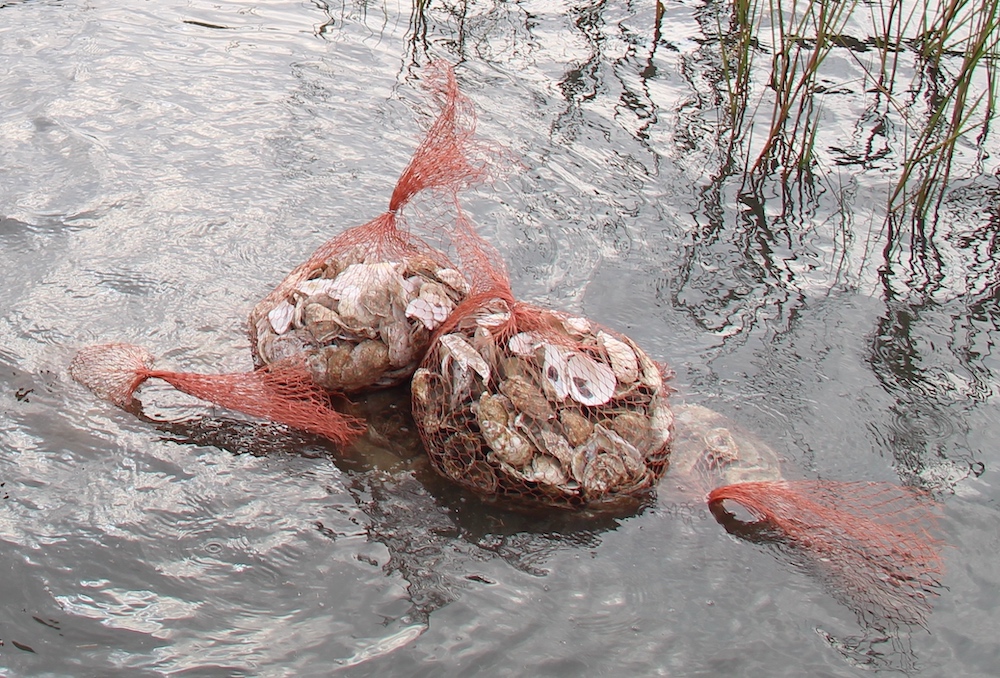
Oyster seeds, in cages to protect against predation, were initially installed in three locations in Georgica Pond in 2019. Oyster “spat on shell,” also in cages, was deployed in 2021, and small test oyster reefs using shell bags containing spat on shell were installed in two sites in 2022.
On Monday, Christopher Gobler of Stony Brook University’s School of Marine and Atmospheric Sciences, who has been monitoring waterways under trustee jurisdiction for more than a decade, told the trustees that the oysters in Georgica Pond “are displaying some of the fastest growth rates and highest survival rates of anywhere across Long Island.” This, he said, is in part due to the pond’s salinity. The same cohort of oysters did not survive in Shinnecock Bay, he said, because at higher salinity they are vulnerable to a disease caused by Perkinsus marinus, a parasite.
Throughout the progression from growing oysters in cages to growing them in spat on shell inside of cages to growing oyster spat on shell outside of cages in shell bags made of biodegradable mesh, “the results continue to be the same: oysters thriving,” Dr. Gobler said.
A healthy and robust blue crab population in the pond preys on juvenile oysters, he said, but oysters grown in shell bags “grow and grow,” ultimately immune to predation by blue crabs. “It’s actually a really nice balance in there,” he said. “The blue crabs are getting some benefit, but they’re not able to fully inhibit the oysters themselves.”
Now, Dr. Gobler proposes a reef five meters wide, 10 meters long, and one meter high, constructed from shell bags populated with individual oysters. “We have evidence that the oysters in Georgica Pond are also, on their own, reproducing,” he said. “Therefore, there’s the potential for the oysters, if we do expand there, to become a self-sustaining population with more oysters settling on that reef.”
Oysters can only grow on a proper substrate, he said, which is why shell bags are essential. “You’d never get oysters all across the bottom of Georgica Pond because the substrate there is inappropriate.” The northern third is muddy, he said, and the southern third is dominated by sand. “They need some sort of calcium carbonate in order to settle. That’s the nice thing here, is that we’re only going to get oysters where we put out the proper substrate.”
The reef would be constructed in the pond off Briar Patch Road, from which a property owner previously allowed Stony Brook researchers to access the site.
The trustees had been concerned that a reef might obstruct baymen who seine and trap a variety of fish and crabs in the pond. John Aldred said he had spoken with one several weeks ago, and “there is an object in the water, in the vicinity that the oyster reef is proposed, that is large and heavy and prevents them from pulling the seine in that vicinity.” It may be an engine or even a vehicle, he said. “So this location seems good for the project and a good place to avoid conflict with any baymen activities as well.”