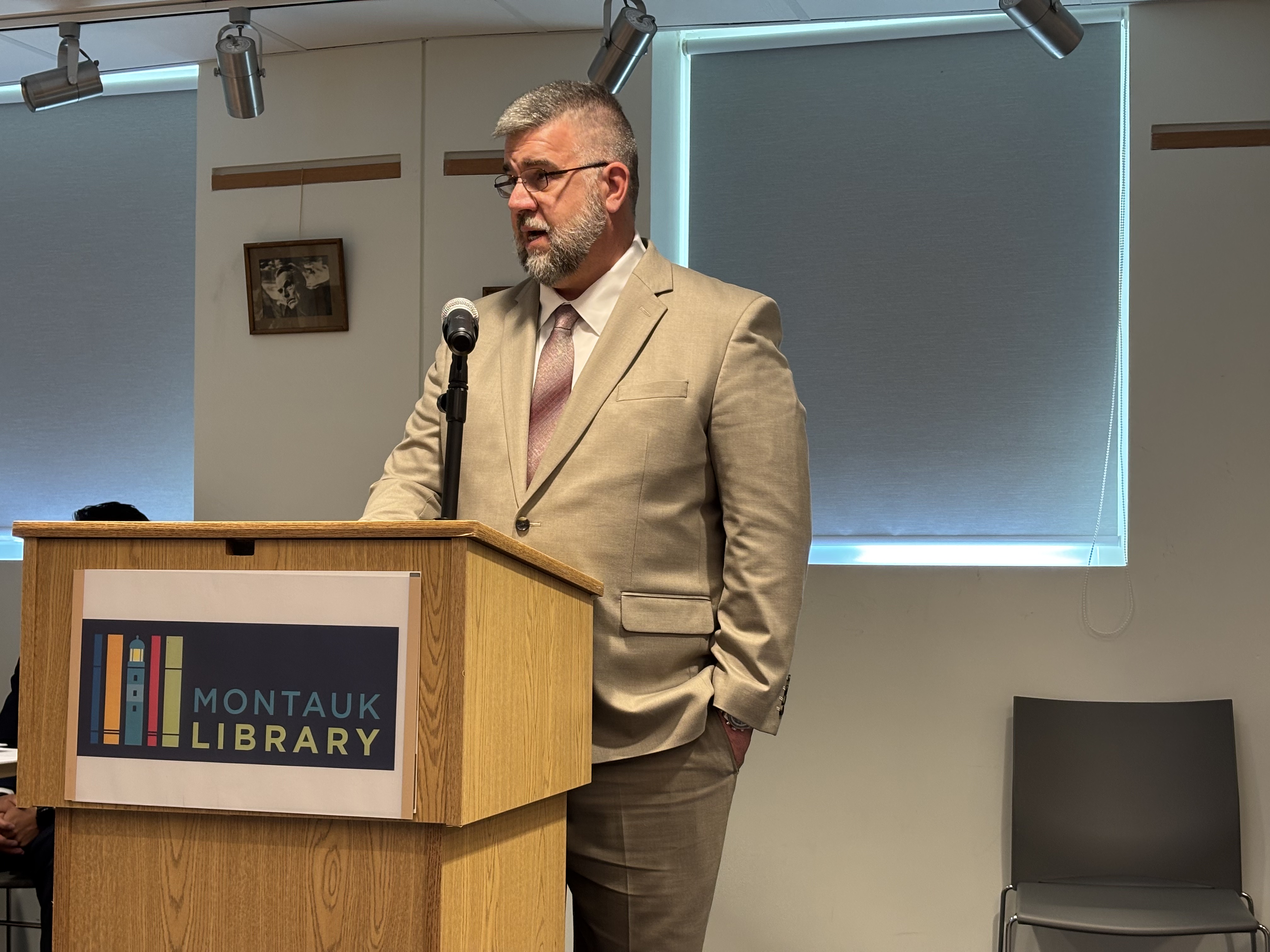
Months after questions were raised regarding whether Richard Normoyle Jr., East Hampton Town's chief building inspector, was properly certified by New York State for the role, an answer is in, via a statement from Patrick Derenze, the town's public information officer.
It turns out Mr. Normoyle wasn't properly certified, but now he is.
"We recognize that our earlier understanding was incorrect," Mr. Derenze wrote in the statement. "Once we learned that additional requirements remained outstanding, we acted to address the issue and ensure compliance with state requirements."
Mr. Derenze added in a follow-up email that the town "first became aware that there could be an issue with Mr. Normoyle's certification status in July," and he "took the required challenge examinations in Albany on Aug. 25. He passed both parts and was recertified that same day."
Also, because of something called the "de facto officer doctrine," the town believes past determinations Mr. Normoyle made are valid because "the acts of one who carries out the functions of public office under color of authority are generally valid . . . notwithstanding irregularities in which the officer was appointed."
The doctrine has its limitations, however. Perhaps the most important is that it doesn't make an invalid appointment legal.
Tiffany Scarlato, a local land use attorney, recently submitted an appeal to the town's zoning board of appeals questioning whether Mr. Normoyle's certification status should affect a determination he made in January about one of her clients, Hampton Raquet at Green Hollow.
She posed eight questions to the board regarding his determination, including: "Whether the administrative record establishes that the official who issued the determination possessed the qualifications and authority required for the office."
Ms. Scarlato could not be reached this week for comment, but it's possible her argument could be copied by other lawyers now seeking to void determinations with which they disagree.
Mr. Derenze said the town wasn't going to "speculate about hypothetical litigation."
"We want to be transparent about what we have learned," he wrote in the statement. "After questions were raised about his certification earlier this summer, the town sought clarification from the Department of State. Through that process, we learned that Mr. Normoyle's prior certification had become inactive during his years outside municipal service and that additional requirements should have been completed when he returned to municipal code enforcement."
He added that the town does not believe he lied on his original application, since "he had been advised when he returned to municipal service that his existing credentials satisfied the applicable requirements."
Mr. Normoyle first completed the New York State Basic Code Enforcement Training Program in 2002 but spent late 2008 until late 2021 outside of government.
The Department of State failed to respond to multiple queries from The Star seeking to clarify Mr. Normoyle's status.
"He continued his required in-service training and worked under the understanding that his certification was active," Mr. Derenze wrote. "That was also the Town of East Hampton's understanding when he joined our Building Department in 2025."
According to the Suffolk County Civil Service qualifications for chief building inspector, a "necessary special requirement" is the "basic training program entitled Minimum Standards for Code Enforcement Personnel established by the New York Fire Fighting and Code Enforcement Personnel Standards and Education Commission."
Mr. Normoyle's résumé, retrieved with a Freedom of Information Law request to the town, does not list the New York State code certification in question.
"Rich has earned my confidence, based on the work he has done since taking over the Building Department in September 2025 following an 18-month district attorney investigation, which created a tremendous backlog in the department," Supervisor Kathee Burke-Gonzalez said when asked if Mr. Normoyle had the town's confidence.
"When Rich started, the department had 10 staff members. Today, we have expanded to 19 authorized positions, with 18 filled, including dedicated plans examiners and additional administrative and inspection staff," she said.
"The department had previously projected that it would be fully caught up with the permit backlog by spring 2027. It is now projecting that the backlog will be resolved by the end of 2026, approximately five months ahead of that earlier estimate."
"The department is already fully caught up on solar applications, rental registry applications, and research requests, with those areas operating at approximately a one-week turnaround," she continued. "Rich has also overseen a reorganization of the OpenGov portal that has allowed smaller applications to be processed at a much faster pace."
"There is still work to do, but the department is moving in the right direction, it is ahead of where we expected it to be, and Rich deserves credit for the progress that has been made."
—
This article has been updated since it was first published.