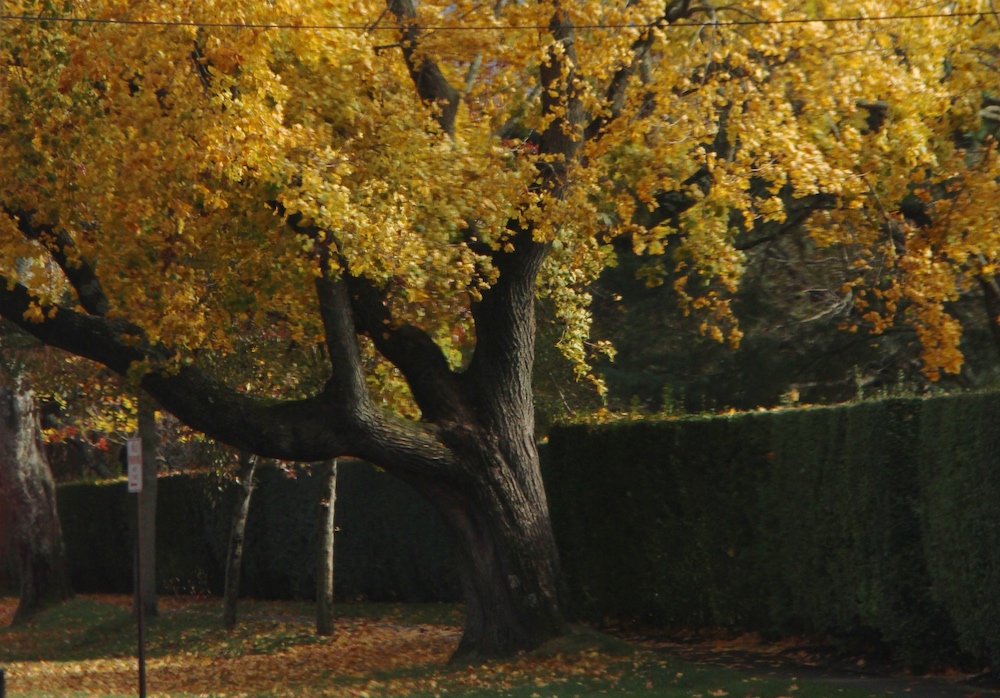
A renewed effort to protect trees located in town-owned rights of way was before the East Hampton Town Board on Tuesday, and all agreed the proposal needed a little “finessing” ahead of a second discussion, which could happen “in a couple of weeks.”
“We’re seeing road rights of way treated as staging areas and getting cleared,” said Councilwoman Cate Rogers. “These are not private property. The town rights of way have a purpose.”
Jake Turner, the town attorney, explained that the legislation would be triggered by application for a building permit. If a tree is to be affected by the issuance of a building permit, say for a new build, the applicant must demonstrate to the Building Department that necessary safeguards are in place to ensure the town-owned tree will be protected.
“How it is judged is determined by the Department of Natural Resources, who says, ‘Yes, we have looked at the proposal and determined that what is being suggested here will provide the adequate safety measures,” said Mr. Turner. Those measures could include fencing an area of the tree large enough to protect its roots.
“What we’ve learned through science is that when you compact a mature tree’s root zone, when you park on it with trucks or cars, it compresses the soil,” said Councilwoman Rogers. “That destroys the roots, which then takes out the tree.”
During the public portion of the meeting, Michael Forst, a builder, said it was an “extreme law,” which could prevent access to parcels with narrow openings. “Tree protection is important,” he said, “but we feel like this is way too vague.” He asked the board to specify sizes or species of trees to be protected.
Jaine Mehring, however, objected: That was really beside the point, she said. While the code could benefit from specifics, most parcels being developed already have a defined access point, she said, “where the driveway should go. Everything outside of that is the right of way. I really don’t understand why we’re not just protecting all the trees in the right of way. You could use a species list. You don’t need to keep certain invasive trees.”
Expanding that idea, she cited a measure brought forth years ago by Councilman David Lys that hasn’t been acted on. “You brought forward the idea of a broader protection of rights of ways,” she said, addressing Mr. Lys. “We should keep all the good vegetation. It’s not just trees. There’s native resources. We should stop sodding, irrigating, all those things in the rights of way.”
The board was supportive in concept, assuming the extra work would not overburden town staff or slow down the building permit process.
Councilman Ian Calder-Piedmonte had a simpler solution.
“Mark the right of way from the property side of things and say you can’t go there,” he offered. “You can open up an access. I’m supportive in concept and open to the measuring of trees and all of that, but to me it’s not so much what species of tree. If it’s not your property, you shouldn’t be cutting anything down. Just say ‘Stay out of the right of way.’ “