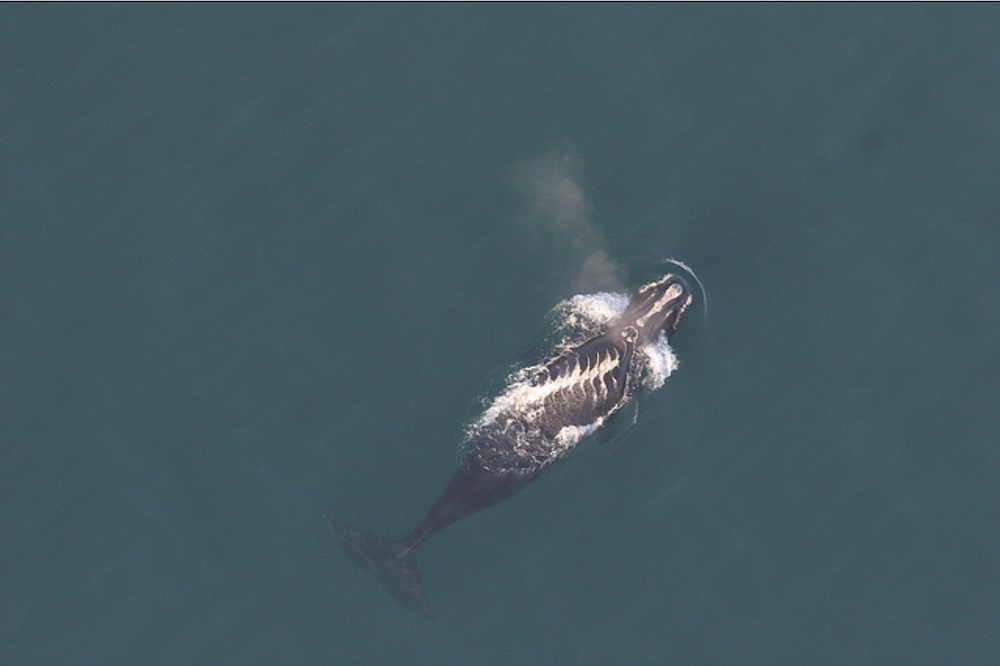
Last week, Representative Nick LaLota joined his Republican colleagues in a mostly party-line vote to extend the postponement of protections for the North Atlantic right whale until 2035.
The bill was introduced by another New York Republican congressman, Mike Lawler.
“This action could most likely exacerbate the extinction of North American right whales,” Artie Kopelman, president and senior scientist at the Coastal Research and Education Society of Long Island, wrote in a text.
The North Atlantic right whale is the world’s most endangered large whale, with an estimated population of only 380, including just 70 breeding females. Right whales are regularly seen off Long Island. They migrate 1,000 miles from their northeast feeding grounds to their southern calving grounds. In 2024, a quarter of the North Atlantic right whale population was found in just a single day 40 miles from Long Island.
The North Atlantic right whale is Long Island’s to save.
The legislation, named the Northeast Lobsterman Protection Act of 2026, passed the house on Sept. 1. It now heads to the Senate.
“Of those 380 whales, 87 are injured or in poor health, including 60 suffering from entanglement-related injuries,” wrote Jared Huffman, a California representative, in the dissent research on the legislation. “H.R. 9436 presents a false choice between a robust lobster fishery and the survival of these whales, when the technology to support the lobster fishery and protect whales exists and has a strong success rate.”
In 2023, the same protections were delayed until 2028. The delay mostly helps to protect the Maine Lobster fishery, which lands 100 million pounds of lobster yearly, employs 5,600 lobstermen, and contributes $1 billion to the state economy, according to the legislation.
By contrast, according to the New York State Department of Environmental Conservation, New York landings of lobster over the last five years have averaged just 115,000 pounds, with no signs of recovery. Between 1988 and 2003, Long Island landed over a million pounds of lobster annually, peaking at over nine million in 1996.
The D.E.C. says climate change has simply pushed them north.
“The Atlantic States Marine Fisheries Commission Lobster Technical Committee identified a shift in the distribution of surviving Southern New England lobster to deeper water, likely driven by warming water temperatures,” the D.E.C. relayed in an email. “Prolonged exposure to water temperatures above 20 degrees Celsius is very stressful to American lobster.”
“The most recent Atlantic States Marine Fisheries Commission American lobster benchmark stock assessment (2025) has shown that lobster abundance estimates in Southern New England have declined since the late 1990s to record low levels. Model estimates of recruitment and spawning stock biomass for Southern New England have also declined to record low levels. Analysis of these estimates indicates a declining trend in stock productivity, indicating reproductive success is insufficient to sustain a stable population at current exploitation rates.”
So, unless ocean temperatures decline, which is unlikely, the lobster fishery won’t be returning to Long Island too soon, whatever nets they use.
So why not shift focus to the steeply declining whale instead?
Because even after one postponement, the Maine lobster fishery says it needs more time “to inform workable regulations.”
Meanwhile, since the first postponement was enacted, at least 55 right whales have been killed or seriously injured, according to Representative Huffman’s research. That equals nearly 15 percent of the total population dead in just the last four years.
If the math continues to work in that matter, by 2035, there will be fewer than 250 of the whales remaining.
Ahead of the vote, advocates wrote to Mr. LaLota and other New York and New Jersey congressional members, but to no avail.
According to the Aug. 31 letter from community, environmental, and civil leaders, including the the aforementioned Dr. Kopelman, and Carl Safina, an endowed professor in marine science at Stony Brook, and Brody Eggert, the Long Island Chapter manager of the Surfrider Foundation, “86 percent of living right whales carry scars from past entanglements.”
Mr. LaLota acknowledged the whale’s precarious situation, but argued the extension was necessary.
“The North Atlantic right whale remains critically endangered, and protecting it matters to Long Islanders and to me,” he wrote in a statement.
“After speaking with stakeholders on both sides, I joined a bipartisan majority, including 10 Democrats, to extend the current framework while keeping National Oceanic and Atmospheric Administration’s existing whale protections in place,” he continued. “Fishermen have already made significant changes to reduce entanglements, but the next generation of fishing technology is not yet proven safe, affordable, or scalable. This extension gives NOAA, scientists, and fishermen more time to develop solutions that actually work, protecting right whales without unnecessarily putting Long Island fishermen and other working waterfronts at risk.”
Those who support protections do not want lobstermen to cease catching lobster, they just want them to use different equipment to do so.
“Rope-less or on-demand traps have absolutely shown to become effective and safe,” wrote Dr. Kopelman. “Scalable and affordable, I can’t speak to. The biospheric costs of the loss of this species is most likely significant and costly. We can and must continue to protect this species for all.”
At the Atlantic Marine Conservation Society “when we respond to a stranded or injured animal on our beaches, we see the end of a story that began in the ocean,” said Rob DiGiovanni, its founder and chief scientist. “Across our 2017-2025 whale stranding records in the New York Bight, approximately 42 percent of cases documented human interaction, including vessel strike, entanglement, and interactions with marine debris and fishing gear, during the examination. These findings underscore the importance of understanding and reducing the human-caused threats facing whales in the waters we share.”
Craig O’Connell, a shark expert who runs the O’Seas Conservation Foundation out of Montauk, said in a text, “The fishermen I work with in Montauk understand sustainability and how gear entanglement can greatly impact wildlife -they do everything in their power to prevent it. That’s the fishermen I work with, I don’t speak for others. With that said, that just sounds like an uninformed excuse by Represenative LaLota.”
“I once had a piece of technology that would successfully minimize the potential negative interaction between sharks and beachgoers,” he continued, “and it was the most rigorously tested piece of shark mitigation technology to date; however, governments used the same excuse -‘the technology isn’t affordable or scalable’ (even though it was substantially cheaper than current approaches). These are called political decisions rather than informed ones.”
“According to current best science, the North Atlantic right whale can afford only 0.7 whale deaths per year due to human causes if it is to recover,” wrote Representative Huffman. “Since 1996, fisheries operating in state and federal waters have been required to comply with the Atlantic Large Whale Take Reduction Plan to reduce whale injury and mortality.”
“H.R. 9436 would delay the deadline for implementing new regulations to reduce whale entanglements from 2028 to 2035, effectively creating a 13-year waiver from Endangered Species Act and Marine Mammal Protection Act requirements.”
“Such an extension would reduce incentives to test and deploy innovative fishing technologies while disadvantaging lobstermen and women who have already made good-faith efforts to adopt safer gear,” he added.