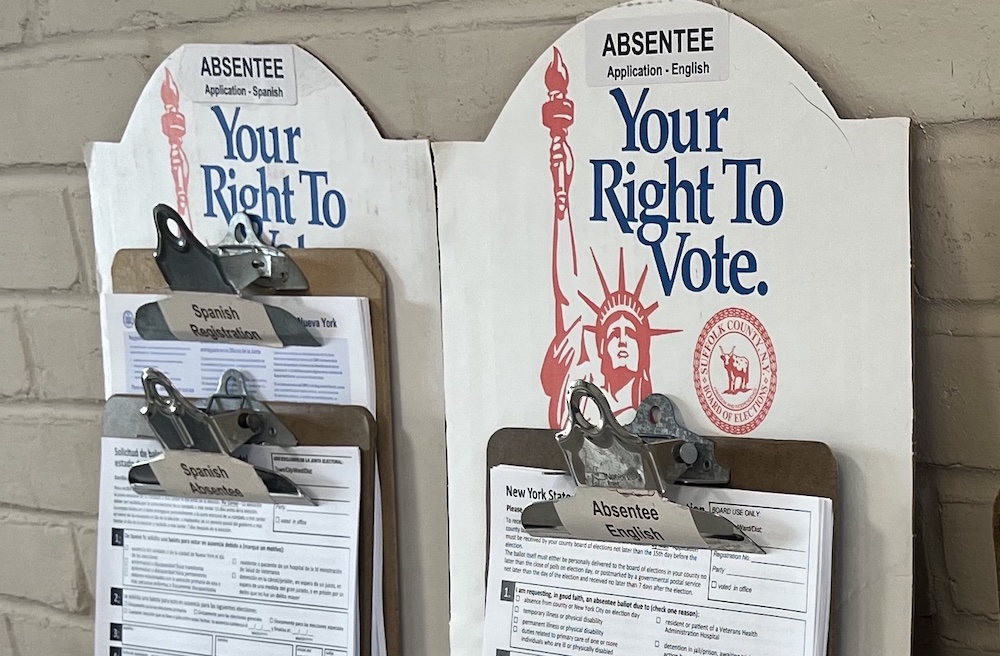
The Supreme Court is expected to rule imminently on the legality of the Trump administration’s effort to restrict voting by mail, a plan that as of yesterday remained in limbo due to lower court rulings. Should the Supreme Court side with the administration, critics say, massive voter disenfranchisement is the likely outcome.
A presidential executive order issued in March directed creation of a national list of citizens that would determine voter eligibility, though the executive branch has no constitutional authority over elections. Rather, under the Constitution, states have responsibility for regulating elections.
The order requires states to upload a voter list to a federal mail ballot portal that, fewer than eight weeks before the Nov. 3 midterm elections, has yet to be unveiled and that a whistle-blower contends was developed “in a rushed and sloppy manner that could jeopardize voting by mail across the country,” according to The New York Times.
States would upload the names, addresses, and a unique bar code of voters to whom mail-in ballots would be sent, and they would be required to use United States Postal Service-approved envelopes for all mail ballots so that the bar codes could be scanned. The Postal Service would scan the bar code of one ballot among as many as 10,000 to check the recipient against the list of voters uploaded to the portal. If a bar code did not match one on the voter list provided via the portal, the ballot would be rejected and returned to election offices, potentially delaying an entire bulk mailing, according to The Times.
States that do not provide their voter data would be denied services for election mail altogether. Multiple Democratic-led, or “blue,” states, along with voting rights advocates, have sued to block the rule and indicated that they will not comply.
North Carolina has already begun sending out absentee ballots, and 19 other states are set to mail ballots to voters by Sept. 19.
According to the nonpartisan nonprofit States United Action, 31 percent of people voted by mail in the 2024 election, and 32 percent voted by mail in 2022. The president, who himself has voted by mail twice in 2026 alone, regularly asserts without evidence that mail-in voting is vulnerable to fraud and attempts to sow doubt in the integrity of elections. In fact, illegal voting is vanishingly rare.
In June, a Massachusetts federal court struck down components of the executive order. The administration appealed, and last month the Supreme Court sided with it, ruling that the lower court’s decision was preliminary but not weighing in on the executive order’s legality. On Aug. 27, the United States District Court judge in Massachusetts again blocked key components of the Postal Service’s plan.
On Sunday, the Trump administration again asked the Supreme Court to allow its restrictive mail-in voting rules to take effect before the midterm elections.
The Postal Service, according to a Sept. 1 statement, “has spent months developing a U.S. Federal Ballot Mail Portal to provide election officials with a simple, secure, and efficient way to share lists of individuals receiving ballots by mail in their respective states. This work has at all times been conducted in a manner consistent with court orders.”
The Postal Service, the statement continues, “is now finalizing the portal and will soon make it available to election officials who voluntarily wish to familiarize themselves with the platform. USPS will also provide tools, presentations, and other resources to help election officials understand the platform and make informed decisions about whether and how they wish to use it. . . . Regardless of political party or perspective, we share a common goal: ensuring that Americans
can have confidence that their election mail will be handled securely and delivered reliably.”
Polls, and history, suggest a “blue wave” midterm election: Though he is not on the ballot, an Ipsos poll conducted between Aug. 28 and 31 put the president’s approval rating at 33 percent, against 63 percent disapproval. Other polls have the Democratic candidate leading the Republican candidate in several campaigns for the House of Representatives and the Senate. Should those prove accurate, the Democratic Party is expected to regain a majority in the House and, possibly, the Senate.
The party that does not control the White House has historically made gains in midterm elections, particularly in a president’s second term.
The progressive political action and advocacy organization MoveOn will promote early voting as a strategy “to overcome attempts to rig our elections,” according to an email sent on Monday. The group plans block parties, rallies, walks to polling stations, “and everything in between.”
The League of Women Voters of the Hamptons, Shelter Island, and North Fork will host a virtual forum on voting rights and the midterm elections on Sept. 30. That and other League events are covered separately in this issue.
Election Day is Nov. 3. In Suffolk County, early voting begins on Oct. 4 and concludes on Nov. 1.
An email and calls to the Democratic and Republican commissioners at the Suffolk County Board of Elections seeking information on their plans in the event that mail-in voting restrictions are implemented had not been returned as of Wednesday.