“Happy Tumbleweed Tuesday!” East Hampton Town Supervisor Kathee Burke-Gonzalez said at the start of Tuesday’s work session before the town board attacked another plant, bamboo, with a discussion of draft legislation that would prohibit its planting.
“We’re saying, ‘All right, no more bamboo,’ ” said Jake Turner, the town attorney.
However, it’s not that simple. Bamboo would still be allowed 10 feet from a property line if it is properly contained. What is proper containment? That wasn’t clear.
Bamboo would be prohibited from encroaching onto neighbors’ properties. If it did, the owner of the bamboo would receive a “notice and opportunity to cure” the situation from code enforcement. How long would they have to remediate the situation? Not yet clear.
The draft legislation gave 30 days, Ms. Burke-Gonzalez mused that maybe a year was a more appropriate time frame, given how difficult and expensive it is to remove the plant.
The Department of Natural Resources would provide “technical expertise concerning bamboo identification, growth, containment, and remediation.”
Also, if bamboo travels onto a homeowner’s property from elsewhere, they may still be liable for its removal.
Violations would be adjudicated by the bureau of administrative adjudication, “an internal court within Town Hall,” explained Mr. Turner. “It’s not criminal in nature, instead, it’s civil in nature. We have our lesser-fined offenses go to such a court, the internal court.”
Michael Forst, owner of Forst Construction, called into the public portion of the meeting to warn the board about the cost to homeowners.
“I agree it’s invasive,” he said. “But you don’t realize the cost you’re putting on homeowners. The disposal costs are huge.” He cited a removal in East Hampton Village last year on an acre that cost close to $100,000. “Maybe the cost could be helped by the town in some fashion,” he said.
Meanwhile, Jaine Mehring wanted to make it even simpler. “The code says it prohibits the planting of new bamboo except where it complies with containment and setback requirements. I don’t understand why we’d even allow the planting of bamboo anywhere. Many other municipalities just ban all the invasives.”
Encroaching bamboo has been the subject of a summerlong planning board application by Most Holy Trinity Cemetery on Cedar Street in East Hampton.
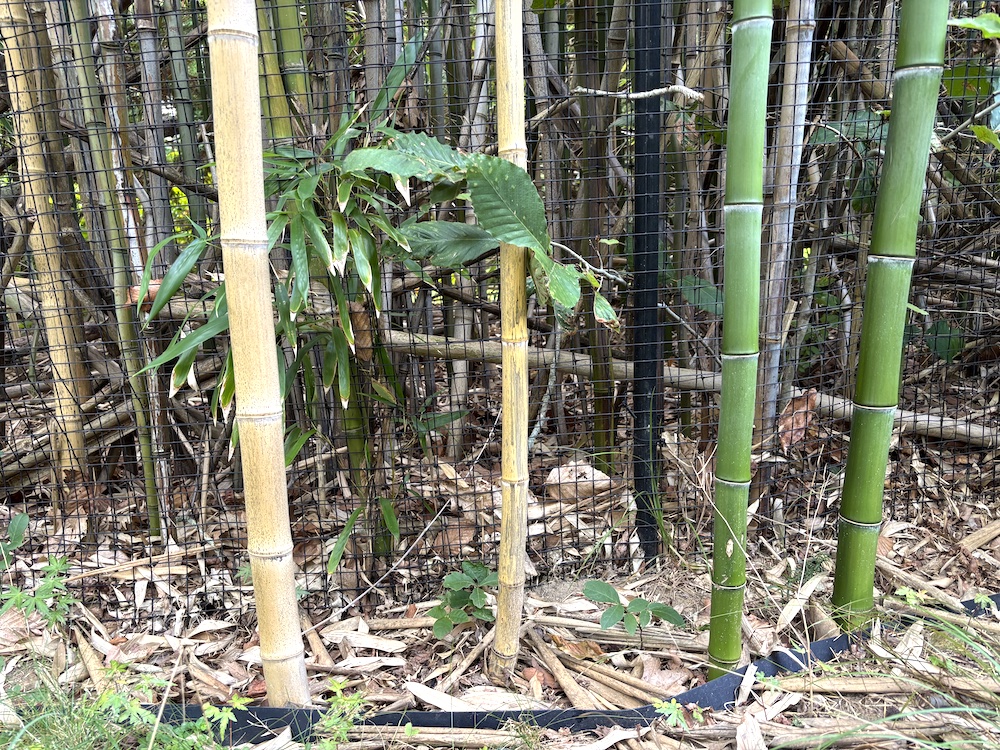
Bamboo planted decades ago by the cemetery’s neighbor, the LongHouse Reserve, has jumped its southern property line, entered into a “non-disturbance buffer area” and could threaten graves.
The cemetery, even though it never planted the bamboo, has to get rid of it. Of three options to do so, the Planning Department supported the installation of a root barrier and gave the cemetery permission to cut the bamboo at grade level to remove it. After it is removed, it would revegetate the area with clover or native grasses.
“The invasive species on site appear to be spreading aggressively and rapidly and a root barrier would most likely be the most effective way to stop the spread and protect burial plots and existing woodlands on site,” said Eric Schantz, a principal planner, at an Aug. 5 planning board meeting.
The planning board appeared ready to approve the plan, but is waiting on covenant and restriction language to be added to the determination. The work will come at a high cost to the cemetery.
“When the bamboo leaves the property that it’s planted on, then it becomes the burden of the neighbors and the cost to the neighbors,” said Councilwoman Cate Rogers, back at Tuesday’s meeting. “So that’s why this is important legislation.”
The rest of the board was supportive, if questioning.
“There are two types of bamboo,” said Councilman Tom Flight, “running and clumping. Whether we want this to include all bamboo is a question we need to consider.” He also wasn’t comfortable with someone being fined if they didn’t plant the bamboo themselves. “We need to think of justice and of someone being at fault for something outside their control.”
“That’s another reason we put it in the” bureau of administrative adjudication, said Mr. Turner, “so it’s more civil in nature and not criminal.”
Mr. Flight also said the legislation needs to define “adequate containment,” and questioned whether the Natural Resources Department would be able to handle the added workload.
“Bamboo can be problematic and destructive,” agreed Councilman Ian Calder-Piedmonte. He wondered if there was a way to notify potential homebuyers that it could be their responsibility to remove the invasive if they purchase a property encumbered with it.
Even dumping downed bamboo is problematic. It can’t go in with organic waste material because it easily resprouts. It must be dumped with construction debris, which is more costly.
“I agree in concept,” Ms. Burke-Gonzalez said.
The board will soon have another discussion, with more specifics, including both the Highway and Natural Resources Departments.
Regardless, a public hearing will have to be held before any law is passed.