Slowing things down in Sag Harbor may be the best way to clear up traffic woes for village residents, it seems, and making it more difficult to drive through the village may be the key to keeping unwanted traffic out.
Traffic, which has become intolerable for many in a village that has grown exponentially in population and popularity in recent decades, has become more of a hot-button issue than ever.
During a work session on June 25, the village board discussed the possibility of creating more stops and backups to make the village a less desirable cut-through for traffic heading to points east or points west.
L.K. Mclean Associates, the engineering firm from Brookhaven and Hicksville contracted by the village to perform the first phase of a traffic and parking study, appeared that evening with theories on how to revamp the most notorious traffic hang-ups in the village — most involving adding all-way stop signs to difficult four-way intersections.
A designated turning lane was proposed to keep traffic flowing on Hampton Street between Hamilton and Lincoln Streets.
Bob Plumb, a trustee, described adding more stops as “traffic calming,” an engineering term that refers to slowing traffic down to reduce the impact of cars. Signs, surface markings like crosswalks, road rules, and added police enforcement would all be implemented.
Ed Haye, the deputy mayor, said a pilot program that started last month in the John Street and Jesse Halsey Lane neighborhood to reduce traffic has been successful so far. Anecdotally, residents have reported a 60-percent decrease in traffic, he said. Simple changes like stop signs and one-way signs have changed the traffic landscape of the area.
Mayor Tom Gardella suggested the possibility of a full-time police team that would focus entirely on traffic. “That’s all they’ll do,” he said of the group, adding that he is working with Sag Harbor Village Police Chief Robert Drake on the matter.
While traffic calming may seem contrary to the goal of reducing traffic, some say the plan will allow local traffic to move more freely since, eventually, fewer cars would be on the road. Pedestrians also would be safer under the plan, they say.
However, pedestrians themselves may be part of the problem, Mr. Haye said. He floated the idea of eliminating the crosswalk from Bay Street to Main Street, saying pedestrians mindlessly cross in the high-traffic area while looking at phones or otherwise not paying attention
Matt Jedlicka, a principal at L.K. McLean, said eliminating crosswalks is “tricky,” and Steve Eisenberg, an associate at the firm, told the board there are other tools that could be used. He suggested a flashing light that would signal when pedestrians could safely cross.
At the same time, Mr. Haye suggested the possibility of adding a crosswalk across Route 114 to help pedestrians get to Havens Beach.
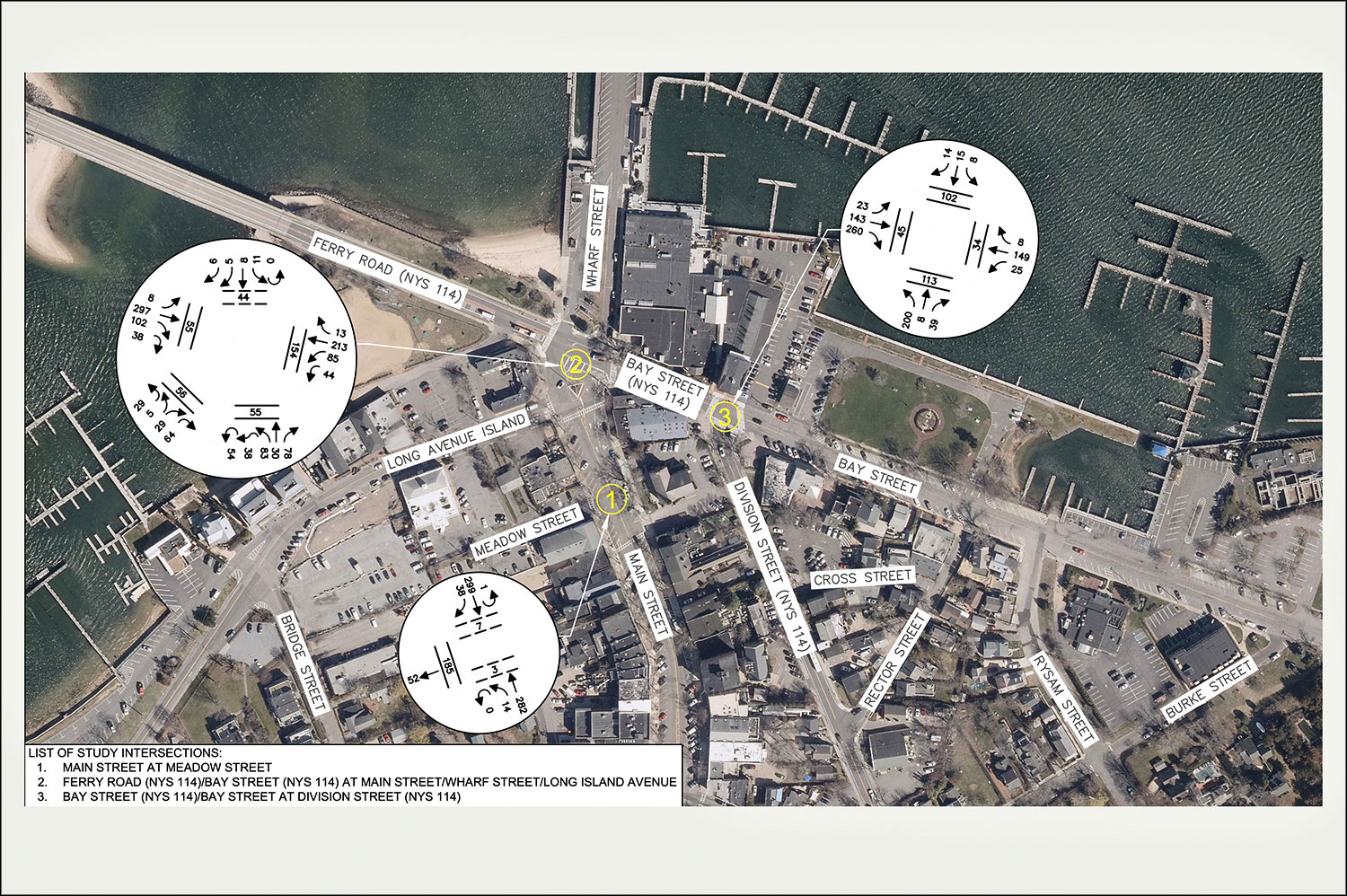
L.K. McLean compiled data last summer from Memorial Day through Labor Day weekend. The firm’s designs and plans are still in the conceptual phase as village officials parse the details and review written comments from residents.
The intersections studied were Ferry Road at Main Street; Long Island Avenue and Bay Street at Division Street; Main Street at Garden Street and Union Street; Hampton Street/Division Street and Union and East Union Streets, and Spring Street at Main Street and Madison Street.
Notably missing, some in the audience that night said, is Jermain Avenue, a main artery that cuts through the village and intersects at Hampton Street (Route 114), Division Street, Madison Street, Suffolk Street, and ultimately Main Street at the Bridgehampton-Sag Harbor Turnpike.
Board members seemed all to agree that Route 114 is dangerous as it splits from Division Street. Mayor Gardella, a member of the Fire Department for 40 years, said the area is notorious for “really major car accidents when it veers off.”
Mr. Haye said the road banks at just the place where people start to pick up speed leaving town. Mr. Plumb added that the house on the corner has been hit multiple times by cars, and Aidan Corish, another board member, said a sign someone nailed to a tree at one point said simply “journey’s end,” calling attention to the number of accidents in the area.
Something as simple as stop signs there could cut down on speed.
Route 114 is owned and maintained by the state, which complicates what the village is able to implement and enforce there. Mr. Eisenberg said that while the state would be unlikely to pay for improvements to the highway, officials would have input on any changes the village proposes.
Of the intersections analyzed and graded by the group on a scale of A-F (A being working well and F being failing), all received grades of either E or F. Both grades indicate long waits and backups.
Commercial traffic is at the heart of the issue, Mayor Gardella said. What is known as the “trade parade,” traffic consisting of tradespeople coming to work on the East End from points west during rush hour, is streaming through the village in order to avoid traffic congestion on main roads.
This is a relatively new development since mobile applications like Google Maps and Waze have grown in popularity, leading to traffic following most efficient routes created by an algorithm that collects real-time traffic data.
That traffic “bottlenecks” at the base of the Jordan C. Haerter Bridge to North Haven at the intersection of Bay Street, Main Street, and Wharf Street, the mayor said.
Narrow streets like Union Street cannot support two-way traffic of large commercial vehicles. Mayor Gardella said in that case, the village should prohibit commercial vehicles from using those roads.
The traffic-calming pilot program in the John Street and Jesse Halsey Lane neighborhood is seeking to change those algorithms that let drivers know it is quicker to cut through the neighborhood.
Local laws that change speed limits and add one-way designations are part of that shift.
Parking in the village has proven to be just as complicated. And while the village board has revamped parking areas, limitations, fees, and residential permitting, a larger and longer-term solution is now being discussed.
There are nearly 2,000 parking spaces in the village — both publicly and privately owned.
As Mr. Corish sees it, the village should be approaching the parking issue as many European cities do — by removing parking from the downtown area — something he called “remote parking.”
Indeed, according to Robert Bove, a senior traffic engineer from L.K. McLean, some cities, most notably San Francisco, have pushed that concept even further by creating a dynamic pricing system on parking areas. Dynamic pricing can be increased or lowered to incentivize drivers to park where the village wants them to park.
For example, if parking on Wharf Street is full, the village could, in real time, drop the price of parking at the gas-ball lot on Bridge Street.
Other ideas, such as a parking garage and underground parking, were suggested by the engineers. The mayor said most residents are opposed to a parking structure, but added that he would be open to seeing what a structure would look like.
Additionally, some green space in Marine Park could be taken for additional parking. A curb cut along Ferry Road could also allow for some new parking.
The traffic and parking discussions will continue, with additional phases of study to come. Residents have been asked to submit comments or suggestions in writing. An online form is available on the village’s website.