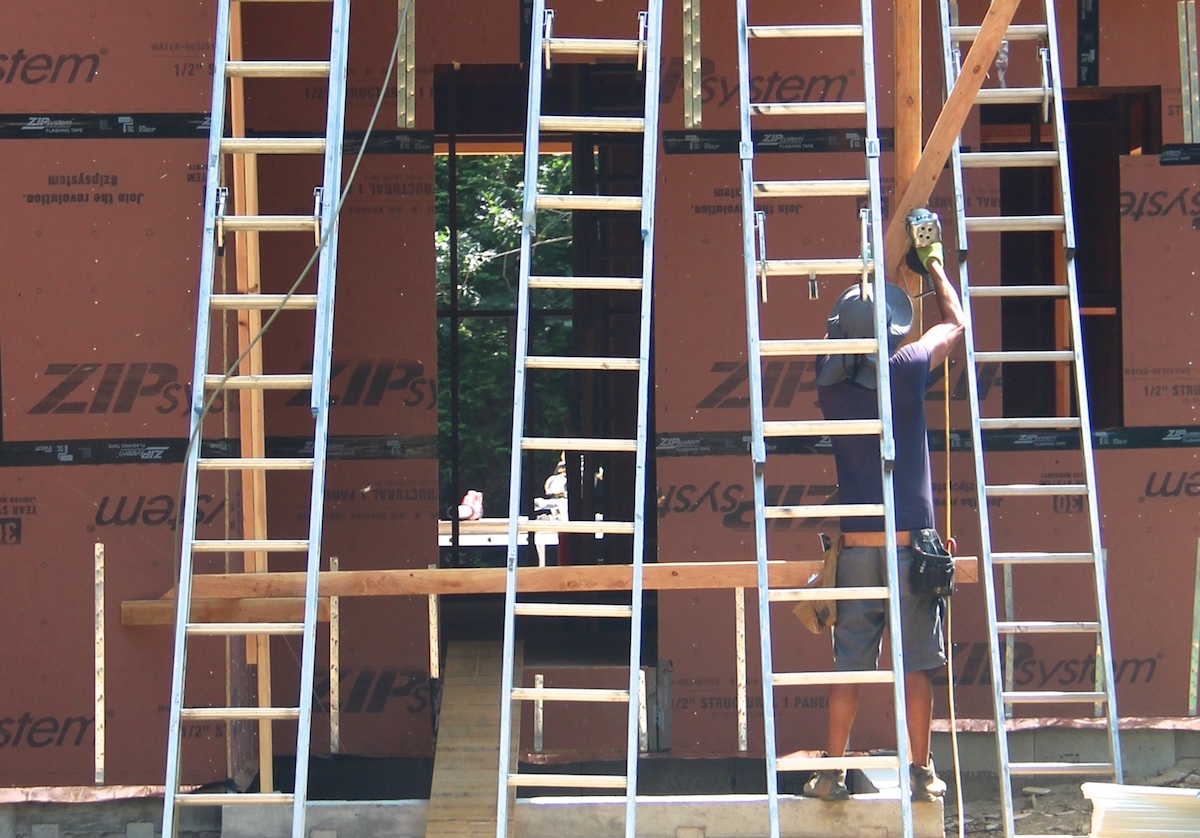
The Let Them Build agenda that is aimed at expediting construction of housing, a component of New York State’s fiscal year 2027 budget signed by Gov. Kathy Hochul last month, is drawing negative reviews from environmental advocates on the South Fork, while the legislation was quickly followed by the Long Island Builders Institute’s formation of a council dedicated to construction in the five East End towns.
The enacted budget includes “significant reforms” of the State Environmental Quality Review Act, or SEQRA, “modernizing the law to expedite projects that meet criteria which ensure they have no significant environmental impacts and to let localities build the housing and infrastructure New Yorkers need in communities across the state,” according to a statement from the governor’s office.
Housing projects in New York can take as much as 56 percent longer to get from concept to groundbreaking compared to those in peer states, according to the governor’s office. The budget includes “common-sense changes to modernize SEQRA and expedite categories of housing and infrastructure projects consistently found not to have any significant environmental impact.”
Reforms will provide exemptions from “duplicative environmental review,” according to the governor’s office, when “too many projects . . . including much-needed affordable housing developments, are forced to navigate a web of red tape created by state mandates that add unnecessary costs and years of needless delays.” Let Them Build “will help cut costs and speed construction for qualifying housing” of up to 100 units in non-urbanized areas.
But “there isn’t a word in the legislation about affordability,” said Bob DeLuca of the environmental advocacy organization Group for the East End. “What that means for this region is, the types of projects that could now be exempt could include market-rate luxury development proposals . . . and there is no good reason those projects should be denied a rational environmental review, because they won’t have anything do to with affordability.”
“I am really angry about the potential ramifications of weakening SEQRA,” said Adrienne Esposito, executive director of Citizens Campaign for the Environment. “Protecting the environment isn’t preventing affordable housing from being built. There’s no reason to be pitting housing against environmental protection, we should be able to do both. The reason developers don’t build affordable housing is because they make more money building expensive housing.”
“I don’t think the issue is so much about more building,” said Kay Tyler, executive director of Concerned Citizens of Montauk. “The issue is, where in the language does it identify what affordable housing is? We all believe in more affordable housing — it’s a dire need, not just in New York but everywhere. The issue is the language does not identify it. That’s the scary part of it. This is where big builders will find that loophole and build a number of $10 million mansions because there is the space for it.”
“For this region, the market is driven toward high-end and luxury development,” Mr. DeLuca agreed. “If you really want to say, ‘We believe this process is impossible to go through, for affordable projects we will provide an exemption,’ I could have my concerns about that. But the word is not even in there.”
Also troubling, he said, “is that it showed up in the budget and didn’t start as a regulatory proposal.” SEQRA regulations have been updated since the law was originally enacted in 1975, he said, typically via “a defined process where there are public hearings,” usually conducted by the State Department of Environmental Conservation and including a report on public comment and a series of recommendations. “This process bypasses that and shoved it into the State budget, where very few people spend a lot of time sifting through 800 pages to even find these.” The changes to SEQRA were opposed by Assemblyman Tommy John Schiavoni and Senator Anthony Palumbo.
He noted that the East End Supervisors and Mayors Association registered its “strong opposition” to amending SEQRA, writing in a May 1 letter that the changes “would undermine important guardrails protecting our natural resources, public health, and sustainable development efforts, particularly on the East End” as well as “take away important tools and decision-making powers from towns and villages, who understand their municipalities better” than the state.
“The idea that somehow the environmental review process is why no one can afford to live anywhere defies reality,” Mr. DeLuca said. Reforms to SEQRA “will not take 35 percent off the value of a home in East Hampton.” It is a trope, he said, “to always say the environment is the reason we can’t do this.” East Hampton and Southampton Towns, he said, “have demonstrated that you can balance both.”
Meanwhile, the Long Island Builders Institute has formed the East End Council, which “will focus on improving communication with local governments, identifying common challenges, and advocating for practical solutions,” its president, Jon Weiss, and chief executive officer, Mike Florio, wrote in the group’s May newsletter. SEQRA reform, they wrote, is “a significant victory for our industry” as builders “have become increasingly frustrated with lengthy delays in securing building permits and approvals.”
But the reforms render SEQRA “even more confusing,” Mr. DeLuca said, leaving it vulnerable to “creative attorneys and developers.” “I don’t know that this does anything except make a mess,” he said. “If you said ‘for specific types of affordable projects in a particular area, a reduced level of review’ . . . but even now, the law allows that to happen. I’m sure developers argue they wish it would happen more often. But we’re sitting on a sandbar 80 miles in the ocean. It’s not like we don’t have to be careful.”
“Our nation is now under the control of climate deniers and science deniers,” Ms. Esposito said. “We need New York to step up and lead in that scenario, not take a step backward.”