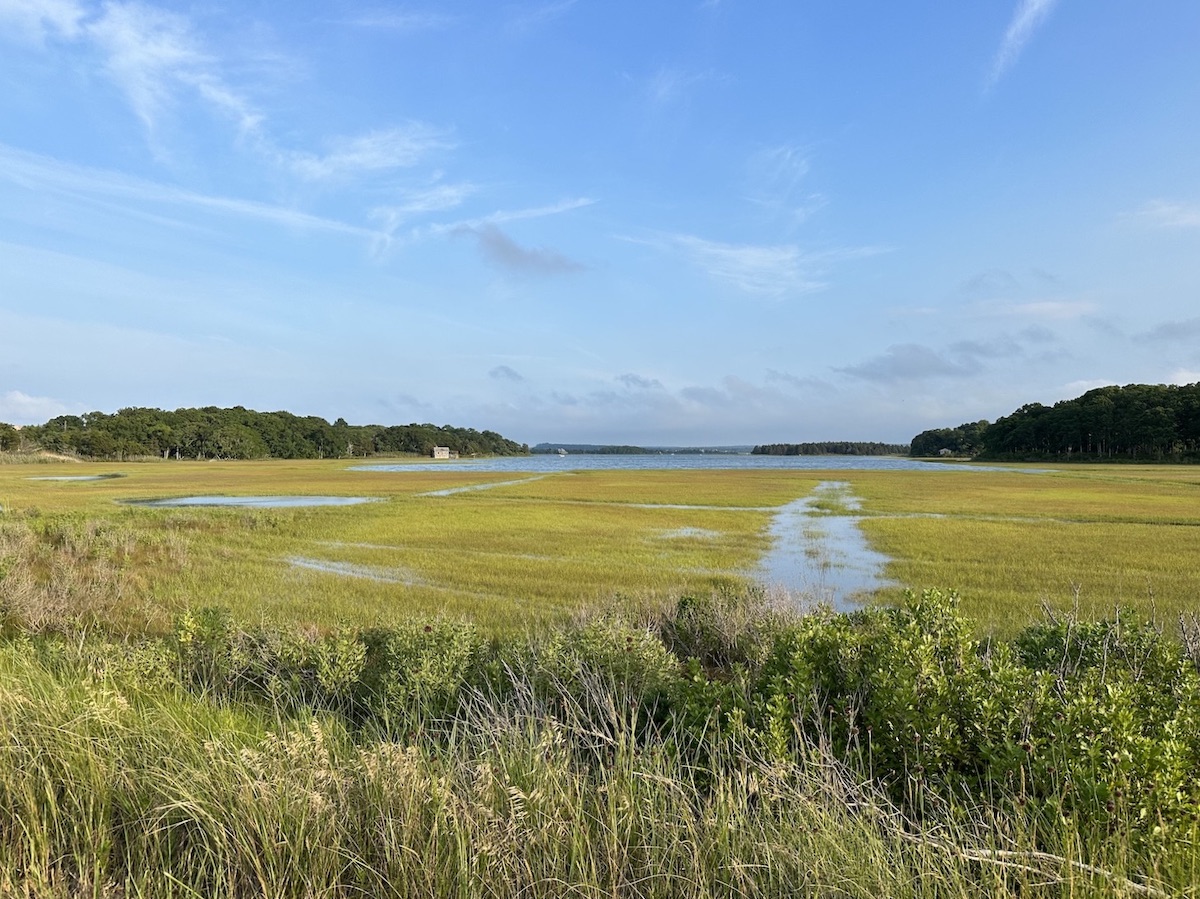
An investigation of submarine groundwater discharge in the northwest area of Accabonac Harbor, some of which is seasonally closed to shellfishing due to fecal coliform detection, another part permanently closed, will be conducted by Cornell Cooperative Extension personnel this summer.
The investigation could provide direct evidence for the importance of replacing aging septic systems in the area.
The East Hampton Town Trustees heard from the extension’s Molly Graffam last week before voting to issue a permit for the study. Dr. Graffam detailed an effort to establish approximately 40 stations, primarily along the western shoreline, a largely residential area, as well as “other areas that might be considered more pristine, or on the opposite shoreline as well.” The study, she said, aims to locate areas with submarine groundwater discharge or seepage, determine the flow rate at three to five of the stations, and identify areas with elevated pore water nitrogen (at root depth, between soil particles) or fecal coliforms.
“We will be collecting this data at low tide and calculating nitrogen loading,” Dr. Graffam said. A Geographic Information System, or G.I.S., map of the data collected will be created, “and we hope that this information helps inform future remediation that’s very targeted in specific areas.”
A goal is to determine if sediment is acting as a storage or collection of fecal coliforms or allowing transport of it into the surface water. “There’s a very high water table, and the area is not sewered,” Dr. Graffam said. “So there are cesspools and outdated septic systems. . . . There’s currently a lack of data about what the submarine groundwater discharge zones are in this area, whether there are elevated pore water nutrients, as well as whether there are the fecal coliforms present in the sediment.”
Investigators will travel by boat and wade in the water at the station sites. Seepage meter readings will be taken and samples will be collected for nitrate, nitrite, ammonium, TKN, or total Kjeldahl nitrogen, which is organic nitrogen plus ammonia, and fecal coliform bacteria.
The investigation will follow a 2021 surface water monitoring program in the same portion of Accabonac Harbor. “We had a final report that came out of that,” Dr. Graffam said, “and then this was the recommendation for the phase two.”
The study will take place in July or August, she said, and data will be analyzed throughout the fall. Cornell Cooperative Extension will prepare a final report and a G.I.S. map by year’s end. That map, prepared in collaboration with the Accabonac Protection Committee, will include information from various people, groups, and websites as well as information gleaned from the investigation, all of which will be available to the public as an interactive map.
“Hopefully,” she said, “all of this will wrap up in about six months.”
In addition to replacing old or failing septic systems, which “would be one example of remediation,” Dr. Graffam said, permeable reactive barriers could also be a recommendation for areas with high nitrogen and groundwater flow, providing immediate interception of contaminated groundwater before it enters the surface water. “That would require another step of site characterization beyond this,” she said.