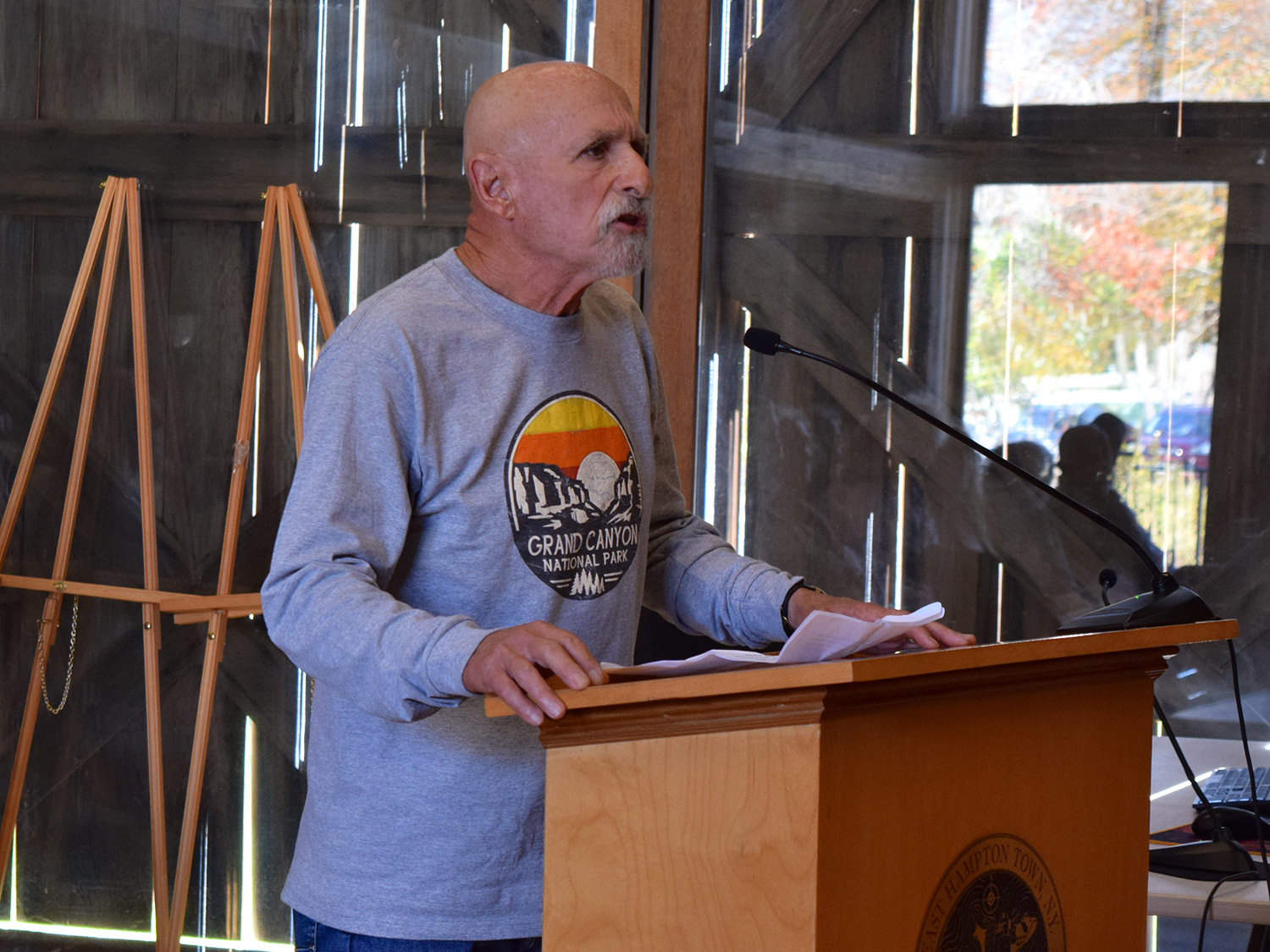
More than two dozen residents of Montauk spoke at a hearing last Thursday on a management plan for Arthur Benson reserve, more of them in favor of a plan to use goats and machinery to remove invasive species at the roughly 40-acre strip between Montauk Highway and the ocean but also many others who said the plan was for aesthetic and not environmental reasons, some also predicting that it would be ineffective or was even reckless.
The promise of litigation was also aired, should the East Hampton Town Board approve the plan, which was proposed by Concerned Citizens of Montauk in July as a means to restore habitat as well as vistas, and increase resilience against erosion. It was also pitched as an effort to return the land to its condition of a century and more ago, but according to opponents, it could violate Suffolk County Supreme Court Justice William Underwood’s 1994 ruling that permanently bars the erection of fences or any other structures on the property.
The town acquired the land in 1999, after a lawsuit was decided in favor of Breakers Motel, et al. and against the defendants Nicola Biase and Sunbeach Montauk Two. The plaintiffs had successfully argued that their deeds grant an easement over the latter’s property. Mr. Biase had bought the land in 1982 and planned to develop it, and in 1984 erected fencing blocking access to the property, which precipitated the lawsuit. The judge ruled that a restrictive covenant runs with the property, that the plaintiffs and the public have access rights, and that the defendants must remove the fencing and “are without the right to erect fences, berms or other structures” and are “forever barred from making claim to erect such structures.”
Proponents of the plan say that the use of two or three goats per acre on a portion of the reserve would require fencing and a shelter for them. Some opponents said that renders the plan a nonstarter, pointing to the 1994 ruling.
Among the plan’s detractors, some qualified their opposition by suggesting a smaller pilot project to assess its efficacy. In the end, the board voted to close the hearing but leave the written record open until Tuesday.
Rusty Schmidt, a landscape ecologist with the Nelson, Pope, and Voorhis firm, which devised the proposal, told the board that “invasive species pose one of the most catastrophic threats to our coastal zone and ecology, just as much as development and climate change.” If nothing is done, invasive species will continue to migrate down the cliff, pushing out native species like bayberry, beach plum, grasses, and flowers, he said.
Goats, he said, “eat predominantly woody vegetation.” They will not be selective, and will eat “good things” as well, he said, but for the most part will target unwanted plants.
Southampton Town Supervisor Jay Schneiderman, who spoke not as an elected official but as president of the Breakers Motel on Old Montauk Highway, across from the reserve, urged the board to “support this professionally developed plan,” arguing that habitat as well as the vista have been diminished. His family had “stepped up” to save the reserve from development, he said, and is “again ready to step up.”
But Jeanne Nielsen, who with her family owns the Twin Pond Motel on Old Montauk Highway, noted that her parents were part of the successful litigation that prevented development of the reserve. “The town must uphold and honor the rule of law,” said Ms. Nielsen, who previously criticized the plan to the board and essentially promised a lawsuit should it move forward with the management plan as written at present. The town, she said, “should be soliciting alternative plans compatible with the Underwood decision. The town is not above the law.”
“None of us are entitled to ocean views,” she said. “Neither are vehicles on Old Montauk Highway. It just would be nice.”
Rav Freidel spoke of the many manifestations of climate change observed around the world in 2023. If this is the “new normal,” he said, “then there’s a very real possibility that if the invasive species are pulled out of the Benson reservation, and we’re waiting for new plants to take root, the land could be totally undermined by a severe storm.” He asked that any effort to remove invasive species be slow and deliberate — “start with trimming and pruning to restore the ocean views,” he suggested. “After all, that is what this project is really all about, and to say otherwise is disingenuous. This project has never been on the radar screen as an environmental issue in the 44 years I’ve lived here.”
Jim Grimes, a town trustee who owns a landscape design company, called the plan well thought out and considerate of the environment. “As someone who grew up here, I miss ground nesting birds that were dependent on that tall grass” in the reserve, he said. “I miss flowers that existed there when I was a kid that don’t now, other than a few vestiges.” This is an opportunity that should not be missed, he said.
Several opponents echoed the belief that the project is for aesthetic purposes and risks destabilizing a healthy dune and the wildlife that lives there. Victoria Bustamante, a botanist and horticulturist, called the proposal “a vista project, not an environmental one.” Laura Michaels also questioned the project’s necessity, pointing to Ms. Bustamante’s letter in the Nov. 9 issue of The Star. “Goats are a gimmick,” she wrote in that letter. “The project engineers used examples of some places that have used goats but nowhere do they state how effective they were.” Her letter goes on to say that the director of the South Fork Natural History Museum and an employee at Heckscher State Park in East Islip, both of which used goats to eliminate invasive species, said that those efforts were unsuccessful.
Nearly two hours into the meeting and when the last speaker had delivered remarks, Supervisor Peter Van Scoyoc thanked the Montauk residents for their input, calling it “a crucial part of the board’s decision-making process.” The board had received dozens of letters from people, some of whom had also spoken at the hearing, he said. The ample community input will help it “to formulate a path forward.”