
If you are coming here to read about where the fish are biting, you’ve come to the wrong place. The blustery northeast storm finally ran out of steam and exited on Tuesday, and it kept anglers off the boats and beaches for over a week. Even stout draggers and long-liners were kept tied tightly to the docks as seas approached 25 feet offshore. At least the fish had a reprieve.
It was a long-period storm that no doubt will accelerate the fishing scene’s move into full-time fall mode as the seas settle down.
“Oh man, the weather was nasty and not fishable, but it looks like we will have much improved sunny and warm weather later this week,” said Ken Morse at Tight Lines Bait and Tackle in Southampton and Sag Harbor. “It’ll be interesting to see how it all plays out on the fishing scene.”
Count me as curious, too.
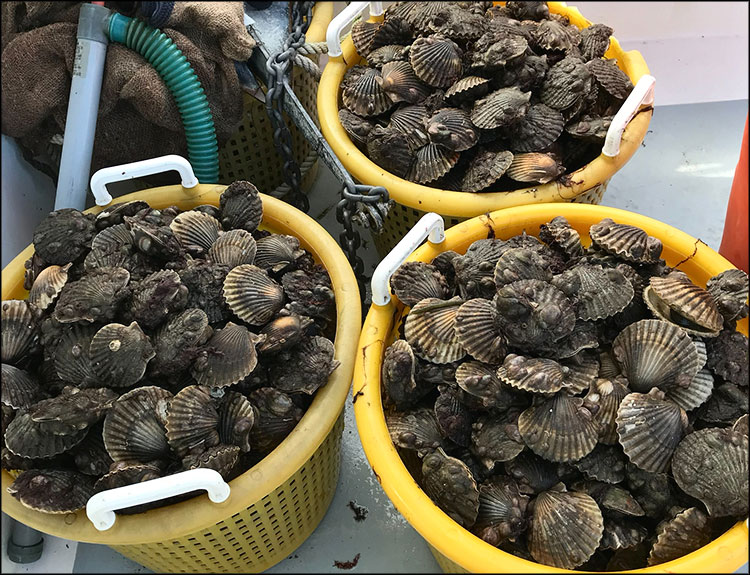
Given the lack of fish news, perhaps it’s a good time to check on the status of our beloved bay scallops. The season, which opens in state waters on Nov. 2, is coming up quickly, but sadly, the early reports are dour.
Unfortunately, for the seventh season in a row, it appears that catches will be extremely light due to a die-off of adult scallops in the latter stages of summer in many areas of the Peconic Estuary system. It’s another tough, but not unexpected, blow to commercial baymen who pursue the highly prized bivalve.
“I’m sorry to report that the news is not good again,” said Harrison Tobi, an aquaculture and bay scallop specialist with the Cornell Cooperative Extension Center in Southold. “It’s pretty much a repeat of what we saw last year.”
Tobi focuses exclusively on local bay scallop population surveys, die-offs, and restoration efforts. He was not enthused with what he’s seen in the 21 dive sites he monitors closely throughout the year.
“The adult scallops that were around in the spring had a spawn, but we are not seeing many bugs, which would grow to adult size by next year,” he said. “And after spawning, the adults started to die off a few weeks later.”
Bay scallops are as delicate as they are delicious. Their cycles of boom and bust have been noted for over 100 years. However, a massive die-off due to an influx of brown tide in 1985 and again in 1995, and a newfound parasite that weakens them while in their spring spawn, continue to put their future in serious jeopardy.
Mother Nature has delivered a nasty curveball to our bay scallop, much to the dismay of many baymen, as well as those who enjoy them on the dinner plate. And dedicated marine scientists like Tobi are trying hard to find a solution to the problem at hand.
“On the positive side, we are seeing a very nice rebound in the bay scallop population in Moriches and Great South Bay, all the way westward to Captree,” observed Tobi. “They are some of the scallops that have been introduced from the stock from Martha’s Vineyard which are more resistant to the parasite. They are almost genetically identical.”
While Tobi has a scallop aquaculture site in Orient Harbor, he is in the process of doing a similar site near Robins Island in conjunction with Capt. Matt Ketchum, the owner of Peconic Gold Oysters in Cutchogue.
“I’m glad we are expanding our efforts to the west,” he said. “Hopefully we will be able to introduce more scallops here that have the same genetic lineage of those in the Martha’s Vineyard area.”
Still, for Tobi, it’s discouraging to see the annual local summer die-off. “There was a spot in spring in Northwest Harbor where we saw hundreds of live adult scallops, but by the middle of summer, they were all dead cluckers.” Cluckers are the name for empty scallops that had recently died that still have their shells connected.
A baymen or two mentioned to me that they believe the cownose ray, a migratory cartilaginous fish, may have also played a part in the scallops’ decline in certain areas, especially Three Mile Harbor. The rays, which can weigh up to 50 pounds, feast on clams, oysters, and scallops.
“We are in the water almost every day and we have not seen a single cownose ray,” said Tobi. “Plenty of cluckers with no sign of damage, which means they were not eaten by rays, but instead died by disease.”
Still, a bayman I know who wished to remain anonymous, said to me with a wink last week that “there may be a few good pockets of scallops around from what I’ve seen.” Many scallopers like to do some pre-season scouting with their 36-inch-wide iron dredges to gauge the season ahead, but they’re a most secretive clan even when scallops are bountiful. The bayman did not wish to tip his hand on the whereabouts of the highly sought-after nugget of sweetness. I just hope he’s correct.
—
Fishing tips, observations, and photographs can be sent to [email protected].