
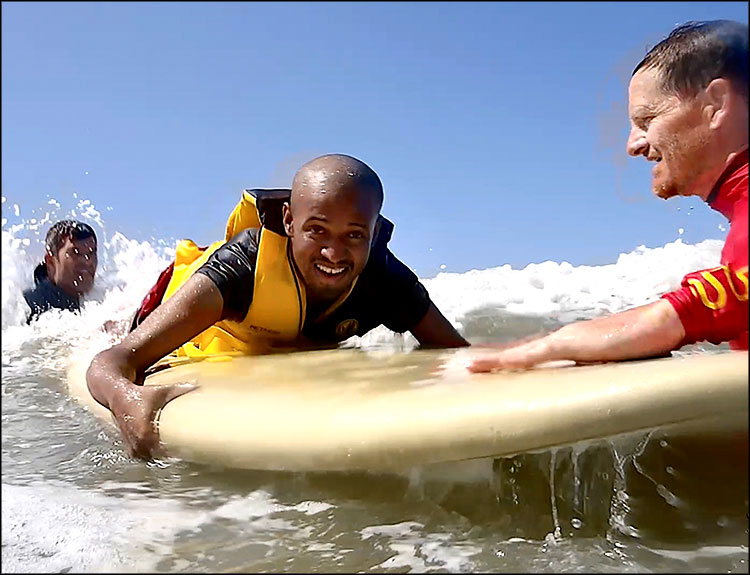
Set against the picture-perfect backdrop of ocean and sky at Ditch Plain Beach in Montauk is a story of selfless devotion to those with special needs and a growing community and spirit of compassion in action.
Flow Surf Academy is a program in which people with Down syndrome or on the autism spectrum learn to surf and swim, at no cost, with the tireless and enthusiastic support of volunteers of all ages.
Last Thursday, one of the twice-weekly sessions conjured carefree summer days of childhood, the sound of crashing waves punctuated only by hooting and shouting from the surf, none of the 20 “athletes,” nor the “groms” — the young surfers helping — nor the ample staff of supporting adults were ready to emerge from the surf, not even for a stack of pizzas promising a well-earned midday meal.
Flow (For Love of Waves) “works on a near-peer model,” Bob Miller, its East Coast director and a longtime lifeguard at Hither Hills State Park in Montauk, said. “A 15 or 16-year-old with autism or Down syndrome doesn’t need a 53-year-old peer to be their best friend. So here we have 15 and 16-year-old groms, some of which I taught to swim and surf over the last 25 years out here, that come back and volunteer for me. I teach them to teach their peers how to surf, so they’re just surfing with their friends.”
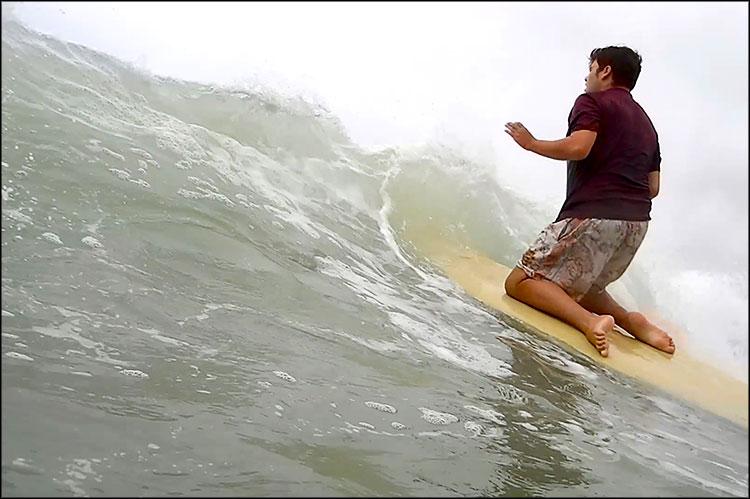
A group of said groms confirmed those observations. “The program’s an amazing thing,” said Caitlin Weimar of Montauk. “It gives opportunity to the kids — obviously, it’s harder for them in the world. This makes everything easier, and it just includes them in stuff that. . . .”
Jaya Lumi, also of Montauk, finished the thought. “It just gives everybody a smile,” she said. Mr. Miller taught Jaya to swim and surf “when I was, like, 2 years old,” she recalled. “Each year I keep coming back, and bring more friends with me. You get to watch these kids grow up, and it’s just like your friends that you see in the summer. It’s a great experience.”
“I was introduced by some friends,” said Leo MacGowan of Sag Harbor. “Even if they’re not too comfortable in the water yet,” she said of the athletes, “you can keep them entertained at the beach. Even having quality time with them is just as meaningful.”
“We have athletes that range from 3 to 73 and volunteers that range from 6 to 60,” Mr. Miller said. “So when there’s a 6-year-old with Down syndrome hanging out, building sand castles on the beach, the daughter of my lifeguard is 6 years old, so she’s there hanging out on the beach building sand castles. It’s that near-peer model, trying to match up athletes and volunteers that are of similar age. That is creating friendships, like these girls said. Some of these athletes and kids have been part of this for almost 10 years, so they’ve grown up together.”
This year’s surf program started early in July and will conclude next week with a boat trip with the Nature Conservancy that will include catching, tagging, and releasing fish and a tank on board for athletes to get up close with marine life. “Our groms and our athletes are going to learn about ocean conservation,” Mr. Miller said, “because if the ocean’s not clean, we can’t surf in it. Each year, we try to expand a little bit more and include these kids a little bit more in everything. I’m fascinated with this stuff, why wouldn’t they be? And to take the groms too, who are perhaps thinking what their futures might be in college in a couple of years, they might find marine research or some sort of conservation.”
Flow Surf Academy, Mr. Miller said, was inspired by organizations like Surfers Healing and A Walk on Water. “It went from strictly kids with autism to including kids with autism, Down syndrome, [cerebral palsy],” he said. “Now, it’s all about independence, allowing them to take their life jackets off when they learn to swim, allowing them to catch waves on their own instead of going tandem. These kids can do it. It’s beautiful.”
The program runs year round, with winter swimming sessions and sailing in the summer through the Breakwater Yacht Club in Sag Harbor. “It’s growing,” Mr. Miller said, “and it’s because these kids show up, and I’m grateful.”
A day at Flow Surf Academy begins with song, led by Tim Gannon, a music therapist and longtime lifeguard at Hither Hills State Park who, prior to joining the athletes in the surf, picks up his guitar. “We use music at the beginning of this camp to bring everybody together,” he said. “A little bit of social recognition, make sure everybody knows each other’s names. It’s really just to welcome everyone to the day.”
The sense of community is profound, the adult volunteers barely distinguishable from the groms and athletes, each seemingly determined to be first in and last out of the surf. Last Thursday, Chris Carillo, a Montauk attorney, had exchanged business attire for a wetsuit. “Bob came by my office and gave me a little pep talk, and here I am,” he said. Mr. Miller “is a catalyst to get me back in the water after a long year.”
Last year, Mr. Carillo endured a bout with Methicillin-resistant Staphylococcus aureus, or MRSA, undergoing emergency surgery and requiring an extended leave from his role as the East Hampton Town Trustees’ attorney. “Now I’m helping out, and I think it’s helping me more than anybody knows.”
“I have to be a lifeguard, a surf instructor, and keep the beach safe, so I have an adult representation of all of those,” Mr. Miller said, pointing to Scott Cullen, a surf instructor who was in the water with athletes; Mr. Gannon in the role of water safety, and Sean Brennan assuring safety on the beach. “I can’t do what we do without the support of everybody in this community. It’s mostly about showing up and being present.”
After photographing a June fund-raiser for Flow Surf Academy at Sole East in Montauk, the photographer and documentary filmmaker Bryan Downey was inspired to make “The Athletes,” which he will submit to film festivals “to enlighten people of what is capable by people with special needs,” he told The Star. “I was humbled and in awe of the volunteers dedicated to this program,” he said, “and really impressed with some of the participants.” One, he said, “has never spoken a word yet was able to write a book of poems.” Another, with Down syndrome, “grabbed the mic and rocked out, entertaining the audience.”
Relentlessly affirmative, Mr. Miller portrayed volunteerism as rewarding, “not just to the adults in our community, but it gives an opportunity to bring their children to volunteer and to instill the idea of community service.” Mr. Gannon, Mr. Brennan, and Mr. Cullen’s children volunteer as well, he said. “The kids are like, ‘This is important to Mom and Dad, maybe it should be important to me.’ That’s that change in the future that’s going to change the next generation.”
When Mr. Miller started working with the athletes, “a group of us just started helping,” Mr. Cullen said. “It was a small group of us that were just getting the kids in the water. Little by little, we’ve grown it to be able to bring in more athletes, more of the near-peers to help them. . . . It helps the athletes incredibly, because it gets them surfing, gets them in the water, and it’s a safe environment.” For the near-peers, “it really builds a sense of understanding and appreciation for people, and joy and bringing happiness to others. If you can teach that, that changes their life, hopefully.”
The verdict is in. “We do it because we love it,” Jaya said, “and because we actually make friends with these kids.”
“It’s not just a program,” Caitlin added. “It’s a beach day with our friends.”