
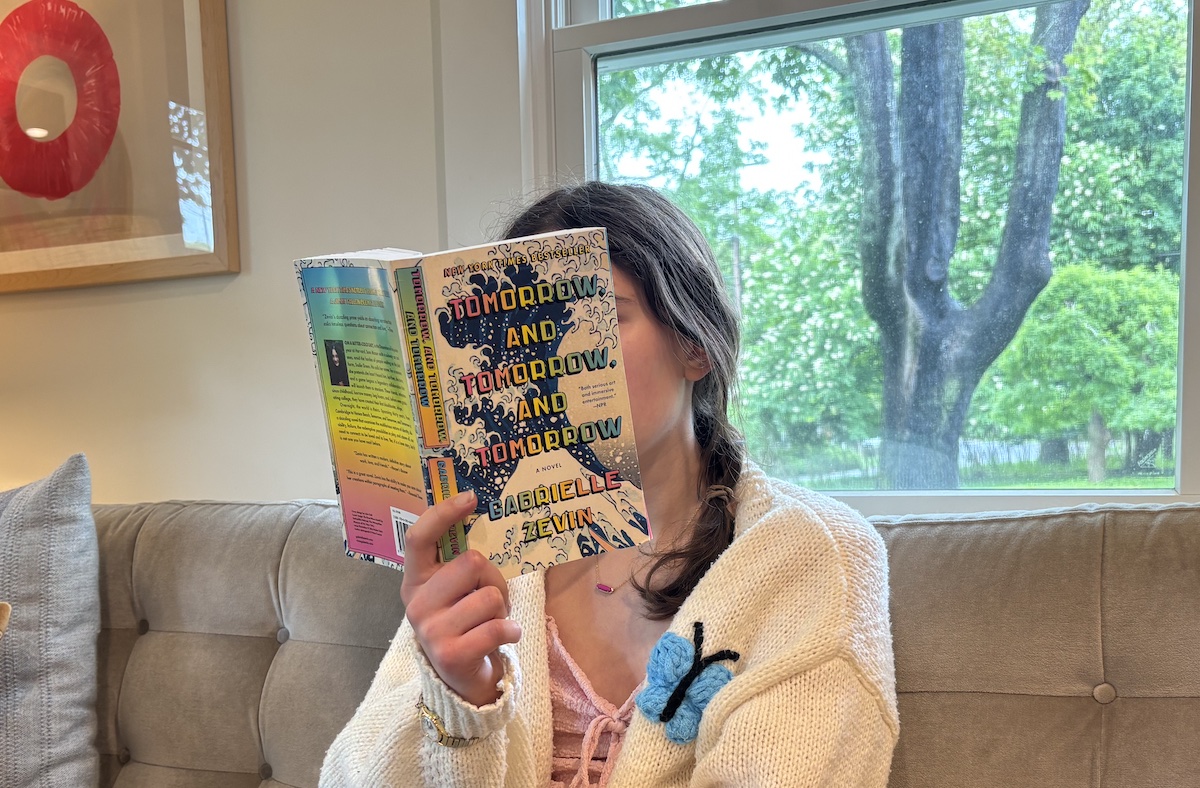
As we get deeper into summer is in sight, I have been finding more time for one of my favorite things. I am talking about reading.
This spring, I finally got around to indulging in some of the books that have long been sitting on my T.B.R. (to be read) list: “Little Women,” “The Song of Achilles,” and “Tomorrow and Tomorrow and Tomorrow.” If there is anything to be said about my reading habits, it is that I enjoy switching up genres. Reading too many books of the same style in a short period can feel redundant, and at times, monotonous. This assortment of books is certainly well rounded; a well-known classic, a heartbreaking Greek mythology romance, and an artful piece of realistic fiction. Their uniting characteristic? A force that strongly pulls the reader into an immersive world of storytelling.
“Little Women”
“Little Women” by Louisa May Alcott, was published over 150 years ago, in 1868, and has since sold over 10 million copies and been translated into more than 50 languages since then. It has such a charming quality of early America, while still feeling timeless, and relevant to the bustling hub that is 2026. The book zeroes in on the four March sisters, Meg, Jo, Beth, and Amy.
Meg, the eldest, 16 at the book’s start, is a caring and kind role model for her younger siblings. She goes about her teenage life with a matrimonial authority that only an eldest child possesses. Although Meg is ever-supportive of her family, pieces of her long for a place more exciting and lavish than the poor lifestyle she lives.
Then there is Jo, almost the polar opposite of her sister Meg. She wants something more than a comforting and traditional female life, and with a strong mind and short temper, is determined to achieve it.
Beth is a sweet and soft-spoken 13 year old with a musical gift and a beautiful sense of empathy for her family, which she often puts before herself. Amy, the youngest, is ever spirited and opinionated, vain, and a little irrational at times. She is a talented 12 year old, often sketching her sisters and their family friend, Lorie, who weaves in and out of the March sisters’ lives, causing delight and chaos as he goes. The novel follows the girls through sisterly troubles: burned hair and manuscript papers, irritable aunts, and scholarly reprimands. Through their trials and successes, the girls bloom into young women, each growing out of their childish faults and making the choices that will impact the rest of their lives. Louisa May Alcott based the March sisters on her own siblings, and Jo on herself. Prolific writers, both Louisa and Jo write to support their families, and have tremendous work ethic.
“Little Women” feels like a warm embrace as the reader is welcomed into a world of caring characters and enticing life experiences. Fun fact: Louisa May Alcott’s house, the Orchid House in Concord, Mass. where she wrote “Little Women” can be visited! I went over February break, and it’s so incredibly cool to see where the story was created. I highly recommend a tour if you are in the area.
“The Song of Achilles”
“The Song of Achilles” by Madeline Miller is the first adult book to be featured on The Teen Pager. I would not recommend this novel for anyone under high school age, due to some mature themes such as violence, grief, and sexual content. The novel focuses on the main protagonist, Patroclus, son of Menoitius, and prince of Opus. Since birth and the death of his mother, Patroclus feels as if his existence is a burden to his kingly father. He has never been extraordinary at anything. Not one for the art of music, not strong, not whip smart, and not good enough for the approval of his kingdom.
When Patroclus commits an act of violence against one of his tormenters, a bigger boy from an important family, his father quickly exiles his 10-year-old son, leaving him banished to a school for boys in a neighboring kingdom called Pithia. There he meets Achilles, the prince of Pithia, son of a Greek goddess, and everything Patroclus wishes he could be. Patroclus resents Achielles but, inexplicably, the two begin to forge a bond.
Eventually Achilles is set to be trained by Chiron, a centaur who is renowned for making young boys into extraordinary warriors. Patroclus accompanies Achilles through his training for about three years, and here they are made aware of a prophecy concerning Achilles. He will become the greatest warrior of all time, and will die a heroic and tragic death during the Trojan War. As the boys’ friendship grows, the prophecy looms over their heads, threatening to consume a blooming love for one another that exceeds friendship.
My final recommendation is “Tomorrow and Tomorrow and Tomorrow” by Gabrielle Zevin. It is another adult novel, so again, I would advise younger people read with caution, as it explores some sexual and emotional themes, including gun violence.
“Tomorrow and Tomorrow and Tomorrow”
“Tomorrow and Tomorrow and Tomorrow” is a revolutionary novel that focuses on the relationship between Sam Masur and Sadie Green, two video game enthusiasts. Although, one might argue that their relationship is the least interesting thing about them. Sam Masur is 21 at the book’s start, in a rush at the Cambridge, Mass., train station, when he runs into an old friend, Sadie. The two met at a hospital in 1986 when they were both 12, Sam recovering from a car accident, and Sadie visiting her sister, hospitalized with leukemia. The two bond over their love for classic video games such as Super Mario Brothers, and a strong friendship forms, but after a big fight, they don’t speak for years.
When Sam and Sadie meet again, they decide to keep in touch, although they are both busy with their respective college careers. Sadie is studying coding at M.I.T. under a professor who tries to advance their relationship beyond student-mentor, and Sam is studying mathematics at Harvard, and is barely scraping by with the little funding help provided by his roommate, Marx. Despite their chaotic lives, Sam and Sadie decide to make a video game together, and this passion project fuels a rekindling of their friendship as they weave complexly through life.
When reading this book, I felt strong urges to laugh, cry, and gasp from the sheer genius of the world that Zevin wrote into existence. When you pick up “Tomorrow and Tomorrow and Tomorrow,” be warned that you won’t put it down until you die of dysentery (you’ll understand when you read it.
Thank you as always for reading this month’s addition of The Teen Pager. These novels will always occupy a piece of my soul, and I hope they will do the same for you.
If you have any suggestions for future books to feature, feel free to email me at [email protected]. Happy reading!