
The important work of the student-driven South Fork Sea Farmers, a nonprofit educational arm of the East Hampton Town Shellfish Hatchery, to construct oyster reefs in town waterways can serve as an example to neighboring coastal communities, and one such student is hands-on in furthering that mission.
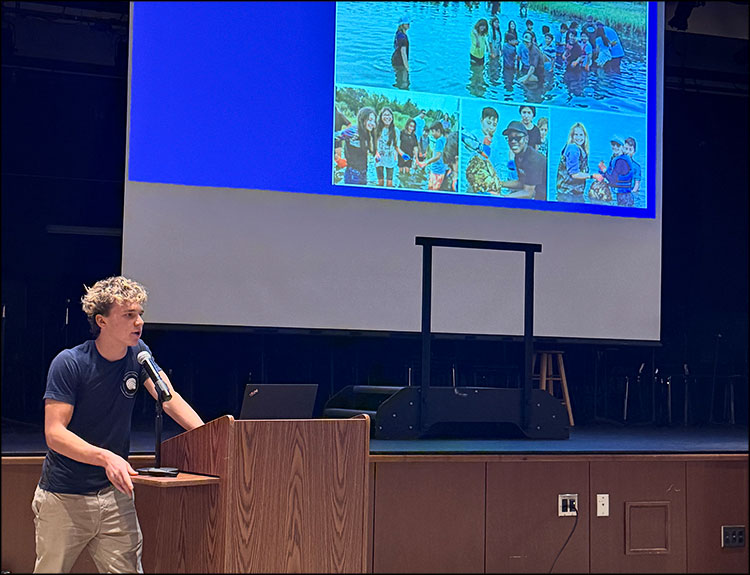
Last Thursday, Hudson Tanzmann, an East Hampton High School junior, addressed some 250 students at William Floyd High School in Mastic Beach. Accompanied by Bob Tymann, head of the Sea Farmers education committee, the Wainscott resident detailed the step-by-step procedure with which the Sea Farmers establishes oyster reefs, from site selection and permitting to construction and data collection.
Growing up here, “I’ve always been in water, kayaking and fishing,” Hudson told The Star. “I knew for my science research project, I wanted to be in the water, and the South Fork Sea Farmers, through word of mouth, found me and I became an intern.” His sister, Skye, a 2023 East Hampton graduate, was also a Sea Farmers intern, working on earlier oyster reef projects.
The South Fork Sea Farmers has constructed five reefs in Accabonac and Three Mile Harbors. “We are here to discuss how we can implement similar programs here at William Floyd,” Hudson told the students.
Adult oysters are filter-feeding bivalves, he said, absorbing nutrients while “simultaneously cleaning the ecosystem of harmful pollutants and overaccumulation of nutrients” at a rate of up to 50 gallons of water per day. “This is super-important,” he said, “because it mitigates something called an algal bloom.”
An algal bloom “basically kills everything underneath the water, stopping the sunlight that comes through,” he said, as a slide presentation illustrated both the harmful algal blooms that have afflicted South Fork waterways and the numerous benefits of oyster reefs. “Oysters are just one way that can mitigate these algal blooms, by just filtering the ecosystem.”
Oyster reefs also protect the coastline against erosion, acting as a barrier against waves. They provide habitat for many other species, he said, displaying an image of a thriving bottomland.
Hudson outlined the six-step process with which South Fork Sea Farmers has taken oyster reefs from conception to fruition. Location is important, he said: The organization looks for a hard bottom and good water flow, as well as sufficient distance from the mouth of a harbor, boat traffic, or duck blinds.
The Sea Farmers obtained permission from the East Hampton Town Trustees, who have stewardship of most of the town’s waterways and bottomlands on behalf of the public, for their reefs. In Mastic Beach, those seeking to build an oyster reef would seek permission from the Brookhaven Town Board, Dr. Tymann said.
Permitting with New York State “can be tricky,” Hudson told his peers. Fortunately, he and Dr. Tymann have written “How to Build an Oyster Reef: A Step-by-Step Planning and Permitting Guide for Long Island Schools and Organizations,” based on the Sea Farmers pilot reef constructed in Accabonac Harbor in 2022.
The State Department of Environmental Conservation’s Joint Application for Permit, for permits pertaining to streams, waterways, wetlands, and other water bodies and coastal areas, must be submitted to the D.E.C. as well as three other state and federal agencies, he told the students. He and Dr. Tymann can help students through the process “so that we can replicate these things in William Floyd,” he said.
He described the components of an oyster reef, including the clam and oyster shells in biodegradable bags that form its foundation, and the top layer of oyster spat attached to shells collected from South Fork restaurants. More than 30 volunteers collect and take them to designated drop-off sites, he explained, “which is just another example of how anyone can get involved in the reef-building process.” He also explained the pre-construction work at the shellfish hatchery, where spawning is induced by raising the water temperature in brood stock conditioning tanks to a spring-like 68 to 70 degrees.
Reef construction is a three-day process, he told the students, that involves staking out its shape, laying the foundation, and placing shell and spat-filled biodegradable bags atop it. “We have kids from all around Long Island that are helping us place these bags on top of the base layer that we placed the day before,” he said. “Once you place all the bags in a pyramid-like structure, that’s how you get your oyster reef, which is going to be naturally filtering the ecosystem and providing habitat.”
Data collection follows, and the D.E.C. requires three years of reporting, Hudson said.
An adult oyster produces 50,000 to 100,000 gametes, and each reef contains many thousands of oysters. “The overall goal,” he said, “is that we’re going to be creating oyster reefs that are self-sustainable so that they grow their own shells, there’s going to be natural set with that natural reproduction, and they’re going to keep growing by themselves,” perhaps eliminating the need for human intervention.
“This is a great opportunity to start a club or just get your hands dirty in the water,” he told the students. “It’s a great way to get out of the classroom, get some real hands-on experience in science. I know that it’s been a great opportunity.”
The students asked many questions, Dr. Tymann said, “which would have gone well past the bell — they had to get to the next class.” The teachers were very complimentary, he added.
The presentation was Hudson’s initiative, Dr. Tymann said, suggesting that Sea Farmers research and development efforts should be shared with other school districts. “To have a district respond, and for him to go teach at another school district, I just thought was incredible,” he said. “To me, that’s a much more rigorous assessment of what he can do than any paper-and-pencil test.”