
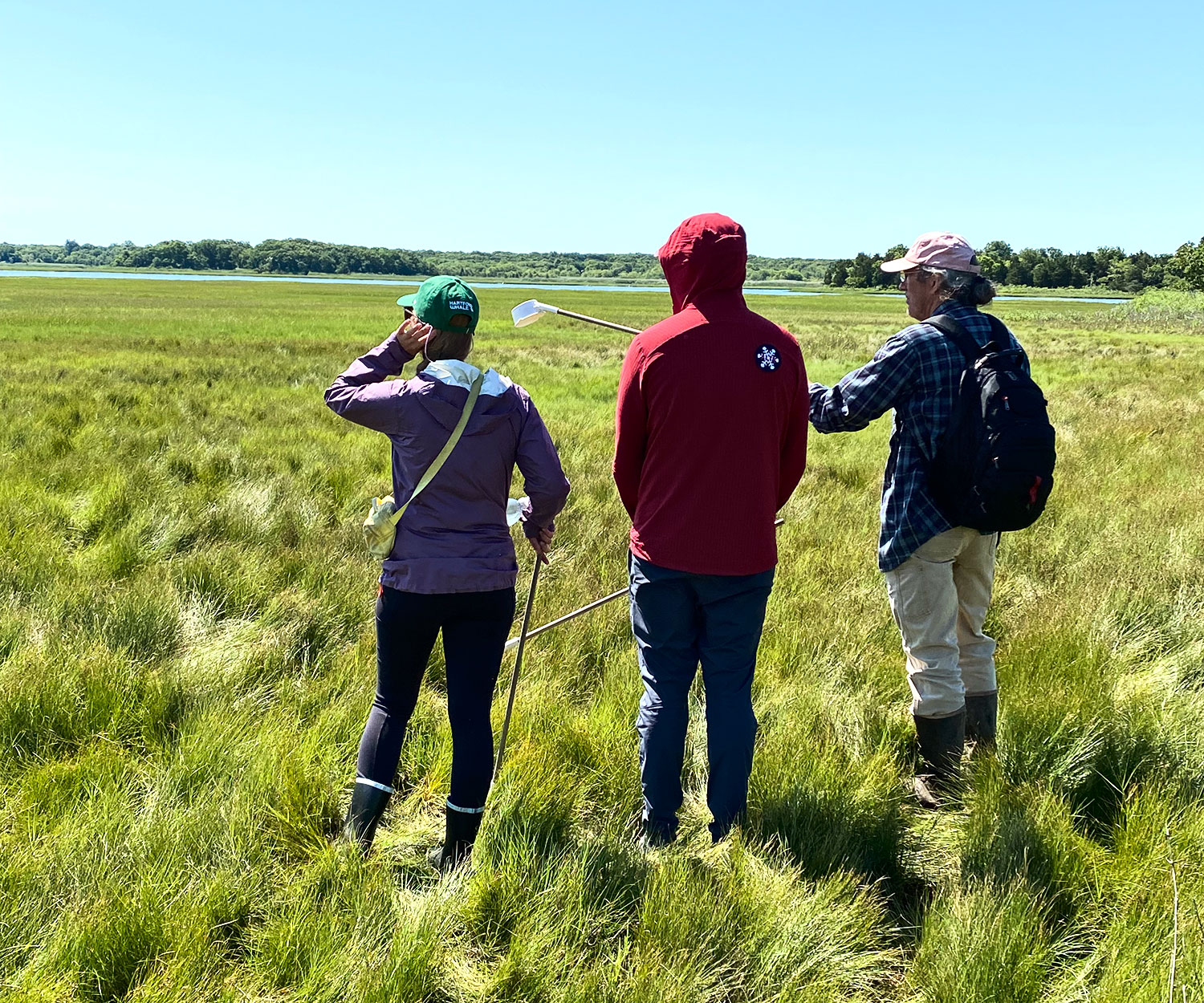
John Aldred stood by the side of a country road in Springs with satellite photographs of the nearby saltwater marsh, Accabonac Harbor, spread out on the hood of a white S.U.V. Two young trainee volunteers, Kristin Schaven and Will Turman, dressed in hiking gear, stood beside him listening as he explained how to conduct a mosquito survey.
“Mosquito larvae are mostly found in the upland areas of the marsh,” he said. His tan fingers traced an imaginary tidal line along the surrounding meadows of saltwater cordgrass, bayberry bushes, and stands of oak, and cedar trees. “This is where we find breeding hot spots.”
Aldred, an East Hampton Town trustee, is a former lifeguard, part-time ichthyologist, environmental analyst, and founding director of the East Hampton Shellfish Hatchery. A tall, slender man with a gray ponytail bun and metal rimmed glasses, he has also been counting mosquitoes for the Suffolk County Division of Vector Control since 2017. Twice a month — during the new and full moon tides — he and his team of volunteers walk miles of boggy marshland looking for mosquito larvae. The data, collected with the help of a plastic dipper cup affixed to a stick, is sent through a digital G.P.S.-enabled app to the county authorities who then tell their helicopter pilots precisely where to unload their cargo of larvicide.
“They used to spray a liquid mixture of methoprene and Bti, but now they use pellets,” Aldred said. Granulated larvicide pellets, he explained, are less likely than aerosols to be dispersed where they are not wanted or needed.
“They use helicopters? Real ones?” Turman, an automation expert, looked surprised, as if he’d stepped on a squeaky toy. “Drones would be more precise and efficient.”
His partner, Schaven, a bio-tech researcher, chimed in, “Work smarter, not harder.”
If Aldred had an opinion about drone-assisted larvicide dispersal, he didn’t voice it. He led his team, armed with their dipper cups, away from the road and through a meadow of milkweed and knee-high grass. Following his lead, Turman and Schaven swiped their stick from side to side like machetes to clear the path of ticks.
Not far away, through beyond the trees south of the trail they were on, is the shack where a young, sweaty Jackson Pollock painted his abstract masterpieces in the late 1940s and early 1950s. Since then, little in the immediate vicinity has changed. There were few, if any houses visible and the sound of exotic sports cars, Subarus, and pickup trucks passing by on Springs-Fireplace Road grew fainter as the team moved toward the distant blue water. Ospreys wheeled and chirped overhead. Orange specked dragon flies zig-zagged through the grass.
Aldred stopped at a slimy puddle of leftover tide water where the path intersected one of the many ditches dug in the 1930s to drain the marsh and attempt to eradicate the mosquitoes. “You usually won’t find larvae in the ditches,” he said. Mosquitoes, he told them, prefer to lay their eggs in muddy depressions left behind in slightly higher ground sections of the marsh after high tides have retreated. The larvae then hatch when the depressions are next flooded by a tide or rain.
Aldred dipped his sample cup into the puddle, gave it a cursory glance and tossed it back. “Nothing,” he said.
Down the path, Turman and Schaven tested pools of shallow water in the cord grass around their boots. They found plenty of detritus and tiny worm-like creatures but no larvae. “Mosquitoes are afraid of Kristin,” Turman teased. “They know she’s participated in other larvicide projects.”
“As an undergraduate I was part of a program that tested larvicide in runoff water by the side of the road,” she acknowledged.
Government spraying of insecticide on Long Island has a checkered history. Mosquito eradication efforts, driven by fears of the spread of malaria, were paused in the 1960s after studies revealed the dangers posed by the insecticide D.D.T. to birds and humans. It was on Gardiner’s Island, visible to Aldred and his team, two miles across the bay from Accabonac, that British ornithologist Dennis Puleston and his associates at Stony Brook University discovered the link between D.D.T. spraying and the nearly decimated osprey population on the island. In 1967, they founded the Environmental Defense Fund, which established the judicial standing of birds and revolutionized protection of the environment through the courts and the actions of citizen scientists.
D.D.T. was eventually banned, but in the late 1990s and early 2000s with the arrival of the West Nile virus to U.S. shores, the continued existence of other mosquito-born, extremely rare diseases like Eastern Equine Encephalitis (only five cases in New York since 1971) and the later resurgence of Dengue fever, the spraying of salt marshes with insecticide, supposedly in a less toxic form, resumed. Though not without controversy.
Bti, the first component of the larvicide pellets being targeted at Accabonac Harbor and dozens of other Long Island marshes, is a naturally occurring bacteria found in soil that has been found to be harmless to humans, other mammals, birds, and fish. Methoprene, too, is said to be harmless to mammals and birds, but there are some also studies that link the chemical to disruptions in the reproductive cycle of estuarine and freshwater invertebrates, crabs, crustaceans, and reptiles.
Concerns arose that the kind of D.D.T.-wrought devastation to the osprey population could happen again, this time to lobsters and crabs (methoprene use has been restricted in coastal areas of Connecticut and Rhode Island). One local environmentalist, Edwina von Gal, and others drew up a petition and a coalition of local government and environmental organizations was formed to find a solution. Inspired by Nicole Maher, a Nature Conservancy coastal scientist, a citizen survey pilot program was launched in 2017 at Accabonac to minimize the use of toxic larvicides and lessen the risk of collateral damage to other species.
Directly under a short, dead pine tree with an osprey nest built in its tangled boughs, Aldred hit the jackpot: a deep pool of residual tidewater shaded by long grass, bayberry shrubs, and the dead tree.
“There’s larvae here,” he said. He showed the others the wriggling, tiny black specks, not unlike sperm, that were twirling through their universe of brackish water and dead blades of grass.
Schaven and Turman lifted their plastic dippers filled with marsh water close to their faces as if it were a delicate soup they were about to taste.
“I’ve got some,” Turman announced. “Maybe 20 or 30.”
Aldred came over to see. “I would call that more like 40 or 50. Focus on one area of the cup and then multiply by quadrants.
Counting individual mosquito larvae in an area two thirds the size of Central Park might seem like a fool’s errand, but in 2019, after only two years of the pilot program, Suffolk Country Legislator Bridget Fleming, the Town of East Hampton, the East Hampton Trustees, and participating environmental groups, including the Nature Conservancy and the Accabonac Protection Committee, announced the program’s remarkable success. The long hours put in by Aldred and other volunteers collecting data pinpointed where the mosquito breeding hot spots were located. This data, reported to the helicopter pilots, resulted in an 81-percent reduction in the use of methoprene and a 77-percent savings in costs for Suffolk County Vector Control. Instead of spraying 2,500 aggregate acres, the county found it only necessary to spray 500 acres, most of that farther away from shore birds, osprey and fish. It was a win-win situation for all involved.
“Do they at least buy you dinner at the end of the season?” Schaven asked Aldred.
“No, they just keep telling us what a good job we’re doing.”
Perhaps too good a job. Leaving the larvae-laden pool under the dead tree behind, the team spread out looking for other breeding hot spots, but there were few to be found that morning. “I guess that’s good,” Schaven said. “It means the program is working, but I’m also disappointed not to find more.”
This item was reported in the 2024 season. Kristen Schaven and Will Turman have since moved on, but the program is ongoing and will need new volunteers for the 2026 season.