
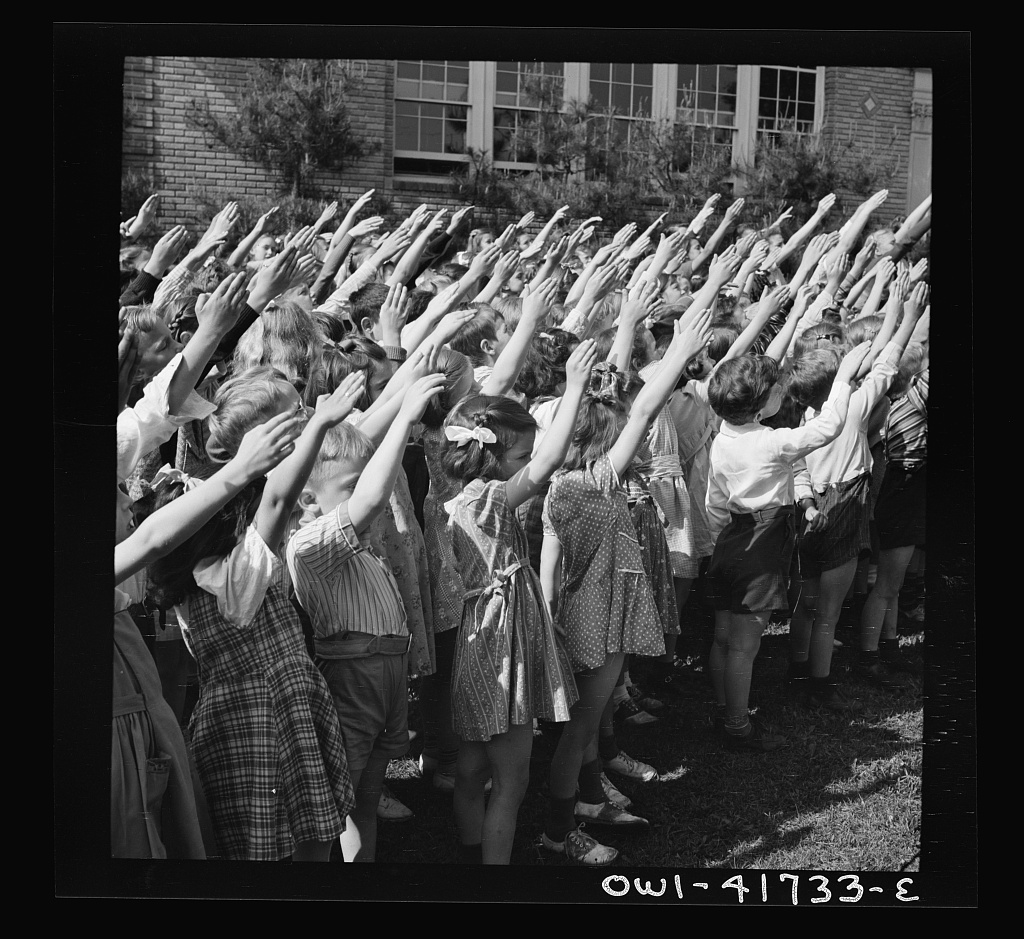
How well I remember the Aussie dad in the Pierson High School gym annoyed at having to stand for the Pledge of Allegiance. And then actually rolling his eyes as he learned he had to turn and face the limply hanging Stars and Bars.
Point taken. It is stone simple. Kid stuff. In fact, the evidence points to its having been written by a 13-year-old boy from Kansas who submitted it to a magazine called The Youth’s Companion, where worked one Francis Bellamy, who seems to have tweaked it and then put his name to it in 1892 for use at the next year’s Columbian Exposition. As well as, believe it or not, to help sell an excess of American flags Youth’s Companion had in stock.
If you find that background suited to the story of our nation, it is not relayed here with satisfaction, but with a touch of sadness, because Bellamy’s own story was also a good one. Hailing from tiny Mount Morris in western New York, outside Geneseo, an exceptionally beautiful part of the country, he notably, admirably, left any fatuous reference to God out of his version of the Pledge. And he was an ordained minister. Although, again admirably, one who preached that Jesus was a socialist.
Another Francis — Scott Key — was somewhat less admirable. Come on, a lawyer working in the nation’s capital against abolitionist efforts?
Surprisingly, he wasn’t drunk as he kicked back on his ship off Baltimore in 1814, ordered to stay put by the Brits after his mission to free a physician held prisoner. Nor was his difficult composition based on a British drinking song, as is widely believed, merely one originating at a London club for amateur musicians.
I’m as big a fan as anyone of Marvin Gaye’s famous soft and soulful rendition at the 1983 N.B.A. All-Star Game. But it was apparently a one-off no one’s ever come close to matching.
So, why, oh why, do we have to sit through, make that stand for, “The Star-Spangled Banner” at the beginning of every single American sporting event? What, exactly, are we trying to shore up?
If the good times of the World Cup now raging across North America have shown us anything — the common humanity, the mass chants from the stands and in the streets, the Europeans suddenly in thrall to Buc-ee’s and Big Gulps — it’s the contrast with the damage and violence that nationalism has traditionally wrought.
There was Pax Romana. There was Pax Christiana. Let there be Pax Sportlandia.