
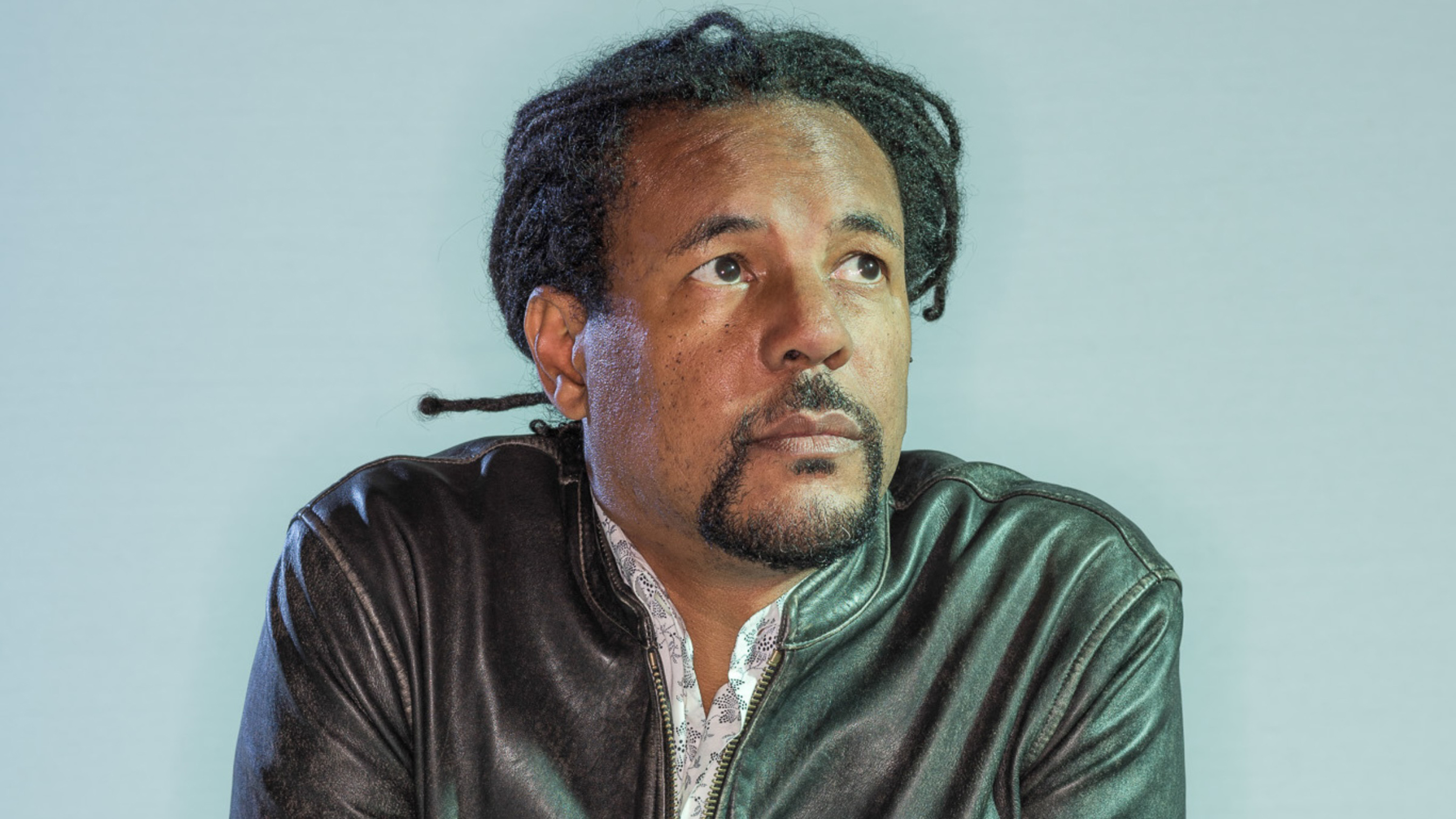
Having spent the last couple of weeks tearing through "Harlem Shuffle" and "Crook Manifesto," the first two books of Colson Whitehead's crooks, cops, City Hall, and corruption trilogy, I ran over to Guild Hall as soon it announced he'd be speaking there, which turned out to be a shrewd move because tickets for last Thursday evening's event sold out within days.
We were the kind of audience an author dreams of: young and old, interracial, book-smart, all of us rooting for the hometown (Sag Harbor) boy-made-good, up there with two Pulitzer Prizes, a MacArthur fellowship, and the National Book Award to his name.
What he told us, in an hour that flew by, was less what two women behind me said they'd expected (random thoughts on D.E.I. and other Trumpian subversions), and more about his trials and triumphs as a writer, particularly of "The Underground Railroad," which won the first Pulitzer. For a moment, though, it looked like those women would be right. "Now about D.E.I.," he began, then paused, peering into the audience. "I'm just kidding," he said. "Not trying to get arrested."
Laughter. A lot. That set the evening's relaxed tone.
"If you took any Stephen King novel and put 'Black' in front of it, that's what I wanted to do," Mr. Whitehead continued, but it wasn't easy.
"I was an able-bodied Black person. My parents were of that generation [when] it was your duty to make something of yourself, become a doctor, a lawyer, an accountant. Those professions weren't up my alley, so I tried to think what else I could do."
He has small hands, he observed, waving them about — almost delicate. But "I could not be a pianist — how could I sit at a chair all hunched over, with no lumbar support?"
At Harvard, he applied for a popular creative writing course and was turned down.
"I was a very self-conscious 20-something. I didn't want to do that autobiographical model that everyone does, about everyone who wronged you when you were a child — I wanted to save that for my fourth novel, 'Sag Harbor.' " (Knowing laughter.)
Rejection after rejection from publishers. Several years passed, with a divorce and remarriage, three or four books, and the continued "jerkiness" of Knopf and Houghton Mifflin, before the idea for "Underground Railroad" surfaced.
"I had the idea that each stop on the train, each state, was an alternative America, like 'Gulliver's Travels' or 'The Odyssey' or 'Pilgrim's Progress,' where our hero or heroine is tested by a series of allegorical trials."
He didn't start it right away, he said. "I didn't feel I'd seen enough or knew enough to deal with slavery with the gravity it required."
Maybe, he thought, if he had some "Hemingway-ish adventures," it would help. "Every couple of years I would think, 'Am I ready,' and the answer was always 'No.' Until 2014."
When he called his editor to make the pitch, he recalled, the response was short and sweet. " 'Giddyap, motherfucker,' " the editor urged. "Which," Mr. Whitehead explained, straight-faced, "is old-school publishing talk for 'That sounds very compelling, and we should pursue it.' "
"Which just goes to show you, even after eight books, the book you don't want to do, the book that scares you silly, is the one you should be working on."
After a sip of water and a brief detour into artificial intelligence — "Go ahead and use A.I. for whatever you like, except art. If you use it for your art, you're a fucking hack" (loud applause) — the author turned to his Harlem trilogy, the most recent of which, "Cool Machine," was published by Doubleday three weeks ago.
In both "Sag Harbor" and "Harlem Shuffle," the first book of the trilogy, he mentioned that a "fence" plays a central part. In the coming-of-age story, the fence is figurative: an invisible line between the SANS neighborhoods — Azurest, Ninevah, and Sag Harbor Hills — and their white neighbors in the rest of the village. The communities are separated not only by segregation but, at the time anyway (the '70s), by suspicion.
In the trilogy, the "fence" is literal — a petty criminal, a receiver of stolen goods, the middleman between a thief and a buyer, named Raymond Carney. Carney, an outwardly respectable furniture store owner, is the protagonist in all three books.
"Harlem Shuffle" begins with a theft, a big one, a "heist," and is followed by several more, one caper leading, for better or, more often, worse, to others.
"It occurred to me that one heist wasn't enough for 300 pages, so what about three stories?" said Mr. Whitehouse. "Then I thought, maybe it's a duology? A trilogy? And each book would have three stories in it, over decades."
"And I'm following Ray Carney for 30 years, and his ups and downs, and the city as well. The heights of Camelot and the World's Fair in the city in '64, the optimism — and then the doldrums of the '70s, the city's bankrupt — and then in the '80s, we're coming out of a terrible decade, a lot of new developments, a new mayor, Mayor Koch — and things are getting done."
He concluded the evening by reading aloud the first page of "Cool Machine," which sets the scene in 1981. " 'Cool Machine' is the resolution," Mr. Whitehead assured the audience, at least half of whom made for Guild Hall's garden afterward, where he was signing copies of the much-anticipated novel. ("Entertainment of a high order," said Sunday's front-page New York Times Book Review.)
I did not buy a copy that evening, smug in the knowledge that I'd been on the Amagansett Library's waiting list for it since publication and was sure to get it soon.
I stopped by the next day.
"There are 58 people on the list," they said. "You are number 26."