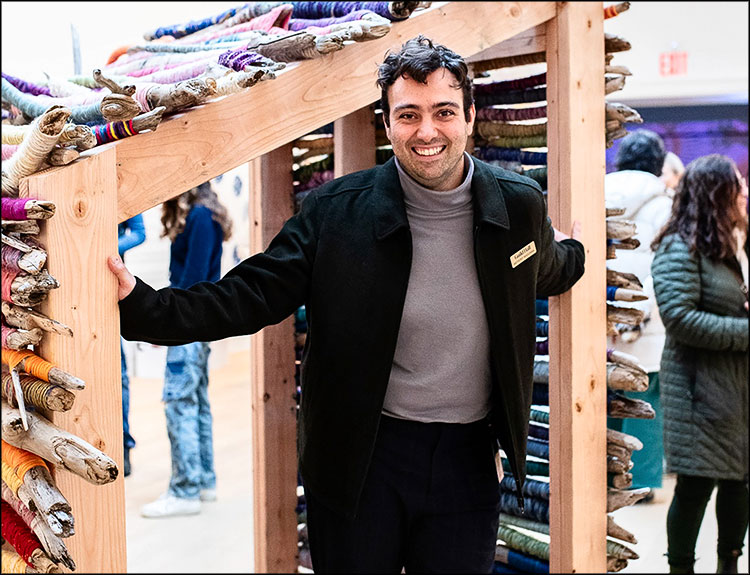
Anthony Madonna’s preparation for his current position as Guild Hall’s theater director and curator of performing arts began long before he first came there on a fellowship in 2019. During a conversation in the venue’s Green Room, he said that “there was always music playing” both in his house and his grandparents’, including Cyndi Lauper, Queen, Meat Loaf, Frank Sinatra, and opera.
While growing up in New Hyde Park he and his sisters attended an exceptional public school. When his sister began to play the violin, he was mesmerized by it, and he began playing the cello in second grade. He was so adept his teachers recommended to his parents that he have a private teacher, and they concurred.
At the same time as Madonna was playing in youth orchestras, he realized he loved to sing, and his teachers once again encouraged him. “In middle and high school I started doing a lot of after-school theater and singing in choirs and playing in orchestras.” He began trekking into New York city for lessons in eighth grade and doing conservatory camps during the summers. He said he owed it all to having a school that emphasized the arts and parents “who gave us support.”
As high school graduation approached, his parents encouraged him to get a music degree and become a teacher. Fast-forward to 2011 when he enrolled in Westminster Choir College in Princeton, N.J. “The degrees there were very specific,” he said, citing music education, vocal performance, piano performance, organ performance, and sacred music conducting.
During his matriculation, he had two mentors. Zehava Gal, with whom he studied in high school and at Westminster, was a mezzo-soprano “who opened up my world to so many different musicians, so many different composers. She really taught me how to be dedicated to a craft.”
Another professor there, Amanda Quist, a conductor, invited him to attend weekly choral conducting classes. “Amanda taught me how to facilitate a group of people. In conducting, that’s what you’re doing, pointing out what to listen to, how to balance yourself, about gesture and presence.”
There was another important component to his time in Princeton: McCarter Theatre, where he landed a job as a teaching assistant for its kindergarten creative drama and middle school musical theater programs. “Working there, sitting in the back of the theater during rehearsals, I could see how Emily Mann, the artistic director and resident playwright, ran the theater programming.”
Madonna also noted how Bill Lockwood, who started the Mostly Mozart festival at Lincoln Center, ran the music programming at the theater. Seeing “the variety of artists he brought into the theater, I began to see what jobs were out there and I had really great examples.”
When asked if he imagined at that time that he would ever run a theater, he explained that Westminster laid down a path. “After you graduated, you would teach for four or five years, get your master’s, get your doctorate, and work at a college.” He chose a different route.
After graduation he decided to take a gap year and applied to an apprenticeship program at the Juilliard School. “You shadowed different staff members, and I was assigned to the vocal arts department there.” His work involved supporting guest artists who were working with the undergraduates and producing recital and vocal arts programs. In addition, it acquainted him with the administrative and producing aspects.
During that year he read a book by Peter Renshaw, who had been the head of research and development at the Guildhall School of Music and Drama in London. (Did someone mention foreshadowing?) When Madonna learned the school only accepted seven to 10 students a year, he wasn’t optimistic, but he was accepted and followed a degree program in music leadership.
Early on a difficult assignment let him to enter “the whole sound world, exploring so many different kinds of musicians and sound artists and creating electro-acoustic music and using my voice to do more experimental vocal works.”
Because the school was connected to the Barbican Centre, one of Europe’s leading performing arts and cultural centers, Madonna not only worked on festivals there, but also had some unusual experiences working in hospital dementia wards and with St. Mungo’s Homeless Charity.
For the hospitals, the students would take their instruments to the ward, learn when the patients had been born, research the music that was popular when they were in their 20s, and play those hits. “People sang to each other, they knew those songs. It was incredible. All the tools I acquired can be used in any context. It was about connecting with people.”
After graduation, he returned to New York in 2018. He began to sing with Moving Star Voices, a company in residence at Carnegie Hall, but he was looking for a more permanent job. When he saw a listing for a two-year fellowship at Guild Hall, “On paper it was like absolutely everything I do.” Aside from occasional day trips to Montauk for picnics with his parents and grandparents, he was unfamiliar with the East End.
When he first drove out for an interview he didn’t think he could live here. Until he met Andrea Grover, Guild Hall’s executive director. “She had been there for a year or two, and I was like, whoa, there is something magical here. I looked up the history of Guild Hall and was amazed by all the artists who performed there, exhibited there, and made work there.” He thought two years was perfect. This is now Madonna’s seventh.
The fellowship involved focus on the Teen Arts Council, in-school programs, after-school programs, and the residency program. While his first year started with acquainting himself with those initiatives and the East End, he began to shift and grow the programs. The Teen Arts Council has tripled over the years, and while there were originally two schools represented, now there are five.
When the fellowship ended, he became the senior associate for learning and public engagement for two years, then director of learning and new works for two more years before becoming the theater director and curator of performance in the fall of 2024.
“The residency program is where I started to shift into my current role. When we were lucky enough to receive support from Katharine Rayner to underwrite the residencies, we were then able to start commissioning work.” During the conversation, Robbie Fairchild, a choreographer and former resident artist, was in the theater rehearsing a new work co-commissioned by Guild Hall and the New York City Center that would be performed at the center’s Fall for Dance Festival. “We get to incubate work at the very beginning, find partnerships, bring it from studio to theater, tech it, have it premiere somewhere, and then come back to us.”
Madonna cited the importance of having a crew whose approach is to work together to make each program the best it can be, as opposed to saying to an artist, “ ‘No, we can’t do that.’ You get to meet so many incredible artists on this stage. I didn’t take stepping into this role lightly, because you’re taking care of an entire team.”
Speaking of the team, they are now working on next summer’s programs, evaluating what happened this past summer, what felt good, what didn’t feel good, and talking to artists.