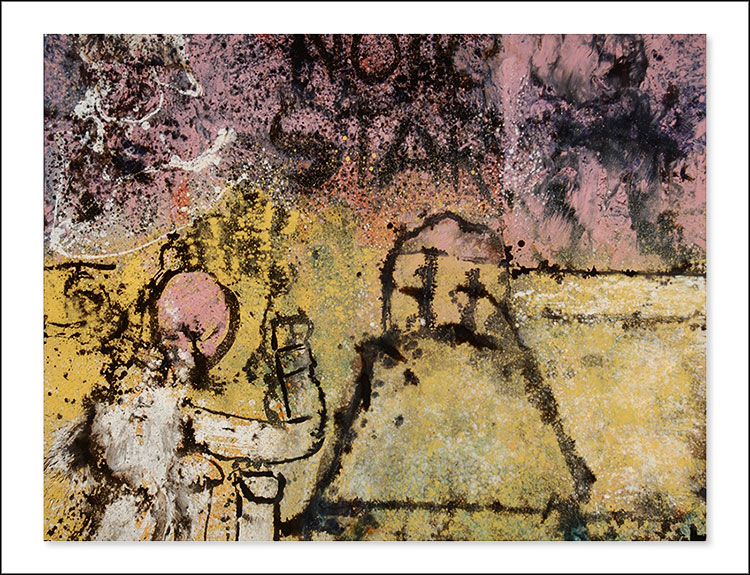
“Abstract Expressionism: The East End, 1940 to Today” will open Saturday at the Parrish Art Museum in Water Mill and continue through Feb. 14. The show extends the museum’s yearlong celebration of the semiquincentennial of the United States, “Parrish USA250: Life, Liberty, and the Pursuit of Happiness.”
Liberty is the concept underlying this survey of the influence of the East End during the rise of Abstract Expressionism and the abstract artistic practice that followed, according to the museum. That liberty and freedom of expression are embodied in the approach of those artists is undeniable.
However, it was documented as early as 1973 in Artforum magazine and elsewhere by such writers as Max Kozloff and Eva Cockcroft that the movement was put forth by such institutions as the Museum of Modern Art and more covertly by the C.I.A. as an alternative to socialist realism, and thus a weapon in the Cold War. The irony is that many of the artists in that movement, if they were at all political, held anti-establishment or leftist views.
Politics aside, the East End is widely considered one of the most significant artistic hubs in the country. “ ‘Abstract Expressionism: The East End, 1940 to Today’ reflects on the deep and continuing influence of this region, its natural landscape, and the sense of creative freedom it elicits for the artists who have called it home,” said Monica Ramirez-Montagut, the museum’s executive director. “From Jackson Pollock and Lee Krasner’s arrival in Springs in 1945 to the artists living and working here today, the East End has remained a space for deep artistic exploration and experimentation.”
Drawn from private collections and the museum’s own holdings, the exhibition begins in the mid-20th century with the work of the first and second-generation Abstract Expressionists, made when they were living and working on the East End. Among them are Mary Abbott, James Brooks, Elaine de Kooning, Perle Fine, Helen Frankenthaler, Gertrude Greene, Lee Krasner, Joop Sanders, and Esteban Vicente.
Works by Willem de Kooning, John Opper, Betty Parsons, Joanna Pousette-Dart, and Syd Solomon highlight the period after the movement’s rise, demonstrating a shifting style during the 1970s and 1980s. More recent works reveal how East End artists have continued to pursue and expand gestural painting from the 1990s to the present, according to the museum. Among them are paintings by Marina Adams, Mary Heilmann, Claude Lawrence, Suzanne McClelland, Pat Steir, Stanley Whitney, and Frank Wimberley.
“The movement’s characteristics of innovation and network of creative influences will be further explored through photographs of artists at work in and around their studios from the museum’s collection, including images by Laurie Lambrecht, Fred W. McDarrah, Hans Namuth, and others,” said Kaitlin Halloran, the museum’s associate curator and publications manager and curator of the exhibition.