Tripoli Gallery in Wainscott is unique on the East End. Since opening in 2009 at its first brick-and-mortar location on Job's Lane in Southampton, it has hosted more than 80 exhibitions. Because its annual Thanksgiving Collective exhibitions have featured as many as 144 artists, the number of artists shown there is at least that high, probably higher. But numbers are not the whole story. The range of artists is as diverse as it is impressive and reflects an ecumenical viewpoint.
"What I look for is authenticity," said Tripoli Patterson, the gallery's founder. "I'm very conscious of the motive behind the creator, why they're making things, and the source of their inspiration. The work has to initially catch my attention. But then it goes to the character behind the work, because I see my relationship with artists like marriages, and I want to be working with them forever. Even if they go to another gallery, my relationship with them won't change."
As evidence of the longevity of those relationships, the first show Patterson ever organized before opening on Job's Lane was at Silas Marder's gallery in Bridgehampton when he was 20 years old. Among the four artists were Lola Montes and Angelbert Metoyer. Montes is included in "Hail Mary," his current exhibition, and Metoyer had a solo show at his gallery last month.
Patterson's openness to a variety of art reflects both his international upbringing and the fact that his father, Leonardo Patterson, was a successful dealer of pre-Columbian antiquities.
Like his other siblings, Patterson was born in Sag Harbor in the family's home on John Street. They moved to Germany, where Leonardo had relocated, when Patterson was 2 and lived there until he was 4. His mother, Terry Patterson, who now lives in Maryland, took the children to India when Patterson was 5 or 6. When he was 13 they moved full time to Bali, where he attended the International School for three years.
As for his father, "Growing up I was surrounded by pre-Columbian artwork. That I played with Aztec, Mayan, and other ancient relics definitely informed my outlook when I'm looking at art today."
His father's success also led to other important relationships in Patterson's life. "My father's from the Caribbean side of Costa Rica, but he made his way up to the Hamptons via Miami when he was in his 20s." On that first visit, Leonardo met Willem de Kooning and did a trade with the painter for some pre-Columbian art. He also met Lisa de Kooning, Willem's daughter, who grew up with Terry Raebeck. It was Lisa who introduced Terry to Leonardo. Not only is the rest history; Lisa was also Patterson's godmother.
Before showing art — long before — there was surfing. Patterson started when he was 8 and began to compete when he was 9. "When I was 10 years old I got second place in the East Coast Championships in the Menehune Longboard, which was for 14 and under." Kelly Slater, who is widely regarded as the greatest professional surfer of all time, signed Patterson's trophy. "That was a very memorable trophy for me."
Patterson continued to compete as a free surfer and was traveling all over the world doing surf movies. When he was 18, after he met Metoyer, he went to Australia to qualify for the World Circuit Tour. "After a very long mission of getting to Australia, finding accommodation, finding transport, I found myself in a 20-minute heat in knee-high waves, and I lost that first heat, so I was out of the contest." After the same thing happened the following week, he returned to the United States and curated his first show at Silas Marder's gallery.
He still surfs, and feels his surfing is as good as it ever was. "I was just in Bali this year and remember getting a stand-up barrel at Uluwatu." Uluwatu is one of the best surf spots in Bali, and for a stand-up barrel, the surfer rides inside the hollow curving part of the wave while standing fully upright rather than crouching or ducking. "It was really scary, and fun."
How he came to open at Job's Lane in 2009 was somewhat circuitous. "In one of my pop-up exhibitions, Larry Gagosian walked in and I sold him a painting. It was the first time I swiped a credit card. I didn't know who Larry was. I remember texting Vito Schnabel [the artist Julian Schnabel's son] and asking who he was, and Vito said he's the biggest art dealer in the world."
At the time Gagosian was representing the de Kooning estate. "I hadn't been in touch with Lisa, but she was my godmother and I decided to connect with her. She and I got acquainted, and we went down to Puerto Rico to see Felix Bonilla's art." Lisa de Kooning put up the funds for a six-month lease on Job's Lane, money that would be reimbursed from sales. "I ended up staying in that space for 10 years, but it was started because of Lisa."
Elaborating on his approach to presenting work, he said, "I want to use my instincts, but I don't want to use too much of my brain. My father passed away last year, and one quote I remember him telling me and my brother Jake on a video chat was, 'Remember to leave space for magic.' So I think if we can be in that fluid state, coincidences can come to life, and synchronicities can happen, and once those things happen without too much of your control, you're doing something correct."
Moving from his office into the exhibition space, he said, "I look at this show every time with the eyes of the people who come in. I want the viewers to feel they're the storytellers, and the pieces become these talismans to assist in that developing story. Not only are the artists telling their stories, but the viewers come in and create their own stories from these pieces as instigators."
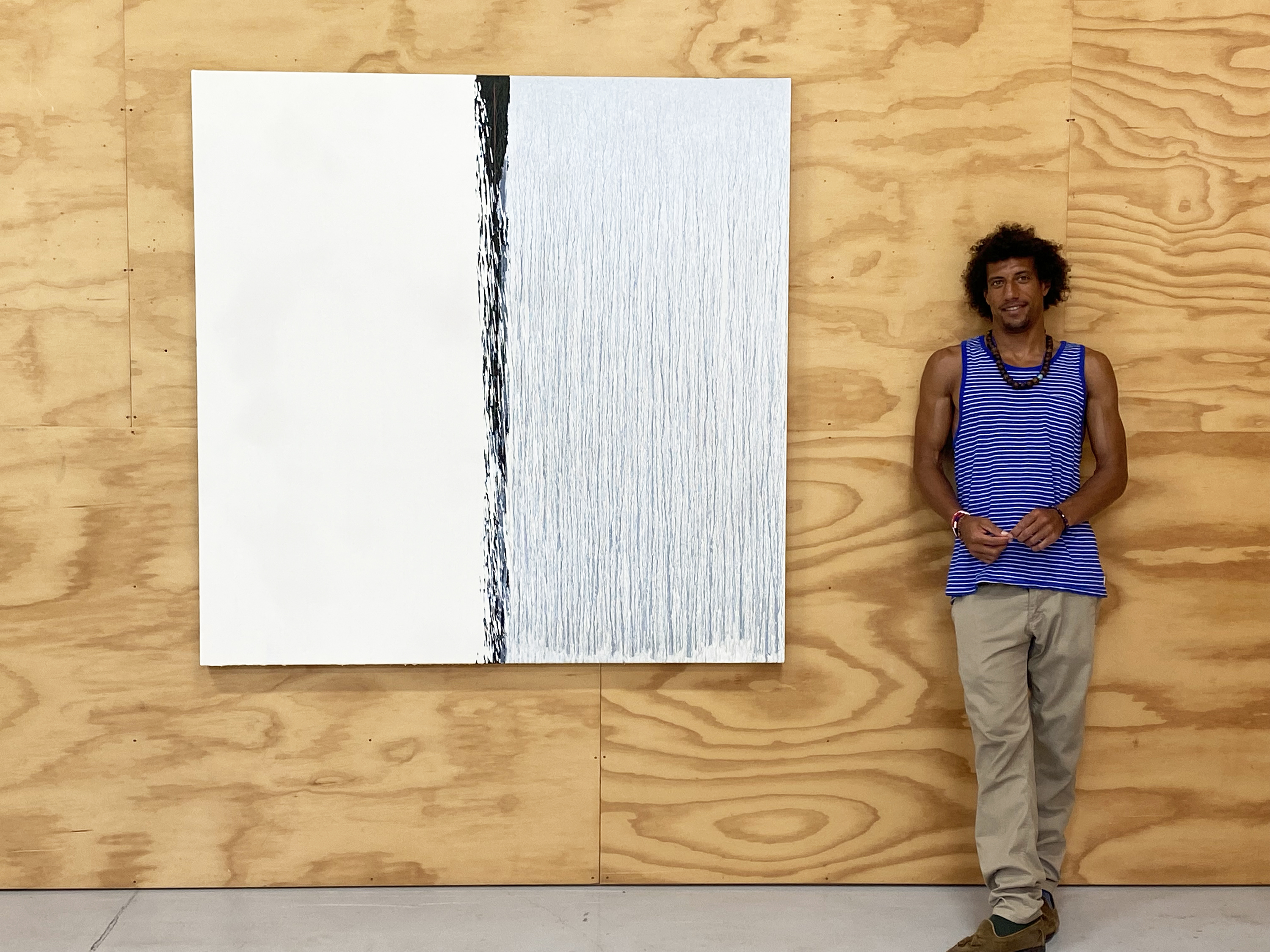
"Holy Mary" includes work by Katherine Bradford, Katherine Bernhardt, Ann Craven, Salvita De Corte, Sally Egbert, Montes, Sabra Moon Elliot, Naomi Samara, Pat Steir, Mary Weatherford, and Lucy Winton. Samara, who is new to the gallery, is from Bali and is half Indonesian and half Dutch. "Because Indonesia was settled by the Dutch, she is part settler and part Indigenous," two perspectives he said were reflected in her work.
De Corte is also Indonesian, but of Spanish descent, "So I love seeing perspective as half Indonesian and half European." Of Sally Egbert, an abstract painter based in East Hampton, he felt her work fit into the story the show is telling. "There's a motherly, nurturing feeling here that can be comforting."
The captivating works on view reflect the range of Patterson's taste. While writing the press release for the exhibition, he stayed at Julian Schnabel's Montauk studio. "It's a very sacred space, it feels like it doesn't change with time. I feel artists' spaces are sacred areas, and I think the gallery's responsibility is being that buffer between the economics and the sacred studio."