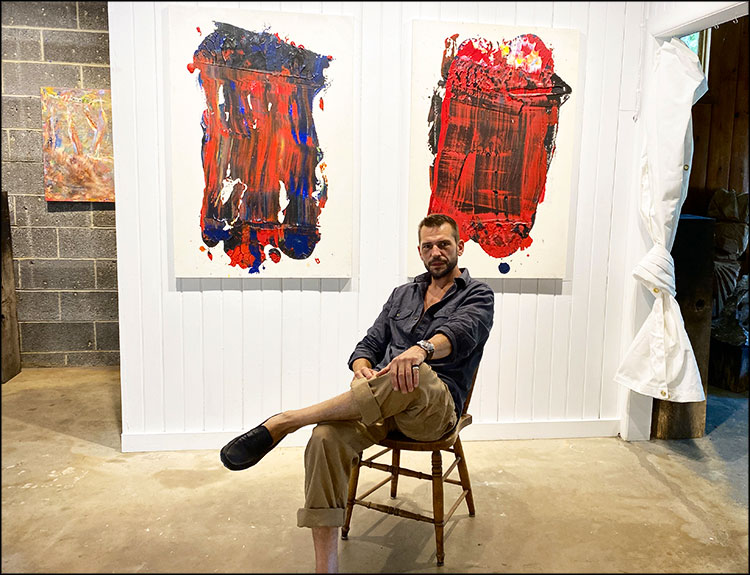
Four weeks ago, Gallery 851 opened at the former home of the Fireplace Project at 851 Springs-Fireplace Road in Springs with “Out of the Woods,” a group exhibition of work by nine local artists. The venue was founded by Alexander Reinwald, who has managed to maintain three careers for most of his adult life: artist, curator, and automobile design and restoration specialist.
The gallery will pivot on Saturday to “Dubious Characters,” a solo show of works by Joe Zucker (1941-2024) from his 1984 series “Portrait of Joseph Smith,” the founder of the Church of Jesus Christ of Latter-day Saints. A reception will take place from 5 to 7 p.m. The exhibition will run concurrently with a show of works from Zucker’s “Brushstrokes” series across the street at the Pollock-Krasner House and Study Center. More on the gallery and its upcoming show later.
It should come as no surprise that the road that led Reinwald to such divergent yet simultaneous careers as art and automobile restoration is a winding one. It began in Red Bank, N.J., where he was born and raised. “Like most children, I was directed toward expression and art when I was young, and I never shook that,” he said during a conversation at the gallery. He excelled in art classes as early as junior high. Then things took a turn.
After his father moved to Santa Fe, N.M., when he was 13, Reinwald spent summers there and decided to move there when he was 16.
That was where the automobile came into play. His father was working for Europa International, which was the first operation in the United States to import and sell the Mercedes-Benz G-wagons. (Those cars were the stylistic forerunners of today’s boxy Jeep-like G-Class S.U.V.s that are so ubiquitous on the East End.) During the summers, Reinwald would wash and detail cars and work in the parts department, “where you start to learn more of the specifics about cars.”
After graduating from high school he moved out of his father’s house and moved in with a group of artists. Over the next several years he was peripatetic, hitting the road with some friends in a Volkswagen bus, returning to Santa Fe, then moving to New Hampshire, where his daughter, Kaya, was born in 1999. At 23 he had a call from his father with a job offer.
Through Europa his father had met Paul Russell, whose auto restoration company is so prestigious that one of his clients was Ralph Lauren, who happened to be looking for someone to manage his collection of about 50 cars garaged in Montauk. Lauren hired Reinwald’s father, who in turn invited his son to join him.
“I came out here in July 2002 and worked for that collection full time until 2006,” Reinwald said. The job involved doing complete analyses of each of the vehicles, determining what needed to be done on each car from a safety standpoint and from a concours, or display, standpoint.
“We did an installation at the Museum of Fine Arts in Boston, and other projects, where I would be sent on location to facilitate the handling and driving of the cars. There were 1950s and 1960s Jaguars and Ferraris and Porsches. There was a 1929 Bentley, Bugattis, Alfa Romeos — grand prix type cars.”
Reinwald noted that Lauren collected for quality over quantity. “I remember early drives with Ralph where we would have discussions about that, about collecting and how he sees the automobiles as moving sculptures.”
Meanwhile, Reinwald never stopped making art. Once he moved to Montauk he began to meet other artists and he transitioned from drawing to painting in 2003. In 2004 he met Gregory Johnston, another artist-auto restoration specialist, who in turn introduced Reinwald to more artists. “It’s so inspiring, meeting artists, going to their studios, and that has continued to this day.” He started showing his own work in 2011. “I enjoy making paintings, exploring materials. Making a painting is like a mechanical thing.”
In 2006, Reinwald began to work on cars with Johnston, who had an auto restoration workshop in East Hampton. When Johnston moved in 2020, Reinwald took over his entire workshop space, then divided it, and the artist Peter Dayton took over half.
Reinwald met Dayton in 2017, when he organized with Salvatore Termini “Defenders of the Water,” a charity art exhibition at the Montauk Yacht Club that included Dayton, eight other artists, and Reinwald himself. “That was the last time I put together a large art show.” The show’s title was a play on the classic Land Rover Defender; examples that Reinwald had restored were also on display.
Speaking of that car, one of Reinwald’s clients is David Netto, the interior designer, who in an article in Town & Country magazine called Reinwald “a Land Rover expert and my new best friend. Alex restored and maintains my wife’s D90. He operates in East Hampton, keeps a low profile, and chooses his clients carefully. There are four or five people to go to in the U.S. for this sort of project, but on Long Island, he’s the Defender Whisperer.”
“Another thing about the automobile and my time with Ralph Lauren was the amount of history I was turned on to,” said Reinwald. “Starting out as a young person I don’t think I thought about it much at all, but over time I realized the job is really to be the steward of these historical objects. If we do our job right, this piece of history is going to last.”
As for Gallery 851, when Reinwald heard that Edsel Williams was closing the Fireplace Project, “I thought maybe that would be a good time for me to re-emerge, because since 2017 I’d been focused on my automotive work and building the business. A time to come ‘Out of the Woods.’ “
Williams introduced him to Shirley Talmage. She and her brothers own the building, which originally housed their father’s plumbing supply business from the 1950s until 2000. “Richard Talmage was an open-door sort of guy, and artists would spend time with him in the building. He would teach them certain skills, such as how to weld. He would also visit their studios. Once I started understanding more about the beginning of this building, that was very alluring.”
Before the gallery opened, he entertained several ideas about what the inaugural show should be. “One was the possibility of trying to start off with the heaviest-hitting artists out here, to make some kind of splash. Matt Satz was going to have a show at the Pollock-Krasner House, and I thought I could get some work from him. I had recently been introduced to Ross Bleckner, so I thought of reaching out to him. The other person I had in mind was Joe Zucker, who will be featured at the Pollock-Krasner House this summer and whom I had been introduced to by Britta Le Va, his widow.”
When he and Le Va first got together, she was reluctant to lend a piece to the opening group show. “Her suggestion was to make sure I’m reaching as high as I can. That advice was helpful.”
Le Va came back with the idea that because Zucker was going to have an exhibition at the Pollock-Krasner House, perhaps Gallery 851 could mount a show from a different series of Zucker’s that would run concurrently with its neighbor’s.
The Joseph Smith portraits exemplify Zucker’s prolific and inventive career, which was marked by a constantly evolving artistic inquiry into the physical properties of painting — tools, processes, materials, content, and subject matter, according to the Parrish Art Museum.
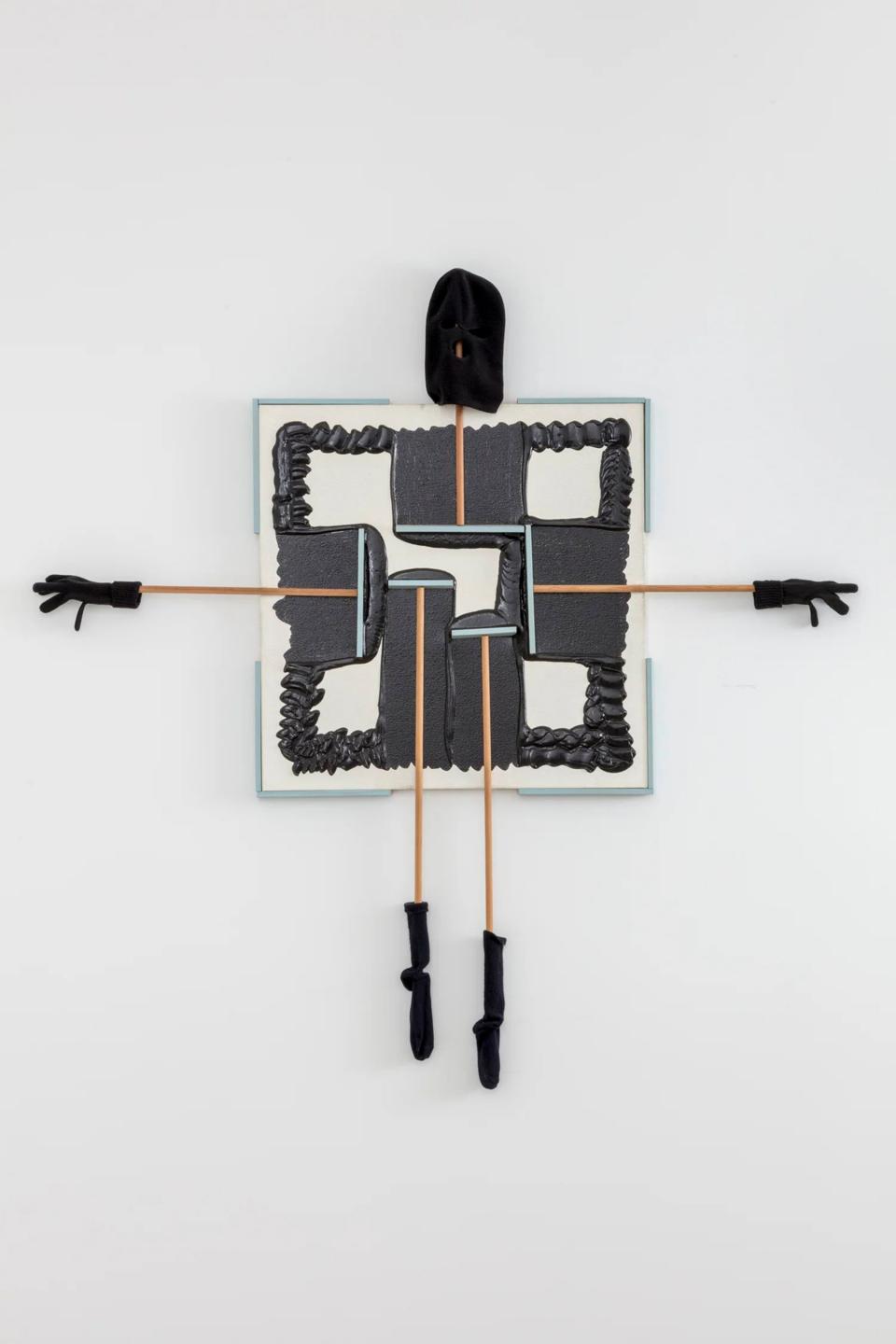
The Smith portraits are literally stick figures. Beginning with slat-framed blank white canvases, most of them rectangular but some triangular, he cut out sections of the frame and attached to each a long wooden dowel. He used the dowels to push thick black paint across sections of the canvas with the attached slats, producing wide paths of paint.
He left the tools, now with their hardened paint, attached to the canvas surface, with some length of the dowels sticking out beyond the perimeter of the canvas. Stick figures, indeed. He added gloves, a ski mask, and socks to the ends of the dowels to create “Joseph Smith in a frozen fascistic pose,” Zucker told Chuck Close in an interview in Bomb magazine.
The winding road of Alexander Reinwald’s journey led him to the East End, where the paths of the automobile and art merged.