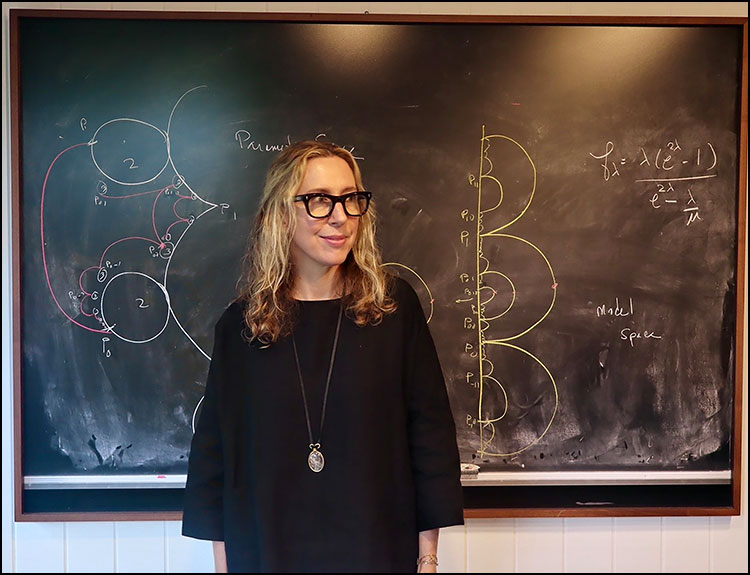
In September 2019, the science section of The New York Times devoted an entire page to Jessica Wynne’s photographs of mathematicians’ chalkboards. Two years later, 110 of those images were published by the Princeton University Press in the book “Do Not Erase.”
What is the origin story of such a project? Did it begin when, growing up, she learned how to develop film in her father’s darkroom? Was it a trip to India in 2018? Or her family’s summer neighbors in Truro on Cape Cod?
Wynne, who divides her time between Springs and New York City, where she is a professor at the Fashion Institute of Technology, cited all of those reasons and more during a conversation in her Springs studio.
That space is where “Under/Cover,” a show she organized of photographs by nine other artists and from two vernacular collections, will open with a reception Saturday from 3 to 6 p.m. More on that later.
Wynne was born and raised in Connecticut, where her parents were teachers at the Taft School. Learning to develop film in her father’s darkroom, “I grew up thinking photography was this magic thing, but I never really thought of it as something to pursue,” she said.
Wynne’s mother, whose stepfather was from India, went to high school there, returning to the United States for college. When Wynne was 15 she decided to do a year at the same high school in Southern India as her mother.
Describing herself as a shy, introverted teenager, she took along a camera her father had given her. “I felt it gave me this power. I felt sort of fearless. I was so curious about that new culture and the people. Having a camera allowed me to talk to people and learn about things that were outside my realm.”
That’s the through line of her career.
That experience helped launch her into photography as a profession. She focused on it as an undergraduate at the San Francisco Art Institute. She cited two professors as mentors, Reagan Louie and Jim Goldberg, a Magnum photographer with whom she interned.
While there she was working in a coffee shop across the street from a single-room-occupancy hotel. One of the residents, Jeff, would come in every day, and they became friends.
She wound up photographing Jeff and then, despite some hesitation at first, spent the next two years at the hotel photographing its residents. “My earlier work was very much like documentary portraiture. But going into places that I was an outsider to, like India or the hotel, is really not that different from engaging with the world of mathematicians.”
The latter project had its genesis during the summer 15 years ago on Cape Cod. Her neighbors, Amie Wilkinson and Benson Farb, were mathematics professors at the University of Chicago. “They are really accomplished mathematicians, and over the years I kept meeting more of their friends, who would come out from Harvard and M.I.T.”
“I thought what they did was fascinating. I wanted to learn not about math but just about the community and understand what drives the process of discovery. One of the reasons I love photography is I can just be curious and enter worlds I have no business being in.”
Through her neighbors, she learned that mathematicians still use chalkboards, despite all of the technological advances. For her book she asked her subjects why chalkboards were not replaceable with digital technology. “A lot of them said our brains don’t match the speed of digital technology. The movement of your hand is more closely aligned to the function of your brain and thinking.”
As for the trip to India in 2018, before she started the chalkboard project she took her students from F.I.T. there, where they visited an elementary school. The principal took them to the roof of the building, where chalkboards lined the entire perimeter. While she had been taking photographs of her students, other people, and the landscape, she found the pictures of the chalkboards were the most interesting. “I didn’t understand them because they were all lessons written in Hindi. I liked that.” Not unlike complicated equations.
She took a paid sabbatical from F.I.T. in order to undertake the chalkboard project. One of the boards she photographed belonged to Deane Yang, a professor at New York University’s Courant Institute of Mathematical Sciences. A few months later, Yang informed her that he had told his brother, who worked at The New York Times, about the project. His brother wanted to show her work to Dennis Overbye, a science writer at the paper.
The result was the full-page, lavishly illustrated article in the science section.
If that connection sounds serendipitous, it was. So was being contacted by Princeton University Press soon after. Her editor thought it would be interesting if the book included the scientists’ perspectives as well as the images.
“I thought it was a great idea, and the point of the project was not to aestheticize the chalkboards but to understand those people are real scientists. I wanted to give them an opportunity to write about their work to give some context to what was on the boards and also to talk about the importance of drawing.”
When she said she had photographed every chalkboard, a visitor mentioned seeing one on her website of an Albert Einstein board from 1931. It turns out it is in the Oxford Museum. “They took it out of a vault for me to photograph it. There are only two left.”
After earning her B.F.A. in San Francisco, she followed a professor’s advice and applied to Yale, where she secured an M.F.A. in a photography program so competitive that it accepted only eight students each year. From New Haven she moved to New York City.
Still shooting film, she dropped off her portfolios at various publications, including The New York Times Magazine, where Kathy Ryan was the photo editor. Ryan hired her to shoot portraits for the magazine, and before long other photo editors saw her work and hired her for other publications. “I just started shooting and taking portraits with my big 4x5 camera, with the dark cloth over my head. It was fun for me to travel and meet these interesting actors and writers and artists.”
She freelanced for eight years. One of her editors felt she would be a good teacher and recommended her for a job at the Parsons School of Design. After two years there, a full-time job opened at F.I.T.; she has been there since 2007. “That’s when everything started to go digital and all the magazines were collapsing because of the internet. And I had my daughter at the same time, so I couldn’t just jump on a plane to take pictures all over the world. I loved doing magazine work, but my intention was to be an artist.”
Three months ago she embarked on a new project: photographing the floors of Jackson Pollock’s studio with her 4x5 film camera. “I’m getting the same sort of feeling as when I’m documenting the chalkboards, because I’m documenting someone else’s work. He’s a famous artist, but this isn’t his art. It’s years of accumulating paint.” Whether the boards or the floor, “It’s about discovering things that are already there but seeing them from a new perspective.”
“Under/Cover,” which will be up through Aug. 8, includes two collections of vernacular photographs, which are everyday images created by amateur or unknown photographers, and not for publication. One belongs to a student of hers, Gram Spina, who inherited them when the collector he was working for died and left a cabinet of 4x5 negatives. The ones that interested Wynne most were black-and-white images of car crashes taken at night, perhaps for a newspaper or an insurance company.
In one, the wrecked car is in the background, while the road is dusted with snow and covered with footprints, which in a way become the subject (and recall the chalkboards). In another a car seemed to be illogically impaled on a wooden or steel railing. They are like unexplained, evocative fragments of a narrative.
Also part of the show is Peter Cohen, a collector who has thousands of vernacular photographs. He works with a lot of museum curators, and if a curator wants something, he gives it to them. “He wants the work to be seen. One of the things that’s interesting is that they were never meant to be seen by us. They weren’t taken to be published.”
Of all the works in the exhibition, Wynne said in a statement, “United by themes of concealment, these diverse bodies of work invite viewers to consider that the tension and suspense of what is not seen is often more compelling than what is on the surface.”
People wishing to attend Saturday’s reception or to make an appointment for another time have been asked to do so by emailing [email protected].
Also, Wynne has chalkboard photographs on view at Onna House, a private home in East Hampton showing the work of women artists, through Sept. 7.
This article has been changed from its original and print versions to correct the name of the photographer who photographed Jessica Wynne and to correct the timeline of when she first met her mathematician neighbors.