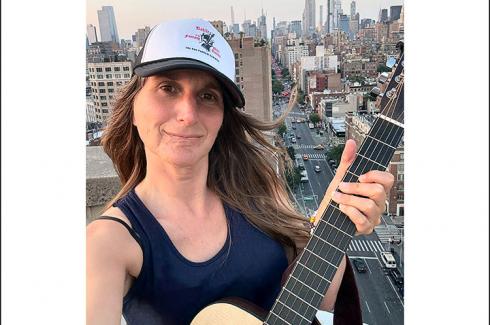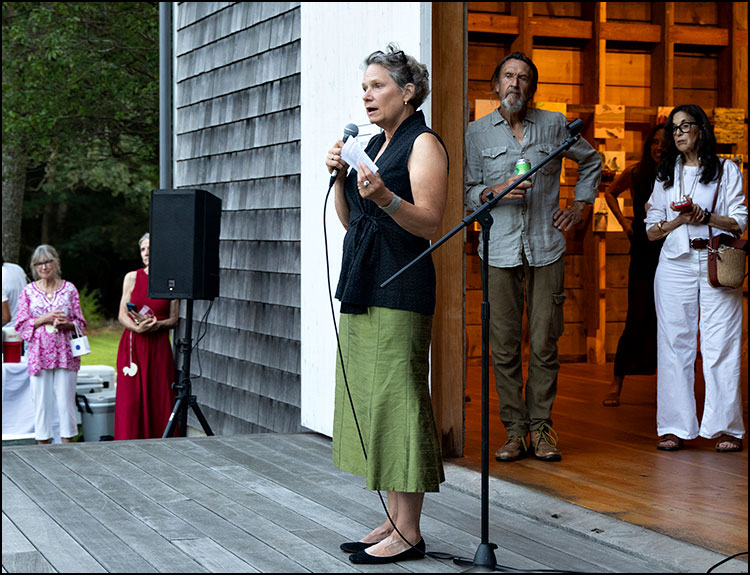
Coincidence or destiny? Jess Frost’s parents bought their house across the street from Duck Creek Farm in Springs in 1973, three years after she was born, and Frost spent weekends and summers there growing up. In 2018 Frost officially became the executive director of the Arts Center at Duck Creek, but she was involved in the property’s transition from John Little’s farm into an art center from the beginning. Sounds like coincidence, however remarkable.
Her parents were graduates of the Rhode Island School of Design, where her father, Guy Frost, studied architecture and her mother, Donna Frost, illustration. After settling in Springs they spent time at the Birches, formerly Jungle Pete’s (and now Springs Tavern), when Willem de Kooning and Larry Rivers hung out there. Her parents went to all the art openings, and she has a pin made by the artist Ibram Lassaw that she is sure they bought at the Elaine Benson Gallery. So Frost might have been destined to land in the art world, if not at Duck Creek.
In 1965, her parents moved to Roslyn and her father was mentored by Admiral Roger Gerry, a master preservationist. Guy worked for 25 years restoring and adapting 50 structures in Roslyn’s historic district. It had its impact on Jess. “In terms of ethics and creativity and meaningful work, my father was really driven by preservation,” she said during a conversation in the John Little Barn.
Considering she was one of Duck Creek’s five founders, along with Ira Barocas, Pamela Bicket, Loring Bolger, and Zachary Cohen, preservation has figured prominently in her own life for over a decade.
But making art preceded what she recently referred to as “creating opportunities for others.” She said that while growing up, “music and visual art helped me understand who I was and communicate to people things I cared about.”
She enrolled in SUNY Purchase planning to study graphic design, but was soon advised to move into the painting department. “That was a revelation for me because for the first time I really devoted myself to understanding abstraction and fighting to advance myself. I fell in love with the idea of breaking down images and understanding composition.”
After graduating in 1993 with a degree in painting, she and a group of friends rented a house in Amagansett and she waited tables at East Hampton Point, then known as Wings Point. “I loved it because back then your co-workers were artists or writers and at the end of the evening while folding napkins they’d be talking about a book they were writing or a show they had and it was really compelling.”
There followed several years of spending summers here and winters in New York, and one job landed her at Nick and Toni’s restaurant, which in another coincidence helped further her career in the arts. In 1997, back in the city, she was applying for jobs and being offered only unpaid internships. It was Barbara Gladstone, one of the most powerful art dealers in New York, who hired her. “She said if I could handle the crowd at Nick and Toni’s, then I could handle the gallery’s front desk.”
But she wasn’t at the front desk for long, moving up to registrar and artist liaison. Matthew Barney, one of the gallery’s most important contemporary artists, was installing his show there, and Frost acted as his liaison with the venue. That in turn led to her becoming Barney’s production manager while he was working on “Cremaster 3,” one of five feature-length films that culminated in a major museum exhibition that traveled to Cologne and Paris before opening at the Guggenheim Museum in 2003. She moved on after the show opened in New York.
“Working for Gladstone taught me professional rigor, accountability, and the importance of protecting artists and their work,” Frost said. “Working with Barney on ambitious international exhibitions taught me how collaborative effort can turn seemingly impossible ideas into reality.”
After she was hired in 2004 by the Drawing Room in East Hampton, Emily Goldstein, the gallery’s director, introduced her to Gerson Leiber, who needed somebody to catalog not only his artwork but the famous handbags created by his wife, Judith Leiber. Considering it was over 10,000 pieces, it’s no wonder she worked on it over a period of seven years, while taking on other positions during summers, among them working on and off with Silas Marder at his Bridgehampton gallery. Her role as director of Glenn Horowitz Bookseller from 2011 to 2013 “lent me a certain gravitas.”
Starting in the fall of 2015, she was hired as Guild Hall’s associate curator to digitize its permanent collection. Working from October to May, the process took five years and involved assistance from Charles Ly, an East Hampton artist. “We were going to Crozier’s storage facility two times a week cataloging everything that was there.” She also organized a show with the sculptor Bryan Hunt drawn from the collection, and curated an exhibition of Ray Johnson’s mail art that was “so much fun to research.”
As for Duck Creek Farm, whose nearly seven acres were purchased by the Town of East Hampton in 2006, it took its first step toward its current iteration in 2013 when the Parrish Art Museum chose it as a site for its “Road Show” exhibition of self-curated work by Sydney Albertini, a Springs artist.
With the structures on the property still unrestored, the following summer Frost curated exhibitions by William King and Christine Sciulli, after which the restoration of the barn began and the founders decided to pursue 501(c)(3) status.
The site was ready to go in the summer of 2017, but nothing had been planned in advance because the team didn’t know if the work would be finished in time. Albertini stepped in again, this time on her own with “This Woman’s Work,” a show in the restored John Little Barn.
Frost took the title of executive director the following year, and that summer the Arts Center at Duck Creek mounted exhibitions of work by Cile Downs, Tara Israel, Jeremy Dennis (another Parrish “Road Show), and Soren Hope, as well as an outdoor sculpture exhibition organized by Bolger, two programs of classical music, and a series of lectures organized by the Pollock-Krasner House and Study Center. Nonprofit status was finalized in 2019, the same year Peter Watrous, an acclaimed guitarist and former music critic for The New York Times, launched the venue’s music series. Frost had met Watrous when he organized a jazz series at Silas Marder’s gallery.
Then came Covid. Eight concerts had been planned, and at first they took place without an audience. The exhibitions were mounted and documented, even though the barn was off limits. “That whole push gave us an opportunity to talk about the value of what we were doing. Everything here is free. It became about artists needing to show their work and musicians needing a place to play. By the end of the summer, we had a pretty big crowd.” For the concerts, guests were asked to sit on separate blankets.
In 2021, the restrictions had been lifted and the Little Gallery opened. The rest — that is, all the exhibitions, music programs, and other events — can be found on the venue’s website, which reflects Frost’s admitted predilection for documentation.
In an email, Frost elaborated on her tenure there. “I was so busy trying to prove myself as a director in the first six or seven years that I wasn’t able to step back and see that we were succeeding in a deeper, more meaningful way than I anticipated. And in a way that reflected my experience living out here as a kid, interacting with artists who didn’t act like or aspire to being ‘art stars.’ I also want families who have moved here full time to have the sense of community, the sense of place we had in the 1970s, before the ‘Lifestyles of the Rich and Famous’ put a spotlight on the East End.”
If there’s one thing that’s clear from spending time with her, it’s that Frost takes credit reluctantly, if at all. “I really needed the encouragement of my co-founders, board, collaborators, and community leaders to help me take risks I might not otherwise have taken. People took a chance on me back then, and in return Duck Creek is taking chances on other artists. Recognition makes me uncomfortable. Seeing Duck Creek become such a valuable part of our community is what makes me feel whole, safe.”