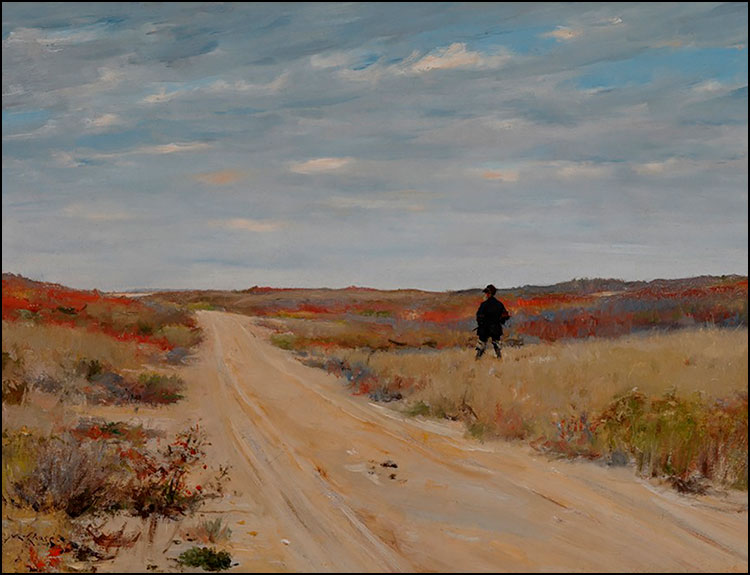
“William Merritt Chase and Walter Granville-Smith: American Impressionists of the East End” will open Friday at the Parrish Art Museum in Water Mill and remain on view through March 21. The exhibition pairs the work of Chase (1849-1916) and Granville-Smith (1870-1938) to show the influence of two American painters who found inspiration on Long Island during the 19th and 20th centuries.
Drawing from both private collections and the Parrish’s extensive holdings of Chase’s art — one of the largest public collections of his work — the show reflects the artists’ shared interest in the natural beauty of Long Island as well as their roles in the regional artistic community of the late-19th and early-20th centuries. They depicted the social milieu of the bourgeoisie, according to the museum, as well as more intimate paintings of family life, landscapes, and seascapes.
“This exhibition examines how two painters with distinct training discovered a new American identity and source of inspiration on Long Island’s East End,” said Monica Ramirez-Montagut, the museum’s executive director. “As our recognition of America’s semiquincentennial draws to a close, the works of Chase and Granville-Smith remind us of not only the East End’s enduring role in shaping American creativity and identity, but also the part our region’s artists have played in imagining new paths forward during times of transformation.”

“The works by William Merritt Chase and Walter Granville-Smith have been integral to defining the early artistic identity of Long Island,” said Kaitlin Halloran, associate curator, publications manager, and curator of the exhibition. “From tranquil coastal scenes to spontaneous depictions of daily life, their paintings capture the light and landscape that first drew aspiring New York-based artists to the East End and that continue to inform how we see it today.”
Chase had a profound influence on the art world of his time, with a career that spanned the United States and Europe. Financed by a group of businessmen, he enrolled at the Royal Academy in Munich in 1872, spending six years in Europe studying and traveling before returning to the United States in 1878, when he took a job teaching at the Art Students League. During a long teaching career his students included Edward Hopper, Georgia O’Keeffe, Rockwell Kent, and Charles Sheeler.
In 1892 Chase built a summer home in the Shinnecock Hills, where, according to the Smithsonian American Art Museum, he produced some of his freest and loveliest work. Shinnecock also became one of his most popular teaching venues. During those years his style ranged from impressionistic plein-air landscapes to the more somber realism of his portraits and still-life paintings. One of his portraits, “A Comfortable Corner (The Blue Kimono),” circa 1888, is on view for the first time since undergoing major conservation treatment.
Granville-Smith began his career as a magazine illustrator while training at the Art Students League. He started to spend summers on Fire Island in 1896 and eventually acquired a house in Bellport. Long Island’s South Shore and barrier beaches became favorite subjects of his landscape and marine paintings.
In 1897 Granville-Smith toured Holland, Belgium, and, perhaps most important, France, where he was impressed by the work of Claude Monet. Around that time he gave up illustration and turned exclusively to landscape painting. His atmospheric plein-air paintings “offer a quieter counterpoint to Chase’s sunlit views of the Shinnecock Hills,” according to the museum. An active member of the New York art community, he served as vice president and president of the Salmagundi Club.