
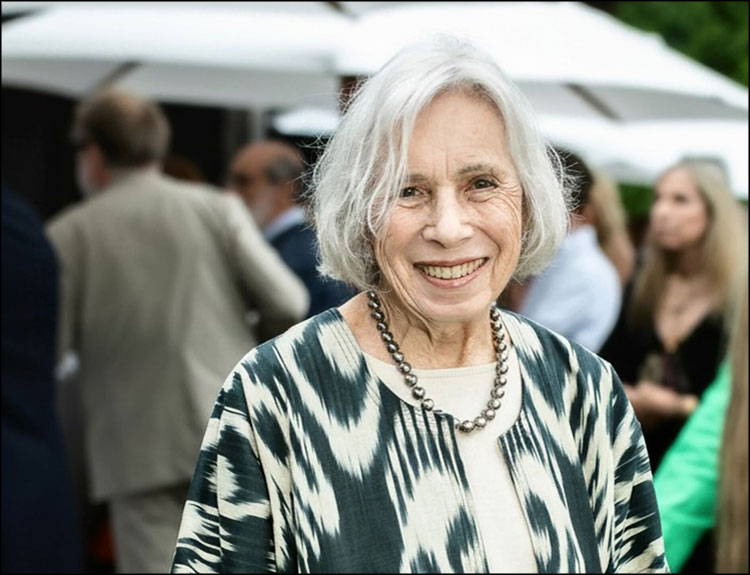
For 15 years, Florence Fabricant, a food critic and food writer for The New York Times and the author of 13 books, has hosted Stirring the Pot, Guild Hall’s long-running series of culinary conversations with chefs, restaurateurs, food writers, shop owners, and others in the gastronomic field.
On Sunday morning at 11, in celebration of her forthcoming memoir, “Salty, Not Sweet: A Life in the Food World,” the tables will be turned. Instead of being the interviewer, for the first time she will be the interviewee, or, as she put it in a conversation at her East Hampton house, “the victim.” (An unlikely outcome, as the questions will come from James Barron, a colleague from The Times she knows well.)
Fabricant expects the talk to focus on the book, her career, and “probably more about The Times, because that’s what James knows.” As for the book, which has a foreword by the acclaimed chef Thomas Keller, it will be published by the Hachette Book Group’s Running Press on Oct. 6.
Her 13 other books, many of which were written in support of such charitable organizations as the L.V.I.S. or City Harvest, were “all about what I love to cook and how I love to cook it. My whole approach is really simple. So as a result, it’s more about the recipes, and sometimes where they have fit into my life, my family, and my career.”
“Salty, Not Sweet,” unlike the others, is “deeply personal. I’m a very private person. I really don’t like to talk about myself, but in doing this book I had to.” When she first embarked on it, encouraged by Keller, about whom she wrote a feature for The New YorkTimes Magazine in 1988, she envisioned it as being primarily about her career.
When she began to write, her husband, Richard, had been developing dementia. Although he was a lawyer, when she was signing the contract, “he wasn’t really capable of fine tuning it in the way he had in the past. The first thing he asked me was whether The Times knew about the book and was okay with it. So he was a presence.”
However, he died last summer, as she was almost at the end of the manuscript. “I realized about halfway through that this was really his book as well as mine. The depth of our relationship, and how it fit into the context of the time, the world as it was, society, culture, was something I knew I had to describe. And I realized in the course of doing this how goddamn lucky I was. Because here I meet this guy and we decided to get married five days later. I redid a lot of the writing reflecting heavily on his influence and his acceptance and his enjoyment of participating in my career.”
She mentioned that it was the Betty Friedan era “when women were separating from husbands who only wanted a martini and lamb chops at the end of the day, and had no patience for a woman who had a career or had obligations.” She went on to recall an incident that isn’t in the book.
“One time the phone rang and it was a work call for me and I had to take the call. I said, ‘Richard, I’ve got to take this call and we’re already running late. Make the bed.’ I’ll never forget the look on his face. But the dam broke. He did it. It was one of those watershed moments. He was always a very good parent, he loved being with his children and his grandchildren, even though there was always some kind of tension, especially with teenagers.”
Asked whether the audience for Stirring the Pot had grown over the years, she said it had less to do with a growing interest in things culinary and more with who the guest is. “People were hanging off the rafters for Anthony Bourdain,” she said. “There are people who have been suggested to me, but I’m a little wary of that, because the number-one thing I want is a full house.”
While the publication of the book will coincide with a number of events in the city, she won’t be doing a tour as such. She was approached to do something in New Orleans, but “I’m kind of practical in the sense that I’m not going to go down to New Orleans and sit in front of 30 people and sell 30 books.” After a pause, she added, “Unless they can get Ralph Brennan to do a party at Commander’s Palace,” a legendary eatery in the Big Easy.
“The other things that I still like about my career, and in a way it was the same compulsion that got me going in the first place, are the sense of discovery and of revealing to people things they may not know. It isn’t just a matter of a restaurant here or a chef there or an eggplant that’s green instead of purple, but it’s a sense, and it’s in the book, too, of sharing information with people.”
Tickets to Sunday’s talk are $62. The morning will begin at 10 with a complimentary continental breakfast provided by Citarella. After the program, guests can meet Fabricant in the lobby and reserve copies of her new book.