Stanley Schellinger
Stanley Schellinger
Stanley R. Schellinger of Sandra Road in Springs died of lymphoma on Aug. 9 at Southampton Hospital at the age of 79.

Stanley R. Schellinger of Sandra Road in Springs died of lymphoma on Aug. 9 at Southampton Hospital at the age of 79.
Gail Weaver, who died on Jan. 18, will be remembered at a gathering Saturday at 11 a.m. at the Cormaria Retreat House in Sag Harbor. Ms. Weaver had been the clerk at the East Hampton Town Justice Court in the 1970s.
June R. O 'Connor, a resident of Montauk since 1955 who served during World War II in the Navy 's Waves, or Women Accepted for Volunteer Emergency Service, died on Saturday in Massachusetts. She was 88 and had been ill for some time.
Mrs. O 'Connor and her husband, Eugene F. O 'Connor, who died in 2004, lived in Brooklyn after their marriage on June 17, 1950, but established a second residence on South Etna Avenue in Montauk. Both were members of St. Therese of Lisieux Catholic Church.
Janice S. Brightwell, whose family was responsible for keeping a large portion of Napeague in a pristine state, died on May 30 at Twomey Hospital in Sumter, S.C.. She was 96.
Mrs. Bench died on Dec. 18, 2010, at the La Jolla Nursing Home in California. She was 99.
Mr. Signorile died on May 24 in Westhampton of complications following an April 30 stroke. He was 87.
Harriett Siegel, a longtime Springs resident, died on April 3 in Boca Raton, Fla., after a long illness. She was 70.
James M. Struble, a carpenter and master craftsman who lived in East Hampton for the past 25 years, died here on March 28. He was 44.

Homeowners who participated in a Suffolk County grant program designed to defray the installation costs of nitrogen-reducing septic systems to protect local waters have gotten an unwelcome surprise in recent weeks. They unexpectedly received 1099 forms, which report income, from the county comptroller’s office signaling they may be liable for thousands of dollars in taxes, contrary to what they were told when they entered the program.
“It definitely feels like a bait and switch,” said Dorothy Minnick, a Flanders homeowner who had a new system installed last year after being approved for a county grant.
John M. Kennedy Jr., the Suffolk comptroller, said Tuesday that he had made a decision in January to send 1099s to homeowners participating in Suffolk’s Residential Septic Incentive Program for the 2018 tax year. He agreed the action — and some others he has made — directly conflicts with the legal determination made by the Suffolk County attorney’s office that guided how the grant program was designed by the County Legislature in 2017, and then implemented by County Executive Steve Bellone in the last two years.
Now, upset homeowners — some of whom consider themselves well versed on the grants given their work for environmental groups or town boards — say they feel blindsided and caught in the crossfire. They were initially told only the designers and contractors who installed new systems would get 1099s from the county, since they would receive money for their work directly.
“I’m in the boat of people who were surprised to get a 1099,” said Chris Clapp, a marine scientist with the Nature Conservancy, who is co-chairman of East Hampton Town’s water quality technical advisory committee. “I sought the opinion of some trusted C.P.A.s and tax and finance lawyers that I know, and the general consensus is, you didn’t receive a check, you don’t get issued a 1099.”
“We were told from the outset the county grant would not be taxable income for us as homeowners,” Timothy Sheehan, a Shelter Island resident, said. Mr. Sheehan is concerned that he and his wife, Kate Rossi-Snook, an environmental advocate for Concerned Citizens of Montauk who serves on the East Hampton Town Community Preservation Fund advisory subcommittee, may have to pay about $3,000 in taxes on the $10,000 county grant they received.
Mr. Sheehan said he and Ms. Rossi-Snook were vigilant about reading and asking questions about the program; Ms. Minnick said she did the same.
“I’m a huge environmentalist, but the way this turned out is killing me,” Ms. Minnick said.
Ms. Minnick, who relies primarily on Social Security income and earnings as a part-time real estate agent, said if she were taxed on all the county grant and Southampton Town rebate money she received, it would “take me from an 11- percent tax bracket to a 22-percent-plus bracket, because not only am I now being taxed on the grant as additional income — it’s made my entire Social Security income taxable as well, when it otherwise would not have been. I might have to pay two-thirds more. So I’m getting zapped on this big time.”
Ms. Minnick said she is thinking of suing the comptroller’s office — and she is not alone.
Unraveling how this happened is complicated.
East End residents who installed nitrogen-reducing systems in 2017 and 2018 were able to apply to both the nascent Suffolk County grant program, which was capped then at $11,000 per installation, as well as to complementary $15,000 rebate programs offered by the Towns of East Hampton, Shelter Island, and Southampton. (The amounts have since been increased.)
By combining two grants homeowners often covered the entire cost and installation of a new system, which commonly runs anywhere from $14,000 to $30,000, depending on site-specific challenges.
The town programs in East Hampton and Shelter Island clearly state that homeowners are to treat the rebates, which are provided through 1099s, as income. The county grant program was different.
Mr. Bellone told The Star in April 2017, “We want to get more systems in the ground,” and “I want it to be workable and affordable to the average homeowner. . . . It still comes down to a house-by-house pocketbook issue.” Mr. Bellone said he had received a ruling from the county attorney’s office that homeowners would be spared counting grant money as income if it were paid directly to installers and site designers. Harris Beech, a firm that routinely advises the county government, including the comptroller’s office, reportedly made that determination after seeking advice from outside legal counsel.
Mr. Kennedy — who on Tuesday stressed it is his duty as comptroller to protect the fiscal interests of the county, said he supports the grant program over all — disagrees with the county’s decision about who gets 1099s. He said one of his concerns is that 1099 payments might not comply with I.R.S. rules because they could constitute a disbursement of public funds for “private benefit.”
Mr. Kennedy, a Republican who announced last month he hopes to oppose County Executive Bellone in the next election, blames him for the confusion. Mr. Kennedy said he had asked the county executive’s office to get a private ruling from the I.R.S. in August of 2018. “They said no. They refused to do that.”
Others trace Mr. Kennedy’s challenge to the 1099 policy back at least eight months earlier, to January of 2018. It has been noted that this is not the first year he has changed how the 1099s would be issued.
One vendor who participated in a 2017 installation reported receiving two 1099s for the same job — one for the 2017 tax year noting the grant amount was $25,000, and a revised 1099 for 2018 reducing that amount to zero. The Star was shown documents corroborating those figures.
“If it did happen, I’m not aware of it,” Mr. Kennedy said Tuesday, but he promised to look into it.
Local officials and advocacy groups like the Group for the East End reported that grant participants have also called the county comptroller’s office to inform it that 1099s were sent to both homeowners and contractors for the same septic-system job, and to ask if this was “double dipping.” Some contractors also said they have experienced months-long delays in getting payments for completed work.
“I’ve had some of those cases cross my desk. On its face, this seems to be an act of colossal incompetence, especially if two 1099s were issued for the same installation — it’s undeniably double taxation,” Bob DeLuca of the Group for the East End said on Monday.
“The 1099 should go to whomever receives the check,” said Len Marchese, the Southampton Town comptroller, who is an accountant. “Why they would send two for the same job makes no sense to me.”
County Legislator Bridget Fleming, who was in the work group that helped design the rebate program, said Mr. Kennedy had been wrong to issue 1099s to homeowners or to suggest the county program was based on unsound tax or legal advice.
“You can’t do this kind of program without understanding what the legalities and regulations are, and all of us involved asked those questions. We got those answers upfront and we had a sense of precisely what the legal obligations should be,” Ms. Fleming said Monday. She said the legal advice from the county attorney’s office “was given in no uncertain terms . . . so the homeowner is not subject to any kind of claim of gross income being increased or any kind of tax obligation under the program.”
“The I.R.S. is the ultimate arbiter of this,” Ms. Fleming added, “and I fully expect that the I.R.S. will agree.”
Although that may turn out to be true, it is no immediate help to the 70 or so homeowners who have already installed new systems using the county grants, nor the 300 who have been approved and are waiting for their systems to be installed.
Mr. Clapp hopes the 1099 flap won’t set back the urgent efforts to protect local waterways. “Water is a non-partisan issue,” he said. “We really do have a clean water crisis on Long Island. These programs, when combined, really allow people to make a better choice for the environment and themselves.”
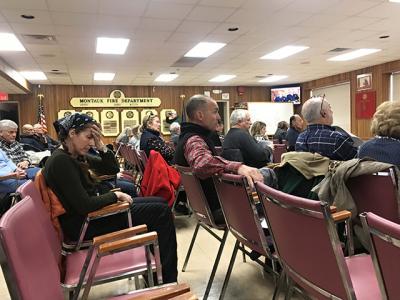
The East Hampton Town Board and residents of Montauk took a few tentative steps toward one another on Tuesday, with some residents acknowledging positive recommendations in the ongoing hamlet study that is meant to guide Montauk’s future and the board agreeing that a planned retreat and relocation of oceanfront structures in Montauk’s downtown is an undertaking with such far-reaching implications that further study of the long-range plan is prudent.
Of all the town’s hamlet studies that began in 2015, Montauk’s has drawn the most criticism from its residents. The retreat and relocation of oceanfront motels and other businesses in the face of climate change-induced sea level rise and extreme weather, as recommended by the consultants engaged to conduct the studies, has deadlocked the process. As a solution, one member of the board suggested at the board’s work session at the Montauk Firehouse a “carve-out” of that component of the study so that the rest of it, a vision statement to be incorporated into the town’s comprehensive plan, can move forward.
The extended debate over the study has at times turned acrimonious: On Tuesday, a member of the town’s planning board who supports the overall study implored residents of Montauk “not to be the Neanderthal, stubborn laggard” while other hamlets move forward with their studies’ adoption. That drew a rebuke from a candidate for town board, who implicitly called him a snob. Both are Montauk residents.
Lou Cortese, who was speaking for himself, said that all residents love the hamlet regardless of their opinion of the retreat-and-relocate recommendation. “Having said that, I do disagree with a lot of people here today.” Opponents, he said, “feel it’s a government-imposed appropriation of property. It’s not, it’s a voluntary program.” The retreat concept is just that, he said, “not a blueprint.” Worse, opponents “want to turn a blind eye to what is more and more certain to happen,” he said, referring to effects of climate change. “Sand replenishment every year comes at an exorbitantly high cost” that cannot be sustained indefinitely.
Adoption of the hamlet study’s recommendations is a necessary predicate, Mr. Cortese said, to securing funding for projects enumerated in the hamlet study, most of which he said are acceptable to business owners.
The town’s other hamlets are moving forward with their studies, he said, “because they understand it’s the intelligent thing to do. Let’s not be the Neanderthal, stubborn laggard while other hamlets move ahead.”
That drew a retort from Bonnie Brady, executive director of the Long Island Commercial Fishing Association and a candidate for town board on the Republican, Independence, and Reform Democrats tickets. “I used to be a snob, too,” she said. After moving to Montauk from Washington, D.C., and becoming part of the community, “I stopped being a snob and thinking there was only one kind of intelligence.”
Mr. Cortese asked for an opportunity to respond. “Those hotels are going to get crushed one day,” he said of the downtown’s row of oceanfront establishments, and the town needs to be proactive in planning for that eventuality.
Ironically, many of the roughly 30 residents who addressed the board had left the meeting before the most substantive discussion took place, an exchange of ideas between the board and its consultant, Lisa Liquori of Fine Arts and Sciences and a former town planning director, in which the board pondered the interdependent nature of Montauk’s environment and its economy.
But before that happened, most in attendance argued against the “retreat, reformulate, and relocate” recommendation, as expressed in a letter from Paul Monte, president of the Montauk Chamber of Commerce, that was read by Laraine Creegan, the chamber’s executive director.
While the chamber’s more than 300 members agree and support many of the study’s recommendations including beach replenishment, community wastewater treatment, the creation of affordable year-round and seasonal housing, improved traffic patterns, and public parks, the chamber could not support adoption of a retreat-and-relocate plan in the town’s comprehensive plan, Ms. Creegan read. “If this radical concept . . . is adopted into the plan now, it will be considered gospel for all boards to march to in lockstep toward this goal,” she read. No serious research has been conducted “to understand the impact of this drastic recommendation,” or an exploration of alternatives to protect downtown from sea level rise and storms while maintaining the hamlet’s tourism-driven economy.
“We have been told, ‘Don’t worry, it’s only a vision, the details will follow,’ ” Ms. Creegan continued. “Honestly, whose vision is it? It’s certainly not the vision of the people who will be directly and immediately affected by this debacle if approved.”
Chris Pfund, whose family came to Montauk around 100 years ago and has owned businesses in the hamlet, agreed with Mr. Monte’s statement. “I totally get that we need to do some planning for the future, we can’t sit idly by,” he said. But “the retreat issue needs to be considered at great length.” A feasibility study must be conducted before adopting a retreat plan, he said, given the effect it would surely have on property owners, particularly hotel owners. He encouraged the adoption of “as much as we can” of the hamlet study’s recommendations, but “we need to slow down, do further study on the retreat.”
If coastal retreat becomes part of the comprehensive plan, some speakers said, oceanfront properties would be effectively worthless.
Some speakers favored the “drastic recommendation” that most opposed, however. Kevin McAllister, a marine scientist and founder and president of the advocacy group Defend H2O, told board members that they are “the de facto facilitators” of coastal adaptation and that, contrary to most opinions expressed at the meeting, time is short. “The process needs to be strictly objective,” he said. “Let’s remove emotion. . . . We don’t have the time to forestall the planning process itself.”
A downtown Montauk erosion control district, a feasibility study for which the town has allocated $200,000, “is inherently tied to the hamlet study,” Mr. McAllister said. Given downtown’s elevation and proximity to both the ocean and Fort Pond, “we’re going to have to make adjustments. I implore the board to move to adoption of the hamlet study.”
Supervisor Peter Van Scoyoc said that the board understood from the comments made “that there could be huge economic impacts from acknowledging that at some point in our future we may not be able to sustain that first row of hotels,” but also “how vitally important the front row of hotels is” to Montauk’s economy. A plan to preserve that economy decades into the future is the challenge, he said. “The question is, are we even going to talk about adopting a vision and acknowledgment of what we face, or ignore and kick the can down the road?”
With Ms. Liquori, the board considered aspects of the hamlet study that might be eliminated. The suggestion of roundabouts on Main Street, Flamingo Avenue, and Second House Road are unpopular, Mr. Van Scoyoc acknowledged, with the exception of the intersection of Flamingo Avenue and West Lake Drive. Developing the low-lying area around the Long Island Rail Road station is probably also ill-advised, he said, though Councilwoman Sylvia Overby said that the idea for an “intermodal transit hub” there was spurred in part by downtown restaurants and other businesses’ complaints that Hampton Jitney buses were occupying many parking spaces downtown. Regardless, there should be a sidewalk from the train station to downtown, “which is very walkable,” the supervisor said.
“When downtown was laid out, the grid was intended to be one-way streets,” Mr. Van Scoyoc said. “It didn’t develop that way.” One-way traffic, he said, “leaves quite a bit more area for safe pedestrian walking and parking,” but public comment has shown resistance to change. “I’m sensitive to that. . . . At this point, I don’t know that we’ve heard enough support to include that.”
But the retreat-and-relocate plan remains the hamlet study’s most divisive component. Recalling Superstorm Sandy in 2012, Mr. Van Scoyoc said that it would be irresponsible “not to take into account resiliency and sustainability . . . given what Montauk faces in any given year from a catastrophic storm.”
There are members of the community who cannot envision coastal retreat “without having as devastating an effect as an actual storm,” he said. “At the same time, those properties are very vulnerable now. Can we risk having a downtown and a hamlet of Montauk without those businesses?”